
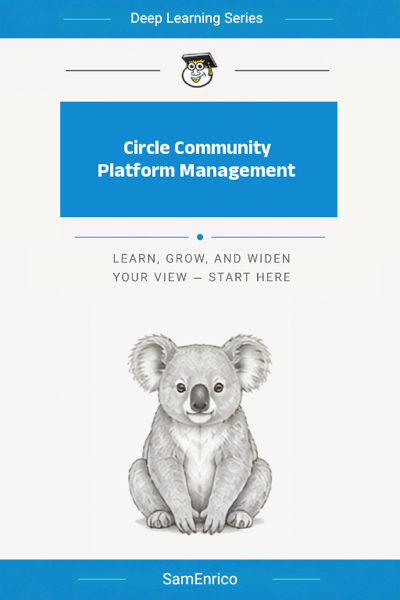
Non-FictionInformativeEducational
Circle Community Platform Management eBook
A Coursebook on Circle Community Platform Manageme
A Coursebook on Circle Community Platform Management
Formats
Free sample
Chapter 1: The Algorithm's Prison–- Lydia had 247,000 followers on Instagram. She had spent four years building her wellness community, posting daily meditation videos, hosting live breathwork sessions, and responding to every comment. Her monthly revenue from digital products and coaching had reached $18,000. Then one Tuesday morning, she tried to log in. "Your account has been disabled for violating our Community Guidelines." No warning.
No explanation. No appeal that a human ever read. Within thirty days, her revenue dropped to zero. Her email list of 12,000 people represented the only asset she truly owned. Everything else—the conversations, the relationships, the trust—had been rented from a platform that revoked her lease without notice.This chapter is not about Lydia.
This chapter is about you.You are reading this book because you have felt the gnawing anxiety that comes from building your business on land you do not own. Perhaps you manage a Facebook Group where reach has plummeted from 80% to 4% due to algorithm changes. Perhaps you run a Slack community where threads disappear into an abyss and free members have eaten up your entire budget. Perhaps you have a Discord server that started as a cozy café and has become a chaotic mall where no one can find anything. Or perhaps you are still on email lists and webinar funnels, sensing that something is missing—a sense of belonging that no automated sequence can replicate.This chapter establishes the existential why before any tactical how.
It argues that traditional social media platforms are not communities but data extraction engines designed to maximize shareholder value, not member value. It introduces Circle as the "sovereign alternative"—a platform where you own the data, control the user experience, and capture 100% of the economic value you create. And it provides three detailed case studies of successful migrations that will change how you think about community ownership. By the end of this chapter, you will understand why Circle is not merely a tool but the infrastructure for a new generation of community-led businesses. More importantly, you will feel the urgency to leave the algorithm's prison before it locks the door behind you.The Great Extraction: How Social Media Became Hostile to Community To understand why Circle exists, you must first understand what traditional platforms took from you.
The year 2010 represented a golden age for online community. Facebook Groups allowed organic reach near 100%. Every post you published appeared in every member's feed. Conversations had longevity measured in days, not minutes. Then the algorithm arrived.Facebook's shift to algorithmic feeds in 2012 marked the beginning of the end.
The platform decided that your members would no longer see your content unless you paid. By 2016, organic reach for Facebook Pages had dropped to 6%. By 2020, some studies placed it below 2%. The same pattern repeated across every major platform. Linked In reduced organic reach to boost paid advertising.
Slack removed features to push enterprise plans. Discord introduced "discoverability" that buried small servers beneath gaming behemoths.This is not accidental. It is the Great Extraction—a systematic transfer of value from community creators to platform shareholders. Every like, comment, and share on a rented platform generates data that the platform monetizes through advertising. You do the work.
They collect the check. And they own the relationship.Consider the economics. A Facebook Group with 10,000 members generates approximately 50,000to50,000 to 50,000to200,000 annually in value through leads, sales, and retention. Facebook captures exactly zero dollars of that value directly. Their business model does not reward community success; it rewards community dependency.
The longer you stay, the more data they extract, but your financial upside never increases. This is a textbook case of value mismatch—your incentives and the platform's incentives point in opposite directions.The problems extend beyond economics. Four fundamental flaws make traditional platforms unsuitable for serious community management.Algorithm Interference The first flaw is algorithmic interference. On Facebook, Linked In, and even You Tube, your content reaches only a fraction of your members. Algorithms decide what is "relevant" based on engagement signals that often prioritize outrage over insight.
A thoughtful 500-word post about member experience might receive 200 impressions. A polarizing meme about politics might receive 20,000. The platform optimizes for time-on-site, not member value. This creates a perverse incentive structure where community managers must chase controversy to maintain visibility.Data Ownership The second flaw is data ownership. When you build on rented land, you cannot export member relationships.
Facebook will give you a CSV of names and emails if your members have consented. But you cannot export the 50,000 comments that represent the collective intelligence of your community. You cannot export the trust signals—who knows whom, who helps whom, who leads whom. When you leave Facebook, you start from zero. Your members may follow you to a new platform, but the history of your community vanishes.
This is not a feature. It is a golden cage.Feature Bloat The third flaw is feature bloat. Discord was built for gamers who need low-latency voice chat and ephemeral text channels. When business communities adopted Discord, they discovered that features designed for teenagers raiding game lobbies do not translate to professional development. Threads disappear after 24 hours by default.
Voice channels have no recording or transcription. Search functionality returns hundreds of irrelevant results. Slack, designed for workplace collaboration, lacks native courses, payments, or member directories. Facebook Groups cannot host paid content without taking a cut. Each platform was built for a different purpose, and grafting community management onto them creates friction at every turn.Monetization Hostility The fourth and most damaging flaw is monetization hostility.
Facebook takes a 30% cut of any sale made through its native payment systems. Linked In does not allow paid groups at all. Slack charges per member, making large communities prohibitively expensive. Discord has no native payment integration; you must send members to a separate checkout page, losing them in the process. These platforms do not want you to monetize your community because monetization creates independence.
An independent creator can afford to leave. A dependent creator cannot.The Sovereign Alternative: Introducing Circle's Three Pillars Circle emerged in 2020 as a direct response to these failures. Founded by Sid Yadav and Rudy Santino, both former community professionals at Teachable and Basecamp, Circle was built from first principles for the creator economy. The founders asked a simple question: What would a platform look like if we optimized for community success instead of shareholder value? The answer became three integrated pillars that collapse the traditional marketing funnel into a single unified system.Pillar One: Spaces Spaces represent the container for conversation.
Unlike Facebook Groups (one monolithic feed) or Discord (fractured channels), Spaces in Circle are hierarchical, searchable, and permissioned. You can create a Space for each topic, course, or cohort. Members can follow Spaces they care about and ignore others. This solves the discovery problem that plagues Discord and Slack—the feeling that valuable conversations are happening somewhere else, but you cannot find them. Spaces can be public (Google-indexed for SEO), paid (requiring membership), secret (invite-only), or paused (archived).
This flexibility allows you to create everything from free marketing Spaces to high-ticket coaching cohorts, all within a single interface.Pillar Two: Memberships Memberships represent the economic engine. Circle native payments…
This is the end of the free sample. Get the eBook to keep going. Buy now
About this book
Details
- Author
- Lovett Barbra
- Publisher
- SamEnrico
- Language
- English
- Genre
- Non-Fiction, Informative, Educational
- Released
- 2026-05-08
- Pages (approx.)
- 138
- Available as
- eBook, Audiobook

Read better in the ZLOADR app
Your eBooks on your phone or tablet. Sign in with your SamEnrico account and start reading.
More by Lovett Barbra
 Giraffe Language HandbookLovett Barbra$11.99
 Design Thinking Collaboration GuideLovett Barbra$11.99
 Call To Action Copywriting GuideLovett Barbra$11.99
 The Homeless Shelter PipelineLovett Barbra$11.99
 Cameo Celebrity InfluencerLovett Barbra$11.99
 Blue Zone Meat ConsumptionLovett Barbra$11.99
 The Stress Sleep Insomnia LinkLovett Barbra$11.99
 The Welcome HomeLovett Barbra$11.99
 Nap for Night Workers GuideLovett Barbra$11.99
 The Maid of Orléans: Joan's Fire Against the CrownLovett Barbra$11.99
 The Love That Mapped the Stars: Hipparchus and the Lost Lighthouse of AlexandriaLovett Barbra$11.99
 The Great Unwind: How a Forgotten 1970s Policy Reshaped the Modern EconomyLovett Barbra$11.99
You may also like
 Hong Kong Handover 1997Dunn Johnnie$11.99
 Zumba For Postnatal Recovery CourseNeal Christian$11.99
 Zumba for BeginnersLadner Nikia$11.99
 YouTube Comment Mining GuideHumes Pandora$12.99
 Worry Box MeditationCarlin Rudy$11.99
 Workplace Stress MeditationNguyen Lynn$11.99
 Workplace Stress and Sleep RepairHawley Ivory$11.99
 Workplace Perfectionism CureDelaney Jeffry$11.99
 Workplace Injustice Anger GuideWallen Isabelle$11.99
 Work Addiction and Burnout LinkGreenwood Ester$11.99
 Women in Yoga and WellnessBeattie Galina$11.99
 Women in Stand Up ComedyChun Evangeline$11.99