
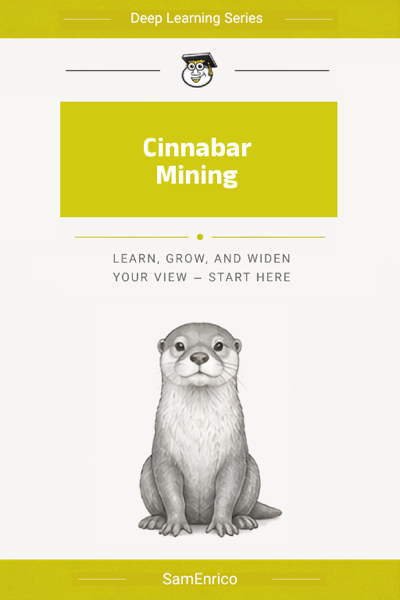
Non-FictionInformativeEducational
Cinnabar Mining eBook
A Coursebook on Cinnabar Mining
A Coursebook on Cinnabar Mining
Formats
Free sample
Chapter 1: The Liquid Enigma...–- Before the first pickaxe struck rock, before the first furnace glowed red, before the first droplet of quicksilver dripped into a Roman flask, there was the mystery. Cinnabar was not merely a rock to be broken and smelted. It was a contradiction carved in stone and sealed in crystal. To the naked eye, it appeared as a vein of frozen blood running through the gray heart of a mountain—a mineral so brilliantly red that ancient civilizations ground it to powder and painted their temples, their tombs, and their bodies. Yet from this same red stone, when heated, there bled a liquid metal as silver as moonlight, a substance that refused to stay still, that broke every rule of metallurgy known to the ancient world.
This was mercury: the only metal liquid at ordinary temperatures, a substance that dissolved gold like water dissolved salt, and a poison so subtle that its victims trembled into madness before anyone understood why. This chapter does not simply introduce cinnabar and mercury. It establishes why this singular mineral has commanded human attention for seven thousand years, why empires rose and fell on its trade, and why—even today, in an age of satellites and spectrometers—the red stone still holds secrets that mining engineers ignore at their peril.The purpose of this coursebook is to equip the reader with a complete, practical, and historically grounded understanding of cinnabar mining, from the geology of ore formation to the engineering of extraction, from the toxicology of mercury poisoning to the environmental remediation of abandoned mines. But before we can design a roaster or calculate a cut-off grade, we must answer a more fundamental question: What, exactly, is cinnabar? And why has humanity pursued it across millennia, through slavery and suffering, through wealth and ruin?The Mineral Identity: Cinnabar as Hg SAt its most basic chemical level, cinnabar is mercury sulfide, written as Hg S.
This simple formula, however, conceals a complex and unusual mineralogy. Mercury and sulfur bond in a hexagonal crystal system—technically known as the trigonal trapezohedral class—which produces distinctive rhombohedral or tabular crystals. When pure and well-formed, these crystals exhibit a diamond-like luster and a color ranging from bright scarlet to deep cochineal red, sometimes with a brownish or lead-gray tint on weathered surfaces. The red coloration arises from the electronic structure of the Hg-S bond, which absorbs most wavelengths of visible light except those in the red portion of the spectrum. In practical terms, this means that cinnabar is one of the most visually unmistakable ore minerals on Earth.
A miner who sees a vein of cinnabar in the wall of a tunnel knows immediately that he is looking at something extraordinary.But cinnabar is not the only mercury-bearing mineral, nor is it the only form of mercury that occurs naturally. In rare circumstances, elemental mercury—liquid quicksilver—can be found as native mercury, typically as small droplets or larger pools trapped in cavities within cinnabar veins or in the surrounding rock. Native mercury forms only under highly specific reducing conditions, where oxygen is scarce and mercury can remain in its elemental state rather than combining with sulfur. These conditions are most commonly found in epithermal deposits associated with recent volcanic activity, such as those at Monte Amiata in Italy or at Idria in Slovenia. The presence of native mercury is always a welcome discovery for a miner, because it requires no roasting; it can be collected directly as liquid metal.
However, native mercury is far rarer than cinnabar, and the vast majority of mercury produced throughout history has come from the roasting of cinnabar.The chemical stability of cinnabar at surface temperatures is one of its most important geological properties. Unlike many sulfide minerals, which oxidize rapidly when exposed to air and water—think of the rusty orange stains of iron sulfide weathering—cinnabar remains inert for extended periods. This stability is the reason that cinnabar can persist as an economic ore deposit for millions of years without being leached away by groundwater or destroyed by surface weathering. It is also the reason that abandoned cinnabar mines remain environmental hazards for centuries after closure; the calcines left behind after roasting continue to release mercury at rates that would be impossible if cinnabar were more reactive. For the mining engineer, this stability is a double-edged sword: it preserves ore bodies for extraction, but it also preserves waste for remediation.The Liquid Metal: Mercury’s Anomalous Properties Mercury—named for the swift, shape-shifting Roman messenger god—is a metal unlike any other.
Its most famous property is its liquid state at standard temperature and pressure. The melting point of mercury is -38.83°C (-37.89°F), and its boiling point is 356.73°C (674.11°F). This means that mercury exists as a liquid across a range of nearly 400°C, from the bitter cold of a Siberian winter to well above the temperature of boiling water. No other metallic element shares this behavior under ordinary conditions. (Gallium melts in the palm of a human hand at 29.8°C, and bromine is a liquid but is a nonmetal; mercury is unique among metals.)What causes this anomaly?
Mercury’s atomic structure provides the answer. Mercury has 80 electrons arranged in a configuration that fills all of its electron shells completely. The resulting lack of strong metallic bonding between adjacent mercury atoms—the electrons are held too tightly to form a true metallic lattice—means that mercury atoms do not lock into a solid crystal structure at room temperature. Instead, they slide past one another with minimal resistance, giving the metal not only its liquidity but also its extraordinarily high surface tension. A droplet of mercury on a flat surface does not spread like water; it beads up into a nearly perfect sphere, rolling away from any attempt to contain it.This surface tension, combined with mercury’s high density (13.534 g/cm³ at 20°C, roughly 13.5 times denser than water), produces another remarkable behavior: mercury does not wet most surfaces.
It does not soak into wood, cloth, or paper. It does not adhere to glass or to most metals, with the important exception of certain metals that form amalgams. An iron bar dipped into a pool of mercury emerges completely dry; the mercury simply beads and falls away. This property made mercury invaluable for centuries in scientific instruments such as barometers and thermometers, where a clean, non-wetting liquid was essential for accurate measurements.But the property that truly drove the economic history of mercury—and by extension the history of cinnabar mining—is its ability to form amalgams with gold, silver, and other precious metals. Amalgamation is not a chemical reaction in the sense of a covalent bond; rather, mercury wets the surface of the precious metal and diffuses into its crystal lattice, forming a soft, pasty alloy.
This alloy can be heated to drive off the mercury as vapor, leaving behind the gold or silver in a porous but pure state. The discovery of this property, likely made independently by multiple ancient civilizations, transformed mining forever. Gold that had previously been recoverable only by laborious washing of placer deposits or by crushing and smelting of…
This is the end of the free sample. Get the eBook to keep going. Buy now
About this book
Details
- Author
- Maxwell Israel
- Publisher
- SamEnrico
- Language
- English
- Genre
- Non-Fiction, Informative, Educational
- Released
- 2026-05-11
- Pages (approx.)
- 148
- Available as
- eBook, Audiobook

Read better in the ZLOADR app
Your eBooks on your phone or tablet. Sign in with your SamEnrico account and start reading.
More by Maxwell Israel
 Hearst Pioneer Helicopter NewsMaxwell Israel$11.99
 Academic Conference Anxiety ProtocolMaxwell Israel$11.99
 Opioid Dependency Peer Support GuideMaxwell Israel$11.99
 Child Hostage SurvivorMaxwell Israel$11.99
 Generative Fill for Video ProductionMaxwell Israel$11.99
 The First Australians: Echoes of the Ice Age PioneersMaxwell Israel$11.99
 Echoes of the Deep: The AI That Listened to WhalesMaxwell Israel$11.99
 Understanding Bowen SyndromeMaxwell Israel$17.99
 Oracle Virtual Internship PathMaxwell Israel$12.99
 Executive Summary Storytelling FrameworkMaxwell Israel$12.99
 Ultimate Handbook Guide to Qiqihaer : (China) Travel GuideMaxwell Israel$11.99
You may also like
 Hong Kong Handover 1997Dunn Johnnie$11.99
 Zumba For Postnatal Recovery CourseNeal Christian$11.99
 Zumba for BeginnersLadner Nikia$11.99
 YouTube Comment Mining GuideHumes Pandora$12.99
 Worry Box MeditationCarlin Rudy$11.99
 Workplace Stress MeditationNguyen Lynn$11.99
 Workplace Stress and Sleep RepairHawley Ivory$11.99
 Workplace Perfectionism CureDelaney Jeffry$11.99
 Workplace Injustice Anger GuideWallen Isabelle$11.99
 Work Addiction and Burnout LinkGreenwood Ester$11.99
 Women in Yoga and WellnessBeattie Galina$11.99
 Women in Stand Up ComedyChun Evangeline$11.99