
Non-FictionSelf-HelpRoman Technique
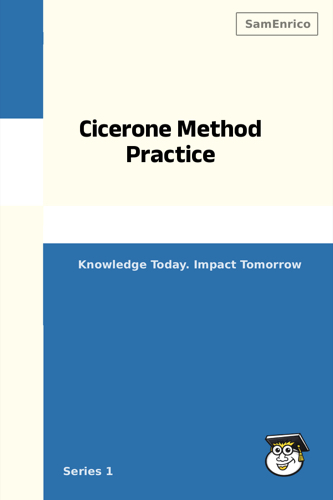
Cicerone Method Practice eBook
Use the Roman room technique to store sequential i
Use the Roman room technique to store sequential information.
Formats
Free sample
Chapter 1: The 2,500-Year-Old Hack--–- On a late summer evening in Thessaly, around the year 477 BCE, a poet named Simonides of Ceos stood outside the rubble of a collapsed banquet hall. The building had crumbled moments after he had stepped outside to greet two young men. Inside, the bodies of his hosts and fellow guests were crushed beyond recognition. Families arrived to claim their dead, but no one could identify the mangled remains. Then Simonides did something that would echo across twenty-five centuries.
He closed his eyes, walked backward through the wreckage in his imagination, and named every guest by where they had been sitting. He recalled that the general had been reclining by the north wall. The politician had been near the wine jug. The young athlete had been at the far corner table. One by one, he matched names to bodies.
He had not memorized a list. He had simply remembered a room.That night, Simonides stumbled upon a discovery that would become the most powerful mnemonic technique ever devised. He realized that human memory is fundamentally spatial. We do not remember names, numbers, or abstract facts as isolated data points. We remember where things are.
The brain that evolved to track predators across savannas, to find water sources, and to navigate complex social environments did not evolve to memorize multiplication tables or grocery lists. But that same brain can be repurposed. It can be hijacked. And the key to that hijacking is something so simple that it almost feels like cheating: you store information by placing it in familiar locations and then walking through those locations in your mind.This is the Cicerone Method. It is named for Marcus Tullius Cicero, the Roman orator, lawyer, and statesman who used spatial memory to deliver hours-long speeches without a single note.
Cicero did not have a teleprompter. He did not have index cards. He had a mental walkway through his villa, and on that walkway, he placed images of his arguments. As he paced from the atrium to the peristyle to the study, those images triggered the words he needed. The method was so reliable that Roman rhetoricians made it the foundation of their training.
To be an orator was to be an architect of memory.If you are reading this book, you have likely experienced the frustration of forgetting a sequence at the worst possible moment. You have stood before an audience and lost your place. You have walked into an exam room and felt the facts slip away. You have stared at a shopping list, then looked up, and already forgotten the second item. This is not a failure of intelligence or effort.
It is a mismatch between the task and the tool. You have been trying to store linear, abstract data in a brain that evolved for spatial, relational navigation. The Cicerone Method corrects that mismatch. It transforms the abstract into the concrete. It converts lists into landscapes.
It turns forgetting into remembering.In this chapter, you will learn why the Method of Loci works at the level of neurons and evolution. You will understand how it differs from other memory systems—and why those other systems fail where the Roman Room succeeds. You will master the three principles that govern all spatial memory techniques: Loci, Imagines, and Action. And you will take your first step toward building a memory palace of your own. By the end of this chapter, you will no longer see your living room as just a living room.
You will see it as a stage for unforgettable performances.The Science of Spatial Memory To understand why the Cicerone Method works, you must first understand how your brain navigates the world. Deep within your temporal lobe lies a seahorse-shaped structure called the hippocampus. For decades, neuroscientists believed its only job was to form new long-term memories. But in 1971, researchers John O'Keefe and Jonathan Dostrovsky made a breakthrough discovery. They implanted electrodes into the brains of rats and watched as individual neurons fired only when the rats were in specific locations.
A particular cell would activate when the rat was in the northeast corner of the box. A different cell would fire when it approached the water dispenser. They called these place cells.The discovery earned O'Keefe a Nobel Prize in 2014. But the full picture emerged later when May-Britt and Edvard Moser identified grid cells in the entorhinal cortex. These cells create an internal coordinate system—a mental map that tracks your position relative to the world around you.
Place cells mark specific landmarks. Grid cells measure distance and direction. Together, they form the most reliable memory system in your brain. You never forget how to walk from your bedroom to your kitchen. You never get lost in your own house.
That spatial memory is practically indestructible.Now consider how your brain handles a list. The hippocampus treats a list not as a spatial arrangement but as a sequence of arbitrary symbols. Your brain was not designed for this. The difference in retention is staggering. In one famous study, researchers asked subjects to memorize the layout of 100 objects in a virtual room.
After a single viewing, participants could recall the location of each object with over 90 percent accuracy. When those same subjects were asked to memorize a list of 100 random words, their accuracy dropped below 20 percent. The same brain, the same people, the same effort—but radically different outcomes. The only variable was whether the information was presented spatially or abstractly.The Cicerone Method exploits this neural asymmetry. You do not train your brain to be better at lists.
Instead, you trick your brain into treating lists as spaces. When you place an image of a shopping item on your living room couch, your hippocampus encodes that image as if it were actually there. The same place cells that fire when you sit on that couch will fire when you later imagine it. And when they fire, they bring back whatever image you placed there. You are not memorizing.
You are navigating.The Roman Room vs. Other Memory Systems Before we go further, I need to distinguish the Cicerone Method from the other mnemonic techniques you may have encountered. Many of them work for narrow purposes, but none scales the way the Roman Room scales. Understanding these differences will save you months of wasted effort on inferior systems.The Major System is the most common alternative. It converts numbers into consonant sounds, then into words.
The number 32 becomes the sound "m" and "n," which becomes "moon." The number 71 becomes "k" and "t," which becomes "cat." This works well for digits. Memory athletes use it to memorize thousands of digits of pi. But the Major System has a fatal flaw: it only works for numbers. You cannot memorize a speech with it. You cannot memorize anatomy or law or history.
Every abstract concept must first be converted into a number, then into a word, then into an image. That is three layers of translation, each one a chance for error.The Peg System is the second most common. It associates numbers with rhyming words: one is bun, two is shoe, three is tree, four is…
This is the end of the free sample. Get the eBook to keep going. Buy now
About this book
Details
- Author
- Hudson Leticia
- Publisher
- SamEnrico
- Language
- English
- Genre
- Non-Fiction, Self-Help, Roman Technique
- Released
- 2026-06-09
- Pages (approx.)
- 143
- Available as
- eBook, Audiobook

Read better in the ZLOADR app
Your eBooks on your phone or tablet. Sign in with your SamEnrico account and start reading.
More by Hudson Leticia
 Radiology Burn PreventionHudson Leticia$11.99
 Athlete Morning ProtocolHudson Leticia$11.99
 Conflict Avoidance TriggersHudson Leticia$11.99
 Emotional Exhaustion RecoveryHudson Leticia$11.99
 Jump Rope HIIT SessionsHudson Leticia$11.99
 Influence For EntrepreneursHudson Leticia$11.99
 EQ Affirmations GuideHudson Leticia$11.99
 The Torso in the Thames: Scotland Yard's First Forensic MysteryHudson Leticia$11.99
 Gladiators and Senators: The Unlikely Alliance That Changed Roman BritainHudson Leticia$11.99
 How to Produce Satellite LnbsHudson Leticia$11.99
 Cardigan Welsh Corgi: Long-backed & BrightHudson Leticia$11.99
 A Collector's Handbook to the Austin 1800Hudson Leticia$11.99
You may also like
 Hong Kong Handover 1997Dunn Johnnie$11.99
 Zumba For Postnatal Recovery CourseNeal Christian$11.99
 Zumba for BeginnersLadner Nikia$11.99
 YouTube Comment Mining GuideHumes Pandora$12.99
 Worry Box MeditationCarlin Rudy$11.99
 Workplace Stress MeditationNguyen Lynn$11.99
 Workplace Stress and Sleep RepairHawley Ivory$11.99
 Workplace Perfectionism CureDelaney Jeffry$11.99
 Workplace Injustice Anger GuideWallen Isabelle$11.99
 Work Addiction and Burnout LinkGreenwood Ester$11.99
 Women in Yoga and WellnessBeattie Galina$11.99
 Women in Stand Up ComedyChun Evangeline$11.99