
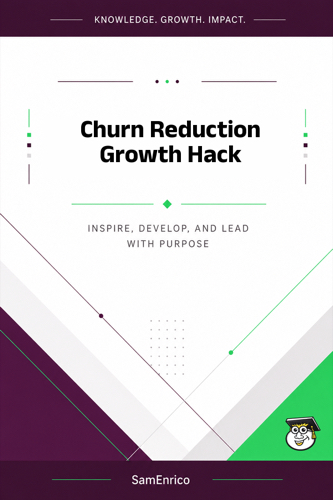
Non-FictionBusiness BriefRetention Strategy
Churn Reduction Growth Hack eBook
Identify at risk users with predictive analytics a
Identify at risk users with predictive analytics and re engage them before cancellation.
Formats
Free sample
Chapter 1: The Leak Beneath...--–- The CEO looked at his dashboard and smiled. Revenue had grown 22% year over year. The marketing team was spending $1.2 million annually on acquisition, and it was working. New customers were pouring in. The product was winning awards. The board was happy. Then, three months later, he was fired.The numbers had lied.On paper, the company—let's call it Pulse CRM—was a high-growth Saa S darling. But beneath the surface, something was rotting. Every month, 6.8% of their customers were canceling. Not loudly. Not with angry phone calls or dramatic exit surveys. They just… stopped. Stopped logging in. Stopped using features. Stopped paying. And then they were gone.The CEO hadn't seen it because his dashboard only showed new logos. His investors only asked about annual recurring revenue. His head of sales was compensated on closed-won deals, not retained revenue. The company was pouring gasoline on a leaking tanker. It was growing fast—but leaking faster. By the time someone noticed, Pulse CRM had lost $4 million in annual recurring revenue that they could have kept for pennies on the dollar.This is the churn trap. And if you cannot see it in your own business, you are already inside it.The Invisible Killer of Subscription Businesses Churn is not a metric. It is a narrative. And most companies tell themselves the wrong story.They tell themselves that churn is inevitable. That some customers always leave. That the cost of keeping them is higher than the cost of replacing them. That retention is a "customer success problem" or a "product quality issue" or something they will fix after they finish scaling.Every single one of these stories is wrong. And believing them has destroyed more subscription businesses than competition, market crashes, or bad fundraising ever could.Here is the truth that the fired CEO of Pulse CRM learned too late: The most expensive customer you will ever acquire is the one you have already lost.Why? Because every customer you lose forces you to replace them just to stay still. This is the hidden math of subscription growth. Imagine a bathtub. The faucet is your acquisition engine. The drain is your churn. If the drain is half the size of the faucet, you can fill the tub forever—but you will never, ever reach the top. You will simply tread water while your marketing budget spirals.Now imagine what happens when you close the drain by just 5%. Suddenly, the same faucet fills the tub twice as fast. You stop replacing lost customers and start growing. You stop fighting gravity and start compounding.This is not theory. This is arithmetic.The Bowtie Lie: Why Almost Everyone Gets Growth Wrong For decades, marketers have worshiped the bowtie funnel. You know it: awareness at the top, consideration in the middle, conversion at the bottom. A beautiful symmetrical shape that suggests customers flow neatly from stranger to buyer, after which—what? After which, the funnel ends.That is the lie.The bowtie funnel treats retention as an afterthought, a handoff from sales to "someone else." But in a subscription business, the moment a customer pays is not the finish line. It is the starting line. The real growth happens after the sale, when customers stay, expand, and advocate. The bowtie ignores this entirely.What you actually need is the hourglass funnel.Funnel Stage Bowtie Model Hourglass Model Top Acquisition Acquisition Middle Conversion Conversion + Onboarding Bottom(Empty)Retention + Expansion + Advocacy In the hourglass, the narrowest point is not the sale. It is the first 30 days after the sale—when a new customer is most likely to churn. After that, the funnel widens again as retained customers buy more, refer others, and become your best source of growth.Companies that understand the hourglass don't ask "How do we acquire more customers?" They ask "How do we keep the customers we already have from leaving?" Because every dollar spent on retention compounds. Every dollar spent on acquisition only fills the top of a leaking bucket.The math is ruthless. Let us prove it.The 5% Rule: How Small Changes Create Massive Profit Most executives believe that reducing churn is a "nice to have"—something they will get to when acquisition slows down. This is a catastrophic misunderstanding of leverage.Let us run the numbers.Assume a Saa S company with:$10 million in annual recurring revenue (ARR)5% monthly churn (that is 60% annual churn—common in early-stage B2B)$1,000 average customer acquisition cost (CAC)24-month average customer lifetime (1 / 0.05 monthly churn)Now reduce churn by just 5 percentage points—from 5% to 4.75% monthly.What happens?Before (5% monthly churn):Monthly churn rate: 5%Average customer lifetime: 20 months (1 / 0.05)Customer lifetime value (LTV): $10,000 (assuming $500 monthly subscription × 20 months)LTV:CAC ratio: 10:1 (healthy)After (4.75% monthly churn):Monthly churn rate: 4.75%Average customer lifetime: 21.05 months (1 / 0.0475)Customer lifetime value: $10,525LTV:CAC ratio: 10.5:1Wait—that is only a 5.25% increase in LTV. Where does the "95% profit increase" come from?The leverage comes from compounded retained revenue over time. Let us look at a 36-month horizon.Metric5% Monthly Churn4.75% Monthly Churn Difference Customers retained at month 36 (from cohort of 100)1619+19%Cumulative revenue from cohort$487,000$578,000+19%Acquisition cost saved (replacing lost customers)$84,000$81,000+$3,000The 19% increase in retained revenue flows directly to profit because retained customers have already paid off their acquisition cost. No additional marketing spend. No sales commissions. No onboarding overhead. Just pure, compounding margin.Now apply this to a $50 million Saa S company. A 5% relative reduction in churn (e.g., from 5% to 4.75%) is worth approximately **$9.5 million in additional profit over three years**. Not revenue. Profit.This is why venture capitalists ask about net revenue retention (NRR) before they ask about growth. A company with 120% NRR (meaning existing customers are spending 20% more year over year) is a rocket ship. A company with 80% NRR is a leaky boat, regardless of how many new customers it adds.Cost Per Retention vs. Cost Per Acquisition: The 10x Lever Here is another number that will change how you think about churn: retention interventions cost roughly one-tenth of acquisition campaigns.Let us compare.Cost Per Acquisition (CPA) includes:Advertising spend (Google, Facebook, Linked In)Content marketing (blog posts, ebooks, webinars)Sales salaries and commissions Marketing automation tools Agency fees For a typical B2B Saa S, CPA ranges from $500 to $5,000 or more.Cost Per Retention (CPR) includes:An automated email sequence (essentially free once built)An in-app message (free)A 15-minute customer success call ($15–$50 in labor cost)A targeted discount or credit (variable, but often less than $100)The most expensive retention intervention—a human phone call from a senior CSM—costs less than the cheapest acquisition channel. And the cheapest retention interventions cost nearly nothing.A case study from the field: Cloud Storage Inc., a mid-sized B2B Saa S with 8,000 customers, analyzed their retention and acquisition costs over 12 months.Channel Cost per "Saved" or "New" Customer Volume Total Cost Facebook Ads (acquisition)$1,200450 new customers$540,000Automated churn email (retention)$0.021,200 saved customers$24CSM outreach (retention)$35300 saved customers$10,500Cloud Storage saved 1,500 customers for $10,524—or $7 per saved customer. They acquired 450 new customers for $540,000—or $1,200 per new customer.Which investment delivered more revenue? The 1,500 saved customers had an average monthly subscription of $100. That is $150,000 in monthly recurring revenue retained. The 450 new customers added $45,000 in monthly recurring revenue.Retention was 3.3x more efficient at generating monthly revenue—at 2% of the cost.If…
This is the end of the free sample. Get the eBook to keep going. Buy now
About this book
Details
- Author
- Borders Syreeta
- Publisher
- SamEnrico
- Language
- English
- Genre
- Non-Fiction, Business Brief, Retention Strategy
- Released
- 2026-06-08
- Pages (approx.)
- 142
- Available as
- eBook, Audiobook

Read better in the ZLOADR app
Your eBooks on your phone or tablet. Sign in with your SamEnrico account and start reading.
More by Borders Syreeta
 Brand Value Review MiningBorders Syreeta$11.99
 Governor of InfrastructureBorders Syreeta$11.99
 Financial Stress Journal WorkbookBorders Syreeta$11.99
 The Devil's Mark: The Forgotten Witchcraft Trials of MaineBorders Syreeta$11.99
 The Mind of a Maverick: Unraveling the Psychology of Steve JobsBorders Syreeta$11.99
 Understanding Hyperbilirubinemia Type 1Borders Syreeta$17.99
 Clinical InstructorBorders Syreeta$11.99
 Telehealth Consumer Adoption OutlookBorders Syreeta$12.99
 Cybersecurity Certificate PathBorders Syreeta$12.99
 How to Start a Cases Made of Corrugated Fibreboard Business (Beginners Guide)Borders Syreeta$11.99
You may also like
 Hong Kong Handover 1997Dunn Johnnie$11.99
 Zumba For Postnatal Recovery CourseNeal Christian$11.99
 Zumba for BeginnersLadner Nikia$11.99
 YouTube Comment Mining GuideHumes Pandora$12.99
 Worry Box MeditationCarlin Rudy$11.99
 Workplace Stress MeditationNguyen Lynn$11.99
 Workplace Stress and Sleep RepairHawley Ivory$11.99
 Workplace Perfectionism CureDelaney Jeffry$11.99
 Workplace Injustice Anger GuideWallen Isabelle$11.99
 Work Addiction and Burnout LinkGreenwood Ester$11.99
 Women in Yoga and WellnessBeattie Galina$11.99
 Women in Stand Up ComedyChun Evangeline$11.99