
Non-FictionSelf-HelpSafetyEmergency
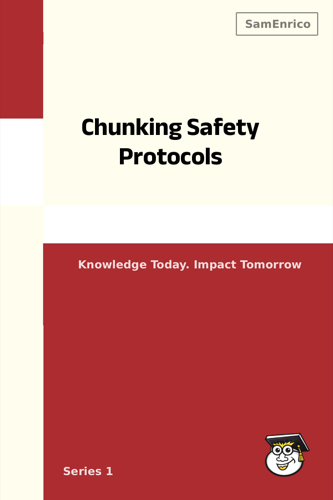
Chunking Safety Protocols eBook
Group emergency procedures into logical sequences
Group emergency procedures into logical sequences for rapid recall.
Formats
Free sample
Chapter 1: The Eight-Second Blackout--–- The alarm cut through the sleep-fog at 2:47 AM. Firefighter Marcus Chen rolled out of his bunk, crossed the apparatus bay in eleven seconds, and climbed into the jump seat of Engine 4. His hands moved through the motions by instinct—helmet, coat, gloves, breathing apparatus. He had done this a thousand times. The truck screamed through empty city streets, red lights painting the rain-slick asphalt, and Marcus ran the protocol in his head.He had reviewed the department's 47-page Hazardous Materials Response Manual twelve times that year.
He had passed the written exam with a 98 percent score. He could recite the chemical classification system from memory. He knew the difference between a boiling liquid expanding vapor explosion and a simple pressure rupture. In the quiet of the classroom, with fluorescent lights humming and a coffee cup warming his hand, he was an expert.Forty-five seconds after arrival, standing in front of a leaking tanker truck, his mind was a white wall.The chemical name on the placard was unfamiliar. The wind shifted, carrying a sweet, acrid smell that caught in his throat.
His heart pounded against his ribs. His breathing quickened. He could feel sweat beading on his forehead inside his mask. He knew he was supposed to do something specific—something he had memorized, something he had been tested on, something that was supposed to be second nature—but the steps would not come. They tumbled in his head like a shuffled deck of cards.
Step seven came before step two. Step four appeared, then vanished. He reached for the binder in his coat pocket.The binder was not there. He had left it in the office. The office was now inside the hot zone.For eight seconds—an eternity in an emergency—Marcus Chen was useless.
He was trained. He was certified. He was well-intentioned. And he was completely, terrifyingly blank. A senior firefighter with twenty-three years of experience grabbed his shoulder, pointed upwind, and shouted the first three steps into his ear.
Marcus moved, finally, mechanically, his body catching up to where his mind had failed.He survived. The tanker did not explode. No one died. But Marcus Chen never forgot those eight seconds. And he never again trusted a protocol that lived only on paper.The Anatomy of a Brain Freeze What happened to Marcus Chen was not a failure of training.
It was not a lack of commitment. It was not a character flaw. It was biology.The human brain, for all its extraordinary capabilities, has a design flaw that safety manuals have ignored for decades. Under stress, the very systems that allow us to reason, plan, and remember begin to shut down. Not because they are broken, but because they are following an ancient script written for a very different world.Let me walk you through what happens inside your skull during the first ten seconds of an emergency.Your brain weighs about three pounds.
It consumes twenty percent of your body's oxygen and twenty-five percent of its glucose, despite being only two percent of your mass. It is the most energy-hungry organ you possess, and it has evolved over millions of years to prioritize one function above all others: survival. Not accuracy. Not completeness. Not compliance.
Survival.When your brain perceives a threat—a real threat, not a classroom simulation, not a scheduled drill, but an actual, honest-to-God emergency—it initiates a cascade of neurochemical events. The amygdala, an almond-shaped cluster of nuclei deep within the temporal lobes, acts as your brain's smoke detector. It does not wait for confirmation. It does not consult the prefrontal cortex, the seat of logical reasoning and working memory. It sounds the alarm instantly, based on pattern matching and raw sensory input.
Smoke? Alarm. Loud noise? Alarm. Unfamiliar chemical smell?
Alarm.Once the amygdala fires, the hypothalamus activates the sympathetic nervous system. Adrenaline floods your bloodstream. Your heart rate accelerates from a resting seventy beats per minute to over one hundred and twenty within seconds. Your respiratory rate doubles. Blood vessels in your skin and digestive system constrict, redirecting blood flow to your large muscles and your heart.
Your pupils dilate. Your hearing sharpens. Your peripheral vision narrows into tunnel vision—a physiological phenomenon called attentional narrowing that allows you to focus on the threat but at the cost of losing awareness of everything else.This is the fight-or-flight response. It is magnificent for escaping a predator on the African savanna. It is catastrophic for reading a ten-step checklist while wearing thick gloves in a chemical hot zone.The Vanishing Whiteboard Here is where the disaster happens, and here is where every traditional safety manual fails you.Working memory is the cognitive system that holds and manipulates information over short periods.
Think of it as a mental whiteboard. You write things on it—a phone number, a sequence of steps, a mental map of a building—and you read from it as you act. Under normal conditions, sitting at a desk, well-rested, low stress, the average adult can hold approximately seven discrete items on that whiteboard. This is Miller's Law, named after cognitive psychologist George Miller, who published "The Magical Number Seven, Plus or Minus Two" in 1956. For nearly seventy years, this finding has been replicated across hundreds of studies.But Miller's Law has a hidden clause that almost no safety manual acknowledges.
The "seven plus or minus two" figure is a laboratory measurement taken under ideal conditions. It assumes a calm participant, a quiet room, no time pressure, and no physiological arousal. These conditions do not exist in an emergency.Under acute stress—the kind produced by an alarm, a chemical spill, a structure fire, a medical crisis, or an active shooter—working memory capacity collapses. Research from military training programs, emergency medicine, and disaster psychology consistently shows that stressed individuals can hold only three, sometimes two, and occasionally just one item in working memory. This is not a failure of training.
It is a feature of human neurobiology. Your brain is not malfunctioning when it loses the ability to remember a seven-step protocol. Your brain is functioning exactly as evolution designed it, prioritizing immediate action over detailed analysis.Let me say that again, because it is the most important sentence in this chapter: When you forget your protocol under stress, your brain is working correctly. Your protocol is not.The Paradox of the Prepared Mind Consider the case of Captain Chesley "Sully" Sullenberger, who landed US Airways Flight 1549 on the Hudson River in January 2009. Sully is often held up as an example of calm, collected professionalism under pressure.
He is rightly celebrated. But the story of Flight 1549 is not primarily a story of Sully's composure. It is a story of his cognitive architecture.What most people do not know is that Sully and his crew did not invent their response on the spot. They did not consult a 147-page emergency procedures manual. They did not run a mental checklist of thirty-seven steps.
Instead, they had trained for decades to reduce complex emergencies to brief, memorable sequences. They had chunked. When both engines failed at 2,800 feet, Sully did not think, "Let…
This is the end of the free sample. Get the eBook to keep going. Buy now
About this book
Details
- Author
- Beverly Agnus
- Publisher
- SamEnrico
- Language
- English
- Genre
- Non-Fiction, Self-Help, Safety, Emergency
- Released
- 2026-06-09
- Pages (approx.)
- 141
- Available as
- eBook, Audiobook

Read better in the ZLOADR app
Your eBooks on your phone or tablet. Sign in with your SamEnrico account and start reading.
More by Beverly Agnus
 Merle Haggard Okie OdysseyBeverly Agnus$11.99
 Liechtenstein Dental LabBeverly Agnus$11.99
 The Roy Chapman Andrews GuideBeverly Agnus$11.99
 Student Burnout Prevention GuideBeverly Agnus$11.99
 The Vanishing of Mary Cecilia: Canada's First Kidnapping for RansomBeverly Agnus$11.99
 Rig WelderBeverly Agnus$11.99
 UTZ Certification GuideBeverly Agnus$12.99
 Understanding Seow–najjar SyndromeBeverly Agnus$17.99
 How to Become a OrthotistBeverly Agnus$11.99
You may also like
 Hong Kong Handover 1997Dunn Johnnie$11.99
 Zumba For Postnatal Recovery CourseNeal Christian$11.99
 Zumba for BeginnersLadner Nikia$11.99
 YouTube Comment Mining GuideHumes Pandora$12.99
 Worry Box MeditationCarlin Rudy$11.99
 Workplace Stress MeditationNguyen Lynn$11.99
 Workplace Stress and Sleep RepairHawley Ivory$11.99
 Workplace Perfectionism CureDelaney Jeffry$11.99
 Workplace Injustice Anger GuideWallen Isabelle$11.99
 Work Addiction and Burnout LinkGreenwood Ester$11.99
 Women in Yoga and WellnessBeattie Galina$11.99
 Women in Stand Up ComedyChun Evangeline$11.99