
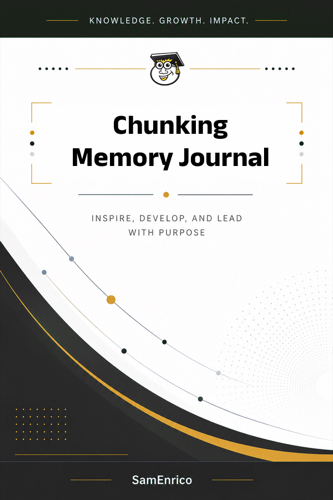
Chunking Memory Journal eBook
Track your grouping practice with this guided refl
by Amato Lenora
Track your grouping practice with this guided reflective workbook.
Formats
Free sample
Chapter 1: The Outsourced Brain--–- When was the last time you truly memorized something? Not the kind of automatic imprinting that happens when you see a billboard a hundred times, but the deliberate, focused act of etching information into your mind so that it becomes yours forever. For most of us, the honest answer is uncomfortable: we cannot remember. Not because our memories have failed us, but because we have stopped asking them to work.This is not a moral failure. It is an adaptation.
The human brain, that magnificent and lazy organ, will always take the path of least resistance. And for the past fifteen years, we have handed it a get-out-of-work-free card. It lives in our pockets. It has a glowing screen and a battery that needs charging by evening. We call it a smartphone, but a more honest name would be an external hard drive for the self.You have outsourced your memory.
So has everyone you know. And the purpose of this chapter is not to shame you for it, but to show you precisely what you have lost—and more importantly, what you can regain by learning one simple, ancient, profoundly effective technique: chunking.The Quiet Epidemic of Digital Amnesia In 2015, a global study conducted by the cybersecurity company Kaspersky Lab surveyed six thousand people across Europe, the United States, and parts of Asia. The results were startling enough to make headlines around the world. Nearly half of the respondents could not remember their own home phone number from childhood. More than a third could not recall their current partner's phone number without looking at their phone.
And when asked to recall a simple three-item to-do list without writing it down, more than half of the participants failed within two hours.The researchers called this phenomenon "digital amnesia." The term is not a clinical diagnosis—you will not find it in the DSM-5—but it describes something real and measurable. Digital amnesia is the tendency to forget information that you know is stored on a digital device. Your brain, in its infinite efficiency, decides: I do not need to keep this. The phone will remember it for me. And then, quietly, it deletes the file.Dr.
Richard Restak, a clinical professor of neurology at the George Washington University School of Medicine and author of The Complete Guide to Memory, has spent decades studying this phenomenon. In his clinical practice, he began noticing a pattern among younger patients. They complained of memory lapses—forgetting where they parked, what they ate for breakfast, whether they had taken their medication—but performed perfectly on standardized memory tests. Their brains were not damaged. They were simply undertrained."We are experiencing a fundamental shift in how memory works," Restak told an interviewer in 2021.
"For most of human history, memory was an internal process. You rehearsed, you recited, you repeated. Now, the default is external. We remember by knowing where to look, not by knowing the thing itself. This is not inherently bad, but it has consequences.
One of those consequences is that we are losing the ability to hold more than a few pieces of information in our minds at once."That limit—the number of discrete items your working memory can hold—is not a character flaw. It is a biological fact, rooted in the structure of your brain. And understanding that limit is the first step toward transcending it.A Short History of Forgetting Let us travel backward for a moment. Not to your childhood, but to the childhood of our species.Before writing, before printing presses, before search engines, human beings relied entirely on internal memory. The Iliad, that sprawling epic of nearly sixteen thousand lines, was composed and transmitted orally for centuries before anyone wrote it down.
The griots of West Africa could recite the genealogies of their villages going back four hundred years. The rabbis of the Talmudic era memorized entire volumes of legal argument, page after page, word after word.These were not superhumans. They were ordinary people who had trained their memories because they had no other choice. And they used techniques that cognitive scientists are now rediscovering and naming with clinical precision.One of those techniques is chunking.The word itself sounds simple, almost childish. Chunking.
Like cutting a chocolate bar into pieces. But beneath that unassuming name lies a cognitive process so powerful that it fundamentally rewires how your brain handles information.Here is the essential insight: Your working memory is not a bucket that can hold a fixed volume of water. It is more like a tray that can hold a fixed number of objects. The objects can be small—single digits, individual letters, isolated facts. Or they can be large—complex patterns, meaningful categories, entire sentences.
The tray does not care about size. It cares about count.If you can learn to group small pieces of information into larger, meaningful chunks, you can trick your working memory into holding far more than it should be able to. A fifteen-digit credit card number becomes four chunks (the bank identifier, the industry code, the account number, the checksum). A twenty-item grocery list becomes three chunks (dairy, produce, dry goods). A complex speech becomes a journey through three rooms in your house (the introduction in the kitchen, the main argument in the living room, the conclusion in the bedroom).This is not a metaphor.
This is neuroscience. And it works whether you are a college student cramming for an exam, a professional trying to remember a client's name, or a grandparent who wants to keep your mind sharp as the years pass.But before you can learn to chunk effectively, you must first diagnose the state of your outsourced brain. You must measure the damage that digital amnesia has done to your natural grouping instinct. And that is precisely what this chapter will help you do.The Self-Audit: How Outsourced Is Your Memory?Take out a pen. Not a stylus.
Not a keyboard. An actual pen, or a pencil, or anything that requires your hand to form letters on a physical page. You are going to answer ten questions. There are no right or wrong answers. There is only honesty.Find a quiet space.
Put your phone face-down on the table, or better yet, in another room. Set a timer for ten minutes if you need one. And then answer each question as truthfully as you can.Question 1: Without looking at your phone or any other device, write down the phone numbers of three people you call at least once a week. Do not guess. Only write numbers you are certain of.
Leave the line blank if you cannot.Question 2: Think of a route you drive or walk at least three times per week—to work, to the grocery store, to a friend's house. Can you describe the turns, street names, and landmarks in order without using GPS or a map? Write down as much as you can.Question 3: Recall the last three items you put in your shopping cart or online basket. Not the full list. Just the last three.
Write them down.Question 4: Without checking your calendar, name three appointments or deadlines you have in the next seven days.…
This is the end of the free sample. Get the eBook to keep going. Buy now
About this book
Details
- Author
- Amato Lenora
- Publisher
- SamEnrico
- Language
- English
- Genre
- Non-Fiction, Self-Help, Journaling
- Released
- 2026-06-06
- Pages (approx.)
- 133
- Available as
- eBook, Audiobook

Read better in the ZLOADR app
Your eBooks on your phone or tablet. Sign in with your SamEnrico account and start reading.
More by Amato Lenora
 Assertiveness for ParamedicsAmato Lenora$11.99
 Aggressive Driver Encounters GuideAmato Lenora$11.99
 Divorce and In Law SeparationAmato Lenora$11.99
 Electronics Inventory AIAmato Lenora$11.99
 Benign Breast Conditions HandbookAmato Lenora$11.99
 Strategic Priorities ListAmato Lenora$11.99
 Constraints for FreelancersAmato Lenora$11.99
 The Forgotten Stand at Pork Chop Hill: Korea's Last Desperate BattleAmato Lenora$11.99
 The Battle of Nakano: Yamato's Last Stand (757 AD)Amato Lenora$11.99
 How to Produce Packing MaterialsAmato Lenora$11.99
 Chipmunks: TamiasAmato Lenora$11.99
 USP University Admission GuideAmato Lenora$12.99
You may also like
 Stress Journaling for TwoPoirier Melodie$11.99
 Workaholism Recovery JournalParis Cheyenne$11.99
 The Self Esteem Journal for WorkStock Cherrie$11.99
 The Mindset Shift JournalForman Marine$11.99
 The Assertiveness Journal MethodEdgar Ruthanne$11.99
 Sugar Addiction Recovery Journal WorkbookHelms Letitia$11.99
 Student Journaling for StressWagoner Joetta$11.99
 Procrastination Journal PromptsDover Delmar$11.99
 Procrastination Journal MethodShank Dona$11.99
 Pet Bereavement JournalEuler Ross$11.99
 Loneliness Journal WorkbookLoveless Rosanne$11.99
 Habit Journaling WorkbookLancaster Valentine$11.99