
Non-FictionSelf-HelpProject Management
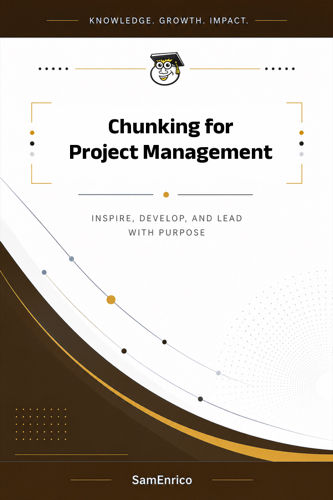
Chunking for Project Management eBook
Break large projects into manageable task clusters
Break large projects into manageable task clusters.
Formats
Free sample
Chapter 1: The Ambiguity Tax--–- Every Monday morning, Sarah stares at her project dashboard. Seventeen tasks are marked "In Progress." Three are labeled "High Priority." One has been "Almost Done" for eleven days. She feels busy. She feels anxious. She has no idea if she is winning or losing.
Her brain, overloaded with vague commitments, has entered a state called overload ambiguity—and it is the single greatest destroyer of productivity in modern project management.This chapter opens with a fundamental psychological crisis that most project managers never name, yet experience daily: the average professional's to-do list has become a source of anxiety, not productivity. We have confused activity with progress. We have mistaken long lists for thorough planning. And we have ignored the hard limits of the human brain. The result is a quiet epidemic of project failure—not because people are lazy or incompetent, but because they are trying to manage complex work with a cognitive system that was never designed for it.The Cognitive Limit You Were Never Told About In 1956, the cognitive psychologist George Miller published one of the most cited papers in the history of psychology: "The Magical Number Seven, Plus or Minus Two." Miller's research demonstrated that the average human working memory can hold between five and nine discrete items at any given time.
More recent neuroscience research has revised that number downward. The current consensus, supported by studies from the Beckman Institute at the University of Illinois, is that the effective limit for complex problem-solving is three to five items. Beyond that, the brain begins to offload information into less accessible storage—or simply drops it.Now consider what a typical project manager carries in working memory: task deadlines, resource constraints, stakeholder expectations, risk registers, budget thresholds, team dynamics, dependency relationships, quality standards, scope change requests, and the ever-present question of "What did I forget?" That is not five items. That is not nine items. That is twenty or thirty or fifty items, all competing for attention in a cognitive space designed for a handful.The result is what this book calls overload ambiguity.
It is the state in which the size and complexity of a project exceed the brain's natural chunking capacity, causing the project to feel simultaneously overwhelming and vague. You cannot point to any single task as impossible. You simply feel stuck. You open your task list, read the same five entries three times, close it, and answer email instead. That is not procrastination born of laziness.
That is procrastination born of cognitive overload—and it is entirely predictable.The Real Reason Projects Fail Conventional wisdom blames project failure on poor communication, unrealistic deadlines, or budget overruns. Those are symptoms, not causes. The root cause, observed across thousands of post-mortem analyses from the Project Management Institute and the Standish Group's Chaos Reports, is something more fundamental: the inability to break large work into small, unambiguous actions that the brain can execute without constant re-evaluation.When a project fails, the post-mortem rarely says "We didn't know how to use Gantt charts" or "We lacked project management software." Instead, it says things like: "The requirements were unclear." "The scope kept expanding." "No one knew who was responsible for what." "Tasks kept getting stuck between departments." These are all failure modes of chunking. They occur when the gap between a high-level goal and a low-level action is too large for the human mind to bridge without error.This book introduces a new term for that gap: The Ambiguity Tax. Every vague task, every poorly defined deliverable, every handoff without clear ownership imposes a tax on the project.
The tax is paid in confusion, rework, missed deadlines, and burned-out teams. The Ambiguity Tax compounds exponentially. One vague task might cost two hours of clarification. Five vague tasks, each interlocking with the others, can cost weeks of schedule slip.Consider two versions of the same instruction. Version A: "Work on the Q3 marketing plan." Version B: "Draft the first three slides of the Q3 marketing presentation, including budget table and channel list, saved to the shared drive by Thursday at 10 AM." Version A imposes a high Ambiguity Tax.
The recipient must infer what "work on" means, decide what constitutes progress, determine the format, guess the deadline, and intuit the standard of quality. Version B imposes near-zero Ambiguity Tax. Every element is specified. The recipient can begin immediately, without interpretation, and will know exactly when the task is complete.The difference between these two versions is the difference between projects that flow and projects that fight you every step of the way. Most project managers default to Version A without realizing the cost.
This book exists to teach Version B as a systematic discipline.The Three Categories of Workload: Sushi, Spaghetti, and Side Dish Before we can fix the problem, we must diagnose it. Not all work is the same, and trying to apply the same chunking strategy to every type of task leads to its own form of failure. Based on the work of Elizabeth Harrin in managing multiple projects, this book adopts a framework that categorizes all work into three distinct types: Sushi, Spaghetti, and Side Dish.Sushi Workloads are complex, multi-step projects with clear deliverables and known dependencies. They are called Sushi because, like a sushi roll, they are composed of distinct ingredients that must be assembled in a specific order, but the overall structure is coherent and predictable. Examples include: launching a website, implementing a new software system, opening a retail location, or publishing a book.
Sushi workloads are the primary subject of this book. They require formal chunking into deliverable-sized units, sequencing, and buffer management.Spaghetti Workloads are interconnected tasks with unclear boundaries. They are called Spaghetti because, like a bowl of pasta, you cannot pull on one strand without moving several others. Examples include: improving customer service culture, optimizing a manufacturing process, or transitioning a team to agile methods. Spaghetti workloads are characterized by high interdependence and low clarity of start and end points.
They require dependency mapping and iterative refinement, not linear decomposition. This book will address Spaghetti workloads primarily in Chapter 6 (The Dependency Matrix) and Chapter 10 (Operational Chunking).Side Dish Workloads are quick, under-two-hour tasks that are largely independent. Examples include: sending an invoice, scheduling a meeting, answering a routine email, or printing a document. Side Dish workloads do not require formal chunking. They are best handled through batching and rapid execution.
However, when Side Dish tasks are allowed to intermingle with Sushi tasks throughout the day, they become a source of dangerous context switching.Most project failures occur when managers treat all three categories the same way. They apply heavy Sushi-style planning to Side Dish tasks (wasting time) or treat Spaghetti workloads as if they were linear Sushi (creating false certainty). Worse, they allow Side Dish tasks to interrupt Sushi work, fragmenting attention and destroying flow.The first step in chunking is honest diagnosis. Look at your current project list. Categorize every item as Sushi, Spaghetti, or Side Dish.
If more than 30 percent of your items are Side Dish, you do not have a project management problem—you have an operational batching problem. If more than 40…
This is the end of the free sample. Get the eBook to keep going. Buy now
About this book
Details
- Author
- Wilhite Carroll
- Publisher
- SamEnrico
- Language
- English
- Genre
- Non-Fiction, Self-Help, Project Management
- Released
- 2026-06-09
- Pages (approx.)
- 138
- Available as
- eBook, Audiobook

Read better in the ZLOADR app
Your eBooks on your phone or tablet. Sign in with your SamEnrico account and start reading.
More by Wilhite Carroll
 Self Hypnosis Fixation Inductions GuideWilhite Carroll$11.99
 Falling Dreams Meaning HandbookWilhite Carroll$11.99
 The Jealousy Anger ConnectionWilhite Carroll$11.99
 Student Insomnia Study GuideWilhite Carroll$11.99
 Whispers from the Silk Road: The Lost Caravans of the TaklamakanWilhite Carroll$11.99
 The Great Map War: The Viking Cartographers and the Secret of the NorumbegaWilhite Carroll$11.99
 Understanding Endomyocardial FibrosisWilhite Carroll$17.99
 How to Start a Feeders Business (Beginners Guide)Wilhite Carroll$11.99
 Fun FairsWilhite Carroll$11.99
 AI Art Upscaling GuideWilhite Carroll$12.99
 SAFe for Adobe StartupsWilhite Carroll$12.99
You may also like
 Hong Kong Handover 1997Dunn Johnnie$11.99
 Zumba For Postnatal Recovery CourseNeal Christian$11.99
 Zumba for BeginnersLadner Nikia$11.99
 YouTube Comment Mining GuideHumes Pandora$12.99
 Worry Box MeditationCarlin Rudy$11.99
 Workplace Stress MeditationNguyen Lynn$11.99
 Workplace Stress and Sleep RepairHawley Ivory$11.99
 Workplace Perfectionism CureDelaney Jeffry$11.99
 Workplace Injustice Anger GuideWallen Isabelle$11.99
 Work Addiction and Burnout LinkGreenwood Ester$11.99
 Women in Yoga and WellnessBeattie Galina$11.99
 Women in Stand Up ComedyChun Evangeline$11.99