
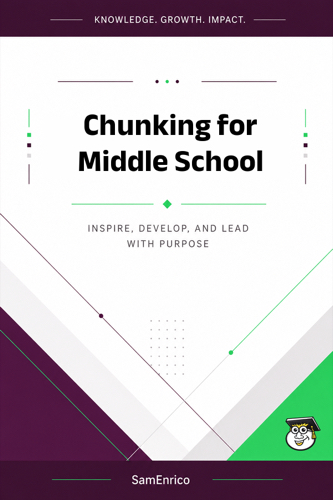
Non-FictionSelf-HelpMiddle School
Chunking for Middle School eBook
Help adolescents master study skills through conte
by Hare Russel
Help adolescents master study skills through content grouping.
Formats
Free sample
Chapter 1: The Brain Lie--You have been lied to.Not by your parents. Not by your teachers. Not by the internet. You've been lied to by something far more convincing: your own feelings.Here's the lie: You think that when you sit and stare at a textbook for two hours, you are studying. You feel busy.
You feel responsible. You might even feel a little bit like a martyr – "Look at me, sacrificing my evening for this stupid science chapter about rocks." But here's the truth that will change your entire school life: Staring at a textbook for two hours is not studying. It is sitting. And sitting is not the same as learning.You have experienced this. You know you have.
Last Tuesday night, you read the same paragraph about the three types of rocks – igneous, sedimentary, metamorphic – maybe four or five times. Your eyes moved across the words. Your finger traced the sentences. You nodded along like you were having a conversation with a very boring friend. And then you closed the book, walked into the kitchen for a snack, and your brain went completely blank.
Not one rock. Not even the word "rock." Just the jingle from a gum commercial you haven't heard in three years.That is not your fault. That is your brain working exactly the way it was designed to work – which is to say, badly, for modern school.This chapter is going to show you why your brain betrays you, what the "forgetting curve" is (and why it's not a personal failure), and most importantly, the single most powerful hack for turning your leaky brain into a steel trap. It's called chunking. And once you learn it, you will never study the same way again.The Nightmare You Know Too Well Let me paint a picture.
Tell me if this sounds familiar.It's 8:47 PM on a Sunday. You have a social studies test tomorrow on the American Revolution. Your teacher said it would cover "the key events, the important people, and the causes." That's basically the entire war. You have a Google Doc open, a highlighter in your hand that you don't really know how to use, and a growing sense of dread that feels like a small animal nesting in your stomach.You start reading. "The American Revolution was a colonial revolt that took place between 1765 and 1783." Okay.
You write that down. "The Boston Tea Party happened in 1773." Write that down too. "Paul Revere made his midnight ride in 1775." Got it. "The Declaration of Independence was signed on July 4, 1776." Sure. "The winter at Valley Forge was brutal." Uh huh.
"The Treaty of Paris ended the war in 1783." Wait, where are we?By the time you get to the end of the second page, you've written seventeen separate facts. You have no idea how they connect. You don't know which ones are important and which ones are just decorative. Your notes look like someone shook a snow globe full of dates inside your brain. And when you try to quiz yourself – "Name three causes of the American Revolution" – you can only remember one, and you're not even sure that one is right.So you start over.
You read the same pages again. Your eyes move. Your brain does not. An hour passes. Then two.
Your parent comes in and says, "How's studying going?" and you say, "Fine," but inside you're screaming because you know that tomorrow, when the test is in front of you, your brain is going to serve up a blank screen followed by the lyrics to a song you haven't heard since fifth grade.This is not a character flaw. This is not laziness. This is not stupidity. This is the forgetting curve, and it is a biological fact.The Forgetting Curve: Your Brain's Terrible Design A German psychologist named Hermann Ebbinghaus (try saying that five times fast) spent years in the late 1800s doing something very boring and very important: he memorized lists of nonsense syllables – words that didn't mean anything, like "ZOF" and "KEL" and "BAP" – and then tested himself on how quickly he forgot them.What he discovered is now one of the most famous findings in all of psychology. It's called the forgetting curve.
And here's what it looks like in real life:Within 20 minutes of learning something new, you have already forgotten nearly 40 percent of it. Within one hour, you've forgotten more than half. Within 24 hours – one single day – you have forgotten nearly 70 percent of what you learned.Let me say that again because it's so important and so terrifying: After one day, your brain has thrown away seven out of every ten facts you tried to learn.That means if you study for two hours on a Sunday night, by Monday morning – before you even walk into the classroom – your brain has already deleted most of what you worked so hard to put in there. It's not that you didn't study. It's not that you didn't try.
It's that your brain is designed to forget things that don't seem important, and unfortunately, your brain is a terrible judge of what matters.Think of your brain like a smartphone with a very small amount of storage. Every day, it's taking in thousands of pieces of information: what your best friend said in first period, the smell of the cafeteria pizza, the sound of the bell, the meme you saw on Tik Tok, the homework assignment in math, the way the light looked through the window, the three causes of the American Revolution. Your brain looks at all of that and says, "Well, I can't keep everything. Most of this is probably junk." And then it deletes aggressively.The problem is that your brain doesn't know that the three causes of the American Revolution are going to be on a test. It just sees another random fact among thousands of random facts.
So it throws it away.This is the glitch. And you cannot fix it by trying harder. You cannot fix it by staring longer. You cannot fix it by drinking more caffeine or making angry faces at your textbook. You can only fix it by understanding how your brain actually works and then working with it instead of against it.The Tiny Whiteboard in Your Head To understand the fix, you first need to understand the hardware.Your brain has something called working memory.
Imagine it as a tiny whiteboard. This whiteboard is where you hold information while you're actively thinking about it – while you're reading, while you're solving a math problem, while you're trying to remember what your teacher just said.Here's the problem: That whiteboard is very, very small.Cognitive scientists have studied this for decades. They've done experiments where they ask people to remember lists of words, sequences of numbers, or patterns of shapes. And what they've found, over and over, is that the average person can hold only about four things on that whiteboard at one time.Four. That's it.Not forty.
Not fourteen. Four.If you try to hold five things, something falls off. If you try to hold ten things, everything gets smeared together into an unrecognizable mess. This is…
This is the end of the free sample. Get the eBook to keep going. Buy now
About this book
Details
- Author
- Hare Russel
- Publisher
- SamEnrico
- Language
- English
- Genre
- Non-Fiction, Self-Help, Middle School
- Released
- 2026-06-10
- Pages (approx.)
- 137
- Available as
- eBook, Audiobook

Read better in the ZLOADR app
Your eBooks on your phone or tablet. Sign in with your SamEnrico account and start reading.
More by Hare Russel
 Creek Stone SittingHare Russel$11.99
 Meth Recovery Sleep Restoration ManualHare Russel$11.99
 Letting Go of Old StoriesHare Russel$11.99
 Giving Difficult Feedback ManualHare Russel$11.99
 CRE Energy Efficiency GuideHare Russel$11.99
 Broken Bonds Mended Self HandbookHare Russel$11.99
 Resume Qatar Specific GuideHare Russel$11.99
 Body Neutrality GuideHare Russel$11.99
 Silent Witnesses: The Unseen Guardians of the TitanicHare Russel$11.99
 The Siege of Rhodes: The Last Stand of the Knights (1480 AD)Hare Russel$11.99
 The Raven's Prophecy: A Lakota Hero's TrialHare Russel$11.99
 Audience Behavior MappingHare Russel$11.99
You may also like
 Hong Kong Handover 1997Dunn Johnnie$11.99
 Zumba For Postnatal Recovery CourseNeal Christian$11.99
 Zumba for BeginnersLadner Nikia$11.99
 YouTube Comment Mining GuideHumes Pandora$12.99
 Worry Box MeditationCarlin Rudy$11.99
 Workplace Stress MeditationNguyen Lynn$11.99
 Workplace Stress and Sleep RepairHawley Ivory$11.99
 Workplace Perfectionism CureDelaney Jeffry$11.99
 Workplace Injustice Anger GuideWallen Isabelle$11.99
 Work Addiction and Burnout LinkGreenwood Ester$11.99
 Women in Yoga and WellnessBeattie Galina$11.99
 Women in Stand Up ComedyChun Evangeline$11.99