
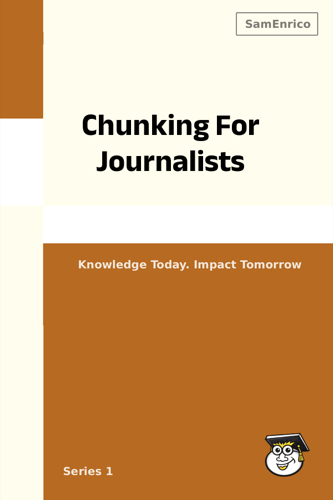
Non-FictionSelf-HelpJournalism
Chunking For Journalists eBook
Structure interview notes by themes and story angl
Structure interview notes by themes and story angles mentally.
Formats
Free sample
Chapter 1: The $10,000 Notebook--–- Maria Torres was crying into her third cup of coffee. It was 11:47 PM on a Tuesday, her deadline was in thirteen minutes, and she had just spent forty-five minutes searching through eighteen pages of interview notes for a quote she distinctly remembered writing down. She found it eventually—buried on page fourteen, sandwiched between a grocery list and a doodle of a cat—but by then her editor had already sent the “?” email. The story ran the next morning with a hole where the quote should have been. Maria blamed herself.
She blamed her bad handwriting. She blamed the source for talking too fast. She blamed everything except the real culprit: her complete lack of a system for turning chaos into copy.Across town, James Chen had just finished the same interview. Same source. Same length.
Same topic. His story was filed at 10:15 PM, forty-five minutes before deadline, and he spent the remaining time eating a sandwich and proofreading. James did not have a photographic memory. He did not have a secret transcription service. He did not have an assistant.
What James had was a method—a live, real-time cognitive workflow that allowed him to walk out of every interview with his story already structured in his head. Maria and James went to the same journalism school. They read the same books. They had the same talent. The only difference was that James knew how to chunk.This is a book about becoming James Chen.
It is not a book about grammar, style, or how to write a lead. Those are important, but they have been covered by Strunk and White, by Zinsser, by dozens of others. This book is about something more fundamental, something that happens before you write a single word of a story. This book is about how you think. It is about the cognitive architecture of reporting—the invisible system of sorting, filing, and prioritizing that separates the journalists who meet every deadline from the ones who cry into their coffee at 11:47 PM.The problem Maria faced is not a handwriting problem.
It is not a memory problem. It is not a speed problem. It is a cognitive drag problem—the mental friction caused when a writer must re-read, re-sort, and re-interpret raw data before writing. Cognitive drag is the enemy of every deadline. It is the reason a thirty-minute interview can take three hours to turn into a five-hundred-word story.
It is the reason you have ever said, “I know the quote is in here somewhere” while frantically flipping through pages of notes. It is the reason you have ever listened to a recording for the third time, hoping to catch something you missed the first two times.The solution is chunking.The Chunking Premise: Thinking Before Writing Chunking is not a new word. Psychologists have used it for decades to describe how the human brain naturally groups information into meaningful units. Without chunking, you could not remember a phone number. Seven digits is too much for working memory to hold as individual units, but if you chunk them into three groups—the area code, the prefix, the line number—they become manageable.
The same principle applies to journalism. An interview is just a long string of words, hundreds or thousands of them, delivered in no particular order, with no paragraph breaks, no headings, no structure. Raw interview notes are the phone number without the hyphens: technically complete but cognitively unusable.Chunking is the act of imposing structure on that chaos in real time. It is the habit of listening not for words but for units of meaning—complete story nodes that can stand alone, be moved, be prioritized, and eventually be assembled into a finished story. A chunk might be a single quote that captures a source’s entire emotional state.
It might be a data point that contradicts everything else in the interview. It might be a visual observation—the shaking hands, the cluttered desk, the nervous laugh—that reveals more than any spoken sentence. Chunking is the skill of recognizing these units while they are still being spoken, marking them, and mentally filing them before the next unit arrives.This book will teach you how to do that. But before we go any further, we need to be precise about what we mean by a “chunk.” The term will appear hundreds of times in the pages that follow, and if it remains fuzzy, the entire system collapses. So let us define it clearly, once, at the beginning.The Chunk Hierarchy: Micro, Meso, and Macro In this book, the word “chunk” is an umbrella term for three distinct levels of information organization.
Think of it like the word “container.” A container could be a shot glass, a cereal bowl, or a moving box. They are all containers, but they serve different purposes and hold different amounts. The same is true of chunks.Micro-chunks are the atomic units of reporting. A micro-chunk is a single piece of information that cannot be broken down further without losing its meaning. A direct quote of one or two sentences is a micro-chunk.
A single data point—“Forty-seven evictions in six months”—is a micro-chunk. A Visual Bloc, which we will explore in Chapter 5, is a micro-chunk: a one-sentence observation about setting or subtext. Micro-chunks are the raw materials of journalism. They are what you collect during the interview. They are what you tag with the Star/Triangle/Square system in Chapter 3.
They are the bricks.Meso-chunks are the assemblies of micro-chunks into paragraph-sized units of meaning. The most important meso-chunk in this book is the Quote Sandwich (Chapter 10): a setup sentence (paraphrased context), the meat (the direct quote itself), and a digest sentence (analysis or transition). A meso-chunk is what a reader actually reads. It is a complete thought, typically three to five sentences, that advances the story. A typical five-hundred-word news story contains ten to fifteen meso-chunks.Macro-chunks are the thematic piles that you create after the interview (Chapter 6).
A macro-chunk is a collection of related micro-chunks and meso-chunks—for example, “everything the source said about the budget” or “every observation about the physical setting.” Macro-chunks are the organizing principle of your story. They become the sections, the subheadings, the narrative blocks. A feature story might have five to seven macro-chunks. A brief might have two or three.Throughout this book, when I say “chunk” without a modifier, I am speaking generally about any of these three levels. When precision matters—when the distinction between a micro-chunk and a macro-chunk is essential to the technique—I will use the full term.
Memorize this hierarchy now. It will save you confusion later.The 80/20 Rule of Note-Taking Here is a truth that separates the Marias from the Jameses: Top journalists do not write faster; they think faster.This sounds like a platitude until you measure it. Sit down with a stopwatch and watch a veteran reporter write. You will notice something strange. They type slowly.
They stare into space. They get up and walk around. They cross things out. They look like they are wasting time. Meanwhile, a junior reporter types furiously, fingers flying…
This is the end of the free sample. Get the eBook to keep going. Buy now
About this book
Details
- Author
- Colburn Laurice
- Publisher
- SamEnrico
- Language
- English
- Genre
- Non-Fiction, Self-Help, Journalism
- Released
- 2026-06-10
- Pages (approx.)
- 131
- Available as
- eBook, Audiobook

Read better in the ZLOADR app
Your eBooks on your phone or tablet. Sign in with your SamEnrico account and start reading.
More by Colburn Laurice
 The Compact Car GenerationColburn Laurice$11.99
 Active Listening for Police and First RespondersColburn Laurice$11.99
 Military Leave Benefit UpdateColburn Laurice$11.99
 Morning Routine MythsColburn Laurice$11.99
 Waitstaff Conversation GuideColburn Laurice$11.99
 Low Carb Bread AlternativesColburn Laurice$11.99
 Supplements GuideColburn Laurice$11.99
 The Arctic Highway: How Millions of Birds Navigate the World’s Most Extreme MigrationColburn Laurice$11.99
 Plague of the Black Moth: The Invisible Killer of 18th Century LondonColburn Laurice$11.99
 How to Produce a LexionColburn Laurice$11.99
 A Collector's Handbook to the Mercedes-benz 260dColburn Laurice$11.99
 Thoracic Extension GuideColburn Laurice$12.99
You may also like
 Hong Kong Handover 1997Dunn Johnnie$11.99
 Zumba For Postnatal Recovery CourseNeal Christian$11.99
 Zumba for BeginnersLadner Nikia$11.99
 YouTube Comment Mining GuideHumes Pandora$12.99
 Worry Box MeditationCarlin Rudy$11.99
 Workplace Stress MeditationNguyen Lynn$11.99
 Workplace Stress and Sleep RepairHawley Ivory$11.99
 Workplace Perfectionism CureDelaney Jeffry$11.99
 Workplace Injustice Anger GuideWallen Isabelle$11.99
 Work Addiction and Burnout LinkGreenwood Ester$11.99
 Women in Yoga and WellnessBeattie Galina$11.99
 Women in Stand Up ComedyChun Evangeline$11.99