
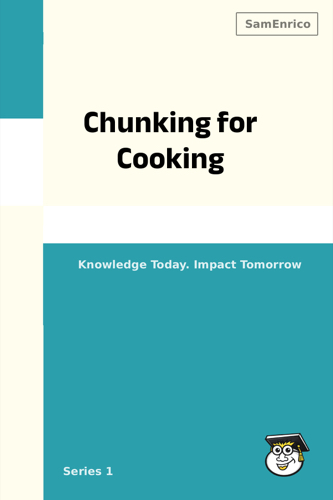
Chunking for Cooking eBook
Remember recipes by grouping ingredients and steps
Remember recipes by grouping ingredients and steps logically.
Formats
Free sample
Chapter 1: The Smoke Alarm Revolution--–- The smoke alarm was screaming. Not the polite, chirping kind that reminds you to change a battery, but the full-throated shriek of a device that has witnessed a crime against cuisine. Black smoke billowed from a cast-iron skillet where what had once been minced garlic was now a cluster of carbonized specks, fused permanently to the metal. In my right hand, I held a jar of cumin—an ingredient nowhere in the recipe’s first three steps. In my left, a wooden spoon I had been using to stir nothing in particular.
The chicken, pale and sweating on a cutting board, hadn’t touched the pan. The onions, chopped beautifully fifteen minutes earlier, sat in a bowl on the opposite side of the kitchen. And somewhere in the chaos, I had forgotten to add salt.This was not my first culinary disaster. It was not my tenth. It was, if I’m being honest with myself, roughly the fortieth time I had stood in my own kitchen, surrounded by ingredients, and watched a meal spiral into something inedible while I clutched a printed recipe that might as well have been written in ancient Greek.
Each time, the pattern was identical: I would read the recipe once, feel a surge of confidence, set it down, and within three minutes find myself staring blankly at the stove, unable to remember whether the garlic came before or after the ginger, or whether I had already added the soy sauce, or if the heat was supposed to be medium or medium-high.The worst part was not the wasted food, though that stung. The worst part was the quiet, persistent voice that whispered: You are bad at this. Other people can cook without chaos. What is wrong with your memory?I spent years believing that voice. I bought more cookbooks.
I watched more cooking shows. I organized my spice rack alphabetically. I pre-measured every ingredient into tiny glass bowls like a television chef. None of it worked. The smoke alarm kept screaming.
The garlic kept burning. And I kept forgetting.Then, almost by accident, I stumbled across a concept from cognitive psychology that would change everything. It was a simple idea, elegant in its simplicity, and it explained not only why I kept failing but also what professional chefs had known for centuries without ever naming it. That idea was called chunking.The Science of Forgetting (And Why It’s Not Your Fault)Let me begin with a confession: I am not a neuroscientist. I am a cook who got tired of burning dinner.
But in the process of trying to save my own kitchen, I went down a rabbit hole of memory research, and what I found was both humbling and liberating.In 1956, a cognitive psychologist named George Miller published a paper that would become one of the most cited works in the history of psychology. Its title was “The Magical Number Seven, Plus or Minus Two: Some Limits on Our Capacity for Processing Information.” Miller’s argument was deceptively simple: the human working memory—the part of your brain that holds information in the present moment while you manipulate it—can only manage roughly seven discrete items at a time. For some people, it’s nine. For others, it’s five. But the range is reliably between five and nine.Think about that for a moment.
Your working memory, the cognitive engine you rely on to navigate the world in real time, can hold somewhere between five and nine separate pieces of information. That’s it. That’s the limit.Now consider the average recipe. Open any cookbook on your shelf. Pick a recipe that claims to be “easy” or “weeknight-friendly.” Count the ingredients.
I just did this with a popular cookbook on my own shelf, turning to a recipe for “Quick Chicken Curry.” The ingredient list contained nineteen items. The instructions contained twelve discrete steps. That is thirty-one separate pieces of information.You are trying to hold thirty-one items in a memory system that caps out at nine.No wonder you forget the garlic.Miller’s law explains nearly every kitchen failure you have ever experienced. You read the recipe, feel confident, turn to the stove, and within seconds your brain is overwhelmed. You remember the first step (heat the oil).
You remember the second step (add the onions). But by the time you get to the third step, the first two have already started to fade. You glance back at the recipe, and now you’ve lost your place. You add the garlic too early or too late. You forget to season.
You leave the cumin on the counter. This is not a memory problem. This is a design problem. The recipe was not built for your brain.The Chunking Solution: How Your Brain Already Works Here is where the magic happens. Miller’s paper did not just describe the limits of working memory; it also pointed toward the solution.
The brain, Miller discovered, has a natural workaround: it compresses information into chunks. A chunk is a single mental unit that contains multiple pieces of related information. When you chunk, you take fifteen separate items and group them into three logical clusters. Your working memory now sees three items instead of fifteen. You have just bypassed the seven-plus-or-minus-two limit.You already do this every single day without thinking about it.
Consider how you remember a phone number. In the United States, phone numbers are ten digits long: 555-123-4567. Your working memory cannot hold ten random digits. But phone numbers are chunked by design: the area code (555) is one chunk, the prefix (123) is another, and the line number (4567) is a third. Three chunks.
Perfectly within your limit. If phone numbers were written as 5551234567, you would never remember them. The chunking is not a decoration; it is a cognitive necessity.Or consider how you navigate your own neighborhood. You do not remember every turn as a separate instruction. You remember chunks: “head toward the grocery store, then turn at the old gas station, then go past the school.” Each chunk contains multiple smaller actions, but your brain has compressed them.Driving directions are chunked.
Phone numbers are chunked. Passwords, shopping lists, meeting agendas, even the way you tell a story—all of it is chunked. The only place we routinely ignore chunking is in the kitchen. Recipes are the last holdout of linear, itemized, working-memory-destroying lists. And that is why we forget the garlic.A Demonstration: Before and After Let me show you what chunking looks like in practice.
Below is a real recipe for lentil soup, written in the traditional style. Read it once, then close your eyes and try to recall the steps.Traditional Recipe (Lentil Soup):Heat 2 tablespoons of olive oil in a large pot over medium heat.Add 1 diced onion and cook until translucent, about 5 minutes.Add 3 minced garlic cloves and cook for 1 minute.Add 2 diced carrots and 2 diced celery stalks. Cook for 3 minutes.Add 1 teaspoon ground cumin, 1 teaspoon smoked paprika, and ½ teaspoon black pepper. Stir for 30 seconds.Add 1 cup dried brown lentils, rinsed.Add 4 cups…
This is the end of the free sample. Get the eBook to keep going. Buy now
About this book
Details
- Author
- Goulet Lucila
- Publisher
- SamEnrico
- Language
- English
- Genre
- Non-Fiction, Self-Help, Cooking
- Released
- 2026-06-11
- Pages (approx.)
- 135
- Available as
- eBook, Audiobook

Read better in the ZLOADR app
Your eBooks on your phone or tablet. Sign in with your SamEnrico account and start reading.
More by Goulet Lucila
 Mindfulness for InterruptionsGoulet Lucila$11.99
 Letting Go of Climate GriefGoulet Lucila$11.99
 Talking About Politics At Work GuideGoulet Lucila$11.99
 Underlying Anger Needs GuideGoulet Lucila$11.99
 Pelvic Floor CourseGoulet Lucila$11.99
 Commercial Real Estate Property TaxGoulet Lucila$11.99
 Poverty and Dysfunction BlueprintGoulet Lucila$11.99
 Body Image For SeniorsGoulet Lucila$11.99
 The Last Ice Hunters: A Race to Save the Arctic’s SecretsGoulet Lucila$11.99
 The Tsarina's Golden Age: Catherine the Great and the Enlightenment of RussiaGoulet Lucila$11.99
 The Silent Diplomat: The Untold Story of Barbara Bush's Hidden InfluenceGoulet Lucila$11.99
 Understanding Amelia (Birth Defect)Goulet Lucila$17.99
You may also like
 Hong Kong Handover 1997Dunn Johnnie$11.99
 Zumba For Postnatal Recovery CourseNeal Christian$11.99
 Zumba for BeginnersLadner Nikia$11.99
 YouTube Comment Mining GuideHumes Pandora$12.99
 Worry Box MeditationCarlin Rudy$11.99
 Workplace Stress MeditationNguyen Lynn$11.99
 Workplace Stress and Sleep RepairHawley Ivory$11.99
 Workplace Perfectionism CureDelaney Jeffry$11.99
 Workplace Injustice Anger GuideWallen Isabelle$11.99
 Work Addiction and Burnout LinkGreenwood Ester$11.99
 Women in Yoga and WellnessBeattie Galina$11.99
 Women in Stand Up ComedyChun Evangeline$11.99