
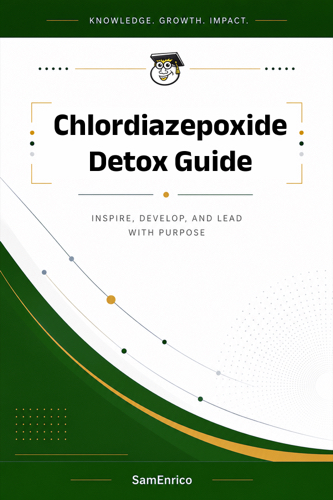
Non-FictionHealth & WellnessChlordiazepoxide
Chlordiazepoxide Detox Guide eBook
Librium protocol for milder withdrawal.
by Linares Karl
Librium protocol for milder withdrawal.
Formats
Free sample
Chapter 1: The Quiet Danger--–- The first time Michael tried to stop drinking, he woke up in an emergency room with no memory of the previous twelve hours. He had been a "moderate" drinker by his own definition—six to eight beers every night, more on weekends, but never in the morning, never before work, never missing a mortgage payment. His hands shook slightly by 3:00 PM, but he told himself that was just low blood sugar. When he decided to quit cold turkey on a Tuesday in October, he expected some insomnia, maybe a little irritability. Instead, by Thursday morning, he was hallucinating spiders crawling up his bedroom walls.
His wife found him on the bathroom floor, teeth chattering, pulse racing at 140 beats per minute, completely disoriented to his own name. The ER doctor called it "alcohol withdrawal delirium" and admitted him to the ICU. Michael was forty-three years old, employed, married, and never thought of himself as "one of those people" who needed detox. He was wrong on every count.Michael's story is not rare. It is not even unusual.
Every day in the United States, hundreds of people who consider themselves "mild" or "functional" drinkers or benzodiazepine users experience withdrawal symptoms that range from uncomfortable to life-threatening. The gap between what patients believe about their own substance use and the biological reality of their dependence is vast, dangerous, and almost entirely unaddressed by mainstream medicine. This book exists to close that gap—specifically for those who fall into the mild-to-moderate category, where chlordiazepoxide (Librium) can be a safe, effective, and even life-saving tool when used correctly.The Core Philosophy: Mild Does Not Mean Risk-Free Let us state the central argument of this book as plainly as possible: the absence of severe withdrawal symptoms on Day 1 does not guarantee the absence of severe withdrawal symptoms on Day 3. Kindling—a phenomenon we will explore in depth in Chapter 2—means that every withdrawal episode, even a mild one, creates neurological changes that make the next episode more dangerous. If you are reading this book because you are considering stopping alcohol, benzodiazepines, or other central nervous system depressants, you must understand one immutable fact: mild withdrawal is still withdrawal, and withdrawal is not benign.The medical literature is unambiguous on this point.
A 2019 systematic review published in the Journal of Addiction Medicine found that approximately 15% of patients who present with "mild" alcohol withdrawal (CIWA-Ar score below 10) will progress to moderate or severe withdrawal within 48 to 72 hours if untreated. Another 5% will experience withdrawal seizures despite having no prior seizure history. These are not acceptable odds for a home detox attempt without a structured protocol, monitoring, and pharmacological support.Yet the dominant narrative in popular recovery culture is that "cold turkey" is somehow more virtuous, more authentic, or more effective than medically assisted withdrawal. This narrative is not just wrong—it is lethal. Alcohol and benzodiazepine withdrawal are two of the only substance withdrawal syndromes that can directly cause death.
Opioid withdrawal, for all its misery, will not kill you. Alcohol and benzodiazepine withdrawal can and do kill people every single day, often people who thought they were "mild" cases.Who This Book Is For (And Who It Is Not For)Before we go any further, we need to establish clear eligibility criteria for the protocols in this book. This is not a one-size-fits-all manual. If you fall outside the following parameters, the appropriate action is to close this book and seek professional medical detoxification immediately.You are an appropriate candidate for this book if:Your CIWA-Ar score is consistently below 10 (we will teach you how to calculate this in the next section)You have a live-in sober supporter who can monitor your vital signs, administer medications if needed, and call for emergency help You have no history of withdrawal seizures, delirium tremens, or previous detox failure with severe symptoms You have access to a prescribing physician who can provide chlordiazepoxide (Librium) and any adjunctive medications discussed in Chapter 4You are not currently taking opioids of any kind (prescription, illicit, or atypical) without explicit medical supervision You do not have significant liver disease (cirrhosis, hepatitis with elevated LFTs) or advanced age (75+ years) without geriatric-specific modifications from Chapter 9You are NOT an appropriate candidate for this book if:Your CIWA-Ar score is 15 or higher (seek medical detox immediately)You live alone without any sober supporter (Chapter 5 provides alternative arrangements, but home detox is not safe for solo patients)You have a history of withdrawal seizures or DTs You are currently using opioids, including kratom, loperamide at high doses, or fentanyl analogues You have end-stage liver disease or severe hepatic impairment You are pregnant (benzodiazepines cross the placenta and may cause fetal harm; withdrawal itself also poses risks—this requires specialist management, not a home protocol)If you are in the first group, welcome. This book was written for you.
If you are in the second group, please put this book down and call your doctor, a local detox center, or the SAMHSA National Helpline at 1-800-662-4357. This is not a failure. It is an act of intelligence and self-preservation.The Three Scenarios: Alcohol, Benzodiazepines, and Anxiety Treatment Chlordiazepoxide (Librium) is used in three distinct clinical scenarios, and it is critical to understand which one applies to you because the protocols differ significantly.Scenario 1: Acute Alcohol Withdrawal This is the most common indication for Librium in clinical practice. A patient has been drinking heavily—typically more than eight standard drinks per day for men, five for women, for at least two weeks—and either wants to stop or is forced to stop due to impending medical procedures, legal issues, or personal consequences. The Librium protocol replaces the CNS-depressant effects of alcohol with a longer-acting benzodiazepine, preventing the glutamate storm that causes seizures and DTs.
The typical duration is 5 to 7 days, with a symptom-triggered or fixed-schedule taper.Scenario 2: Benzodiazepine Cessation (Tolerance or Dependence)This scenario is more complicated. A patient has been prescribed benzodiazepines (Xanax, Ativan, Valium, Klonopin, or Librium itself) for anxiety, insomnia, or muscle spasms and has developed tolerance, dependence, or both. Stopping abruptly can cause a withdrawal syndrome that is similar to alcohol withdrawal but often longer-lasting. Librium is sometimes used as a substitution therapy (switching from a short-acting benzodiazepine like Xanax to the longer-acting Librium) to create a smoother taper. However, the evidence base for Librium in benzodiazepine withdrawal is weaker than for alcohol withdrawal, and some experts prefer Valium (diazepam) for this indication.
We will discuss the Librium-versus-Valium question in Appendix E.Scenario 3: Anxiety Treatment During Detox This is a rarer scenario. A patient undergoing detox for alcohol or benzodiazepines has a pre-existing anxiety disorder that was previously untreated or undertreated. Once the acute withdrawal period is complete (typically after Day 5), residual anxiety may represent relapse of the primary anxiety disorder rather than continued withdrawal. Librium is not appropriate for long-term anxiety treatment due to its dependence liability, but it may be continued at low doses for an additional week while transitioning to a safer maintenance medication (e.g., an SSRI, buspirone, or hydroxyzine).This book focuses primarily on Scenario 1 (acute alcohol withdrawal) because it has the strongest evidence base…
This is the end of the free sample. Get the eBook to keep going. Buy now
About this book
Details
- Author
- Linares Karl
- Publisher
- SamEnrico
- Language
- English
- Genre
- Non-Fiction, Health & Wellness, Chlordiazepoxide
- Released
- 2026-06-10
- Pages (approx.)
- 152
- Available as
- eBook, Audiobook

Read better in the ZLOADR app
Your eBooks on your phone or tablet. Sign in with your SamEnrico account and start reading.
More by Linares Karl
 Comparison To Ex Esteem GuideLinares Karl$11.99
 Sleep And Working Memory TrainingLinares Karl$11.99
 Memory Palace Blueprint GuideLinares Karl$11.99
 CRSD Support Groups OnlineLinares Karl$11.99
 ACT Trigger DefusionLinares Karl$11.99
 Business Insurance GlossaryLinares Karl$11.99
 Apology EQ GuideLinares Karl$11.99
 The Vanishing of Dr. William Leitch: Canada’s First Medical MysteryLinares Karl$11.99
 The Baghdad Bank Heist: The Greatest Robbery in Mandatory Iraq (1931)Linares Karl$11.99
 A Collector's Handbook to the Auburn 851Linares Karl$11.99
 JEE Mock Test Simulator GuideLinares Karl$12.99
 Anchor Pricing Inflation WorkbookLinares Karl$12.99
You may also like
 Hong Kong Handover 1997Dunn Johnnie$11.99
 Zumba For Postnatal Recovery CourseNeal Christian$11.99
 Zumba for BeginnersLadner Nikia$11.99
 YouTube Comment Mining GuideHumes Pandora$12.99
 Worry Box MeditationCarlin Rudy$11.99
 Workplace Stress MeditationNguyen Lynn$11.99
 Workplace Stress and Sleep RepairHawley Ivory$11.99
 Workplace Perfectionism CureDelaney Jeffry$11.99
 Workplace Injustice Anger GuideWallen Isabelle$11.99
 Work Addiction and Burnout LinkGreenwood Ester$11.99
 Women in Yoga and WellnessBeattie Galina$11.99
 Women in Stand Up ComedyChun Evangeline$11.99