
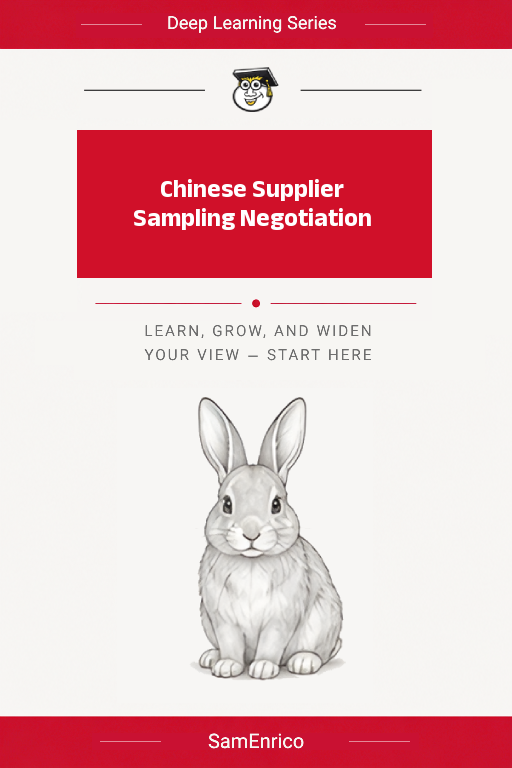
Chinese Supplier Sampling Negotiation eBook
Get free or low-cost samples before committing to
by Harry Mariko
Get free or low-cost samples before committing to mass production.
Formats
Free sample
Chapter 1: The Foreigner Tax--It was 3:47 AM in Shenzhen when Zhang Wei, a production manager at a mid-sized injection molding factory, received a message from a first-time buyer in Ohio. The buyer wanted a quote for 500 custom plastic enclosures. Zhang Wei calculated the actual production cost: raw materials, machine time, labor, and overhead. The total came to 1.20perunit.Hethenaddeda1.20 per unit. He then added a 1.20perunit.Hethenaddeda200 sample fee and quoted the buyer 250fortwosamplesplus250 for two samples plus 250fortwosamplesplus85 for DHL shipping.The buyer paid immediately, thanked Zhang Wei for his "reasonable pricing," and waited three weeks for the samples to arrive.Zhang Wei’s factory made 230profitonthattransaction.Theactualcosttoproducethetwosamples?Lessthan230 profit on that transaction.
The actual cost to produce the two samples? Less than 230profitonthattransaction.Theactualcosttoproducethetwosamples?Lessthan20.This is not a story about a dishonest supplier. Zhang Wei was doing exactly what his sales training taught him: test the buyer. Would this Ohio customer complain about the price? Would they negotiate?
Or would they pay whatever number appeared on the Proforma Invoice?They paid. So Zhang Wei flagged them as an "easy customer" and added a 15% markup to every future quote.The buyer never knew.The Tax You Didn't Know You Were Paying Every year, tens of thousands of new importers send millions of dollars to Chinese suppliers for product samples. A significant portion of that money—often 80% or more—is pure profit for the supplier. Not because the samples are expensive to make, but because new buyers have no idea what samples actually cost.This chapter is not a moral indictment of Chinese suppliers. They are playing a rational game.
Their job is to maximize profit while filtering out buyers who will waste their time. Your job is to learn the rules of that game so you stop paying the Foreigner Tax.The Foreigner Tax is the invisible markup that Chinese suppliers apply to buyers who appear inexperienced, rushed, or desperate. It is not listed on any invoice. It has no line item. But it shows up in the gap between what a sample actually costs to produce and what you are charged.That gap is where your money disappears.Before you can negotiate effectively, you must understand the real economics of sample production.
This chapter deconstructs the Foreigner Tax from three angles: the psychology that creates it, the math that reveals it, and the mindset shift that eliminates it.Strategic Theater: Why Suppliers Quote High Prices When a supplier quotes you 200forasamplethatcosts200 for a sample that costs 200forasamplethatcosts20 to make, they are not being greedy in the way you might think. They are performing what experienced sourcing professionals call Strategic Theater.The logic is simple but brutal. A factory has limited engineering and production capacity. Every hour spent making a sample for a buyer who never places a bulk order is an hour not spent filling a paying customer's order. Suppliers have learned through painful experience that buyers who complain about a $50 sample fee are often the same buyers who vanish after receiving the sample.Therefore, the sample fee becomes a filter.A high sample fee accomplishes three things for the supplier:First, it separates serious buyers from tire kickers.
A buyer who is genuinely planning to order 10,000 units will not balk at a $200 sample fee. They understand it as a cost of doing business. A buyer who is just curious, comparing prices, or daydreaming about a business idea will disappear when confronted with a real cost.Second, it establishes pricing expectations. If you pay $200 for a sample without negotiating, you signal to the supplier that you are not price-sensitive. They will remember this when quoting your bulk order.
The markup on your container might be 20% instead of 10%. You have trained them to charge you more.Third, it creates a psychological commitment. Behavioral economists have documented the "sunk cost fallacy" for decades. Once you pay $200 for a sample, you are more likely to place a bulk order—even if the supplier's quality or pricing is mediocre—because you want to feel that your initial investment was justified.The supplier is not being malicious. They are being rational.
The Foreigner Tax exists because it works.Consider the case of a chemical trader interviewed for this book. He sold industrial solvents in 20-ton containers. His samples were small vials that cost him 5toproduceandship.Hegavethemawayforfreetoanyqualifiedbuyer.Why?Becausetheprofitonthe20−toncontainerwas5 to produce and ship. He gave them away for free to any qualified buyer. Why?
Because the profit on the 20-ton container was 5toproduceandship.Hegavethemawayforfreetoanyqualifiedbuyer.Why?Becausetheprofitonthe20−toncontainerwas2,000. A $5 sample was marketing, not merchandise. He understood that the sample was an investment in a future sale, not a profit center.The factories charging 200fora200 for a 200fora20 sample have made a different calculation. They have decided that most of the buyers contacting them will never place a bulk order. So they monetize the sample stage itself.Which supplier is right?
Both, depending on their business model. But as a buyer, you want to find suppliers who think like the chemical trader—who see samples as a gateway to long-term profit, not as a separate revenue stream.The Real Math: What Samples Actually Cost To negotiate effectively, you must know what a sample truly costs a supplier to produce. Without this knowledge, you are negotiating blind.The marginal cost of a sample—the additional cost to produce one extra unit beyond normal production—is almost always lower than buyers assume. For most manufactured products, the marginal sample cost consists of three components:Raw materials. This is the most straightforward cost.
If your product is made of ABS plastic weighing 200 grams, and ABS resin costs 1.50perkilogram,therawmaterialcostforonesampleis1.50 per kilogram, the raw material cost for one sample is 1.50perkilogram,therawmaterialcostforonesampleis0.30. If your product is a sewn garment using 2 meters of cotton fabric at 3permeter,therawmaterialcostis3 per meter, the raw material cost is 3permeter,therawmaterialcostis6. If your product is a printed circuit board with 8worthofcomponents,therawmaterialcostis8 worth of components, the raw material cost is 8worthofcomponents,therawmaterialcostis8.Labor. The time required to produce a sample varies dramatically by product type. For a simple injection-molded part, a skilled operator might spend 10 minutes setting up the machine and 2 minutes producing the sample.
At typical Guangdong province labor rates of 3to3 to 3to5 per hour, that is 0.60to0.60 to 0.60to1.00 of labor. For a complex assembled product with multiple components, labor might be 1 to 2 hours—3to3 to 3to10.Machine time and overhead. This is the most variable component. A factory might allocate 20to20 to 20to50 per hour for CNC machining or injection molding machine time, which includes depreciation, electricity, maintenance, and operator wages. For a sample that requires 15 minutes of machine time, that is 5to5 to 5to12.50.Add these three components together, and the marginal cost of most samples falls between 5and5 and 5and30.
Even for complex custom prototypes, the marginal cost rarely exceeds $100.Where does the 200or200 or 200or500 quote come from? Four places.First, setup costs (NRE) . Non-Recurring Engineering costs are legitimate one-time expenses for creating tooling, writing CNC programs, building fixtures, or designing packaging. A 500moldora500 mold or a 500moldora200 programming fee is real. The problem is that many suppliers quote these setup costs on every sample, even after…
This is the end of the free sample. Get the eBook to keep going. Buy now
About this book
Details
- Author
- Harry Mariko
- Publisher
- SamEnrico
- Language
- English
- Genre
- Non-Fiction, Business Brief
- Released
- 2026-06-01
- Pages (approx.)
- 149
- Available as
- eBook, Audiobook

Read better in the ZLOADR app
Your eBooks on your phone or tablet. Sign in with your SamEnrico account and start reading.
More by Harry Mariko
 Restless Leg Syndrome Stretching RoutineHarry Mariko$11.99
 Messner Nanga Parbat TragedyHarry Mariko$11.99
 Deep Work Window SchedulingHarry Mariko$11.99
 Chiropractic Success StoriesHarry Mariko$11.99
 Twelve Step Home Group GuideHarry Mariko$11.99
 The EQ for Veterinarians GuideHarry Mariko$11.99
 Subscription Cash Flow ModelHarry Mariko$11.99
 Trance For Yoga PracticeHarry Mariko$11.99
 The Sefas Emes TeachingsHarry Mariko$11.99
 Breaking the Curse: How New Zealand's Tall Blacks Ended a 44-Year March Madness DroughtHarry Mariko$11.99
 The Poisoner’s Prescription: The Deadly Legacy of Dr. Harold ShipmanHarry Mariko$11.99
 The Crown in Crisis: When a King’s Coronation Almost Didn’t HappenHarry Mariko$11.99
You may also like
 Hong Kong Handover 1997Dunn Johnnie$11.99
 Zumba For Postnatal Recovery CourseNeal Christian$11.99
 Zumba for BeginnersLadner Nikia$11.99
 YouTube Comment Mining GuideHumes Pandora$12.99
 Worry Box MeditationCarlin Rudy$11.99
 Workplace Stress MeditationNguyen Lynn$11.99
 Workplace Stress and Sleep RepairHawley Ivory$11.99
 Workplace Perfectionism CureDelaney Jeffry$11.99
 Workplace Injustice Anger GuideWallen Isabelle$11.99
 Work Addiction and Burnout LinkGreenwood Ester$11.99
 Women in Yoga and WellnessBeattie Galina$11.99
 Women in Stand Up ComedyChun Evangeline$11.99