
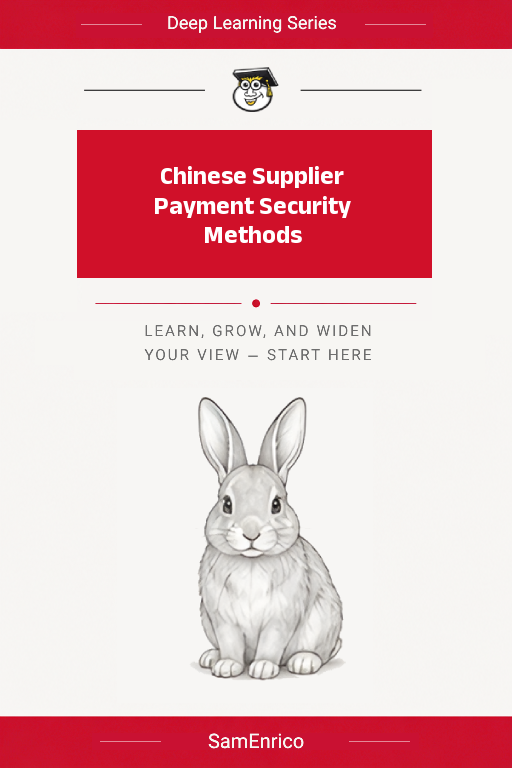
Chinese Supplier Payment Security Methods eBook
Negotiate letter of credit terms or escrow arrange
by Way Vena
Negotiate letter of credit terms or escrow arrangements that protect deposits without insulting trust.
Formats
Free sample
Chapter 1: The Thirty Percent Lie--–- The email arrived at 2:47 AM on a Tuesday. Sarah had been refreshing her inbox for six hours, watching the clock tick past the Chinese workday, past the evening, past any reasonable hope of a response. She had sent 47,000viawiretransferelevendaysago—a30percentdepositonherfirstlargeorderofcustomfitnessequipment.Thefactoryrepresentative,amannamed"Mr.Chen"whohadbeencharmingandresponsiveforthreemonths,hadstoppedanswering Whats Appmessages.Hisphonerangtoadisconnectedsignal.Thefactory′swebsitehadbeentakendown.Theaddressshehadsavedinherfiles—No.23,Jinshan Industrial Zone,Dongguan—turnedouttobearesidentialapartmentbuildingwhenshepaidalocalfreelancer47,000 via wire transfer eleven days ago—a 30 percent deposit on her first large order of custom fitness equipment. The factory representative, a man named "Mr. Chen" who had been charming and responsive for three months, had stopped answering Whats App messages.
His phone rang to a disconnected signal. The factory's website had been taken down. The address she had saved in her files—No. 23, Jinshan Industrial Zone, Dongguan—turned out to be a residential apartment building when she paid a local freelancer 47,000viawiretransferelevendaysago—a30percentdepositonherfirstlargeorderofcustomfitnessequipment.Thefactoryrepresentative,amannamed"Mr.Chen"whohadbeencharmingandresponsiveforthreemonths,hadstoppedanswering Whats Appmessages.Hisphonerangtoadisconnectedsignal.Thefactory′swebsitehadbeentakendown.Theaddressshehadsavedinherfiles—No.23,Jinshan Industrial Zone,Dongguan—turnedouttobearesidentialapartmentbuildingwhenshepaidalocalfreelancer50 to visit the location and send photographs.Sarah was not naive. She had read articles about China sourcing.
She had watched You Tube videos warning about scams. She had even paid for a "supplier verification" service that cost $299 and returned a green checkmark indicating the factory was "verified." But that verification, she would later learn, was nothing more than a check that the business license existed—not that the factory actually produced anything, not that the address was correct, and certainly not that Mr. Chen had any intention of shipping her order.The $47,000 was gone. Wired to a corporate account that would be emptied and closed within forty-eight hours of her deposit landing. The money would be laundered through three shell companies and emerge as untraceable cash.
Sarah would never see a single fitness product, and she would never recover a single dollar.This chapter is not about Sarah's story, though variations of it happen thousands of times each year to importers just like you. This chapter is about understanding why Sarah lost her money, why the industry standard of the "30 percent deposit" is the primary weapon used against unsuspecting buyers, and how you can avoid her fate by recognizing the truth that most sourcing guides refuse to tell you: the 30 percent deposit is not a requirement of international trade. It is a trap, dressed up as tradition, and you have been paying it because you are afraid of losing the deal.The Birth of a Lie: Where the 30 Percent Deposit Actually Came From To understand why the 30 percent deposit has become the default expectation in China sourcing, you must first understand its origins. The practice did not emerge from banking regulations, international trade law, or any formal agreement between buyers and suppliers. It emerged from a specific historical and economic context that no longer exists.In the 1990s and early 2000s, thousands of small factories were opening across southern China, particularly in Guangdong, Zhejiang, and Jiangsu provinces.
These factories were typically undercapitalized—they had enough money to rent a space and buy basic equipment, but they did not have the cash flow to purchase raw materials for large orders. A factory might need 50,000tobuysteel,plastic,orelectronicscomponentsforacontainer−sizedorder,butthefactoryownermightonlyhave50,000 to buy steel, plastic, or electronics components for a container-sized order, but the factory owner might only have 50,000tobuysteel,plastic,orelectronicscomponentsforacontainer−sizedorder,butthefactoryownermightonlyhave5,000 in the bank. The 30 percent deposit became a solution to this problem: the buyer would provide the cash needed for raw materials, the factory would produce the goods, and the remaining 70 percent would be paid upon shipment or delivery.This arrangement was not ideal, but it was functional in an era when supplier verification was difficult, communication was slow, and the alternative was no trade at all. However, that era ended approximately fifteen years ago. China's manufacturing sector has matured dramatically.
Banks now lend to factories. Raw material suppliers often extend credit to manufacturers they have worked with for years. The largest factories have their own cash reserves and do not need buyer deposits to purchase materials.Yet the 30 percent deposit requirement persists. Why? Because it has evolved from a necessity into a weapon.The Two Faces of the Deposit: Legitimate Need vs.
Strategic Leverage Every supplier who requests a 30 percent deposit falls into one of three categories, and understanding which category you are dealing with is the first step toward protecting your money.Category One: The Under-Capitalized Factory. These factories genuinely need your deposit to purchase raw materials. They are often small, relatively new, or recovering from financial difficulties. They are not necessarily scammers, but they are risky because their thin margins mean they cannot absorb any production errors or delays. If something goes wrong, they will use your deposit to pay other debts rather than refunding it, because they do not have the cash to return.Category Two: The Leverage Seeker.
These factories have adequate cash flow. They could purchase raw materials without your deposit. But they have learned that a large deposit gives them enormous leverage over the buyer. Once you have paid 30 percent, you cannot easily walk away. If quality issues emerge, you are more likely to accept defective products rather than cancel the order and lose your deposit.
If delivery is delayed, you will wait rather than demand a refund. The deposit is not about raw materials—it is about handcuffs.Category Three: The Predator. These factories are scammers, pure and simple. They have no intention of producing your order. They may show you a real factory during a video tour (borrowed from an actual manufacturer), send you samples that another factory produced, and provide a business license that is real but belongs to a different company.
Their entire business model is collecting deposits, waiting sixty days while you believe production is happening, and then disappearing with your money. They typically target orders between 20,000and20,000 and 20,000and100,000—large enough to be worth the effort, but small enough that buyers rarely hire lawyers or pursue international arbitration.The critical insight that changes everything is this: you cannot reliably distinguish between these three categories based on the supplier's behavior before you pay. The predator will seem professional. The leverage seeker will seem reasonable. The under-capitalized factory might even seem the most desperate, which can be mistaken for honesty.
This is why the 30 percent deposit is fundamentally dangerous—it requires you to extend trust before you have any verification.The Profit Upfront Problem: Why 30 Percent Breaks the Supplier's Incentives Beyond the risk of outright fraud, the 30 percent deposit creates a more subtle but equally destructive problem: it destroys the supplier's incentive to complete your order with quality and speed.Consider the economics of a typical manufacturing order. A product that sells to you for 100,000mightcostthesupplier100,000 might cost the supplier 100,000mightcostthesupplier60,000 in raw materials, labor, and overhead. Their profit margin is 40,000—ahealthy40percent.Underastandard30/70paymentstructure,youpay40,000—a healthy 40 percent. Under a standard 30/70 payment structure, you pay 40,000—ahealthy40percent.Underastandard30/70paymentstructure,youpay30,000 as a deposit. That 30,000isalreadylargerthanthesupplier′stotalcostforrawmaterials,whichmightbe30,000 is already larger than the supplier's total cost for raw materials, which might be 30,000isalreadylargerthanthesupplier′stotalcostforrawmaterials,whichmightbe20,000 to 25,000.Afterpurchasingmaterials,thesupplierhas25,000.
After purchasing materials, the supplier has 25,000.Afterpurchasingmaterials,thesupplierhas5,000 to $10,000 of your money left over. That leftover amount represents pure profit—money…
This is the end of the free sample. Get the eBook to keep going. Buy now
About this book
Details
- Author
- Way Vena
- Publisher
- SamEnrico
- Language
- English
- Genre
- Non-Fiction, Business Brief
- Released
- 2026-06-01
- Pages (approx.)
- 144
- Available as
- eBook, Audiobook

Read better in the ZLOADR app
Your eBooks on your phone or tablet. Sign in with your SamEnrico account and start reading.
More by Way Vena
 Psychosis Treatment In Low Resource AreasWay Vena$11.99
 TM For First RespondersWay Vena$11.99
 Gacy's Time in PrisonWay Vena$11.99
 Affirmations For Single ParentingWay Vena$11.99
 LTC Insurance For Adult ChildrenWay Vena$11.99
 The Sobriety Evening Wind DownWay Vena$11.99
 FCPA Construction Engineering CasesWay Vena$11.99
 Breath Awareness for Performance AnxietyWay Vena$11.99
 Chunking WorkbookWay Vena$11.99
 Lancelot's Lament: The Knight Who Sought Forgiveness in SongWay Vena$11.99
 Beneath the Ice: The Phantom Sub of the Arctic CircleWay Vena$11.99
 Ghosts of the Mary Celeste: The Sea’s Most Haunting MysteryWay Vena$11.99
You may also like
 Hong Kong Handover 1997Dunn Johnnie$11.99
 Zumba For Postnatal Recovery CourseNeal Christian$11.99
 Zumba for BeginnersLadner Nikia$11.99
 YouTube Comment Mining GuideHumes Pandora$12.99
 Worry Box MeditationCarlin Rudy$11.99
 Workplace Stress MeditationNguyen Lynn$11.99
 Workplace Stress and Sleep RepairHawley Ivory$11.99
 Workplace Perfectionism CureDelaney Jeffry$11.99
 Workplace Injustice Anger GuideWallen Isabelle$11.99
 Work Addiction and Burnout LinkGreenwood Ester$11.99
 Women in Yoga and WellnessBeattie Galina$11.99
 Women in Stand Up ComedyChun Evangeline$11.99