
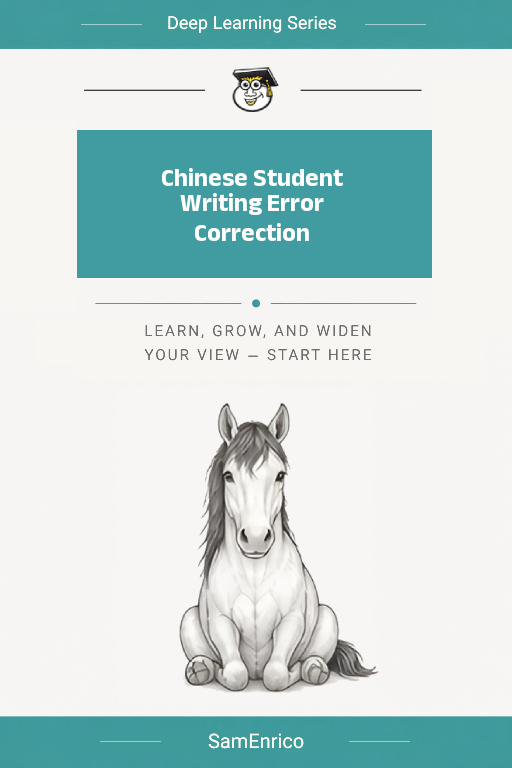
Chinese Student Writing Error Correction
Fix direct translation errors where Chinese senten
Fix direct translation errors where Chinese sentence structure creates unnatural English phrasing.
Formats
About this book
Free sample
Chapter 1: The Word-for-Word Grave...–- Every Chinese student of English has dug this grave themselves. They did it with good intentions, a dictionary in one hand and a Chinese essay in the other. They worked diligently, word by word, replacing each Chinese character with an English equivalent. And when they finished, they stood back to admire a sentence that was perfectly correct in every detail yet completely wrong in every way that matters.This is the word-for-word trap. It is the single most persistent error pattern in Chinese student writing, and it operates invisibly because it feels like translation.
You are not making grammar mistakes. You are not misspelling words. You are doing exactly what you were taught: find the Chinese word, find the English word, put them in the same order. The problem is that English does not think in Chinese order.Most writing guides focus on individual errors – wrong prepositions, missing articles, incorrect tenses. These guides treat each mistake as an isolated event.
But the word-for-word trap is not a collection of errors. It is a cognitive pattern. Your brain has learned to process information in a Chinese structure, and then you pour that structure into English words. The result is sentences that are grammatically defensible but cognitively foreign to an English reader.This chapter will show you what that trap looks like, why your brain falls into it, and how to climb out. By the end, you will not have memorized a list of corrections.
You will have retrained your instinct for where to put the first word of every sentence you write.The Illusion of Direct Equivalence The most dangerous assumption in second-language writing is that every Chinese word has one true English equivalent, and that assembling those equivalents in Chinese order produces English. This assumption is wrong in two ways.First, words do not translate one-to-one. The Chinese character 开 means "open" in some contexts, "turn on" in others, "drive" in still others, and "hold" in phrases like 开会 (to hold a meeting). A student who translates 开电脑 as "open the computer" has not made a vocabulary…
This is the end of the free sample. Get the eBook to keep going. Buy now
Contents
- Chapter 1
- Chapter 2
- Chapter 3
- Chapter 4
- Chapter 5
- Chapter 6
- Chapter 7
- Chapter 8
- Chapter 9
- Chapter 10
- Chapter 11
- Chapter 12
Details
- Author
- Singletary Henriette
- Publisher
- SamEnrico
- Language
- English
- Genre
- Non-Fiction, Side Hustle Architect
- Released
- 2026-05-27
- Pages (approx.)
- 146
- Available as
- eBook, Audiobook

Read better in the ZLOADR app
Your eBooks on your phone or tablet. Sign in with your SamEnrico account and start reading.
More by Singletary Henriette
 The Craving Busting WorkbookSingletary Henriette$11.99
 The Nap Alarm Clock GuideSingletary Henriette$11.99
 Remote Productivity FAQSingletary Henriette$11.99
 Parent Loss and Young ChildrenSingletary Henriette$11.99
 Digital Boundary SettingSingletary Henriette$11.99
 Board of Directors CrisisSingletary Henriette$11.99
 Microbiome Kidney HealthSingletary Henriette$11.99
 Mindfulness Pain ReliefSingletary Henriette$11.99
 Alibaba Inspection ServicesSingletary Henriette$11.99
 The Ballad of the Black Cowboy: Nat Love and the Wild West’s Forgotten LegendSingletary Henriette$11.99
 Hannibal's Ghosts: The Cursed March Over the AlpsSingletary Henriette$11.99
 Bridges of Time: The Lovers Who Built the Iron AgeSingletary Henriette$11.99
You may also like
 Pinterest VA Zapier AutomationTribble Carmelia$11.99
 Pinterest VA Tax Deduction TrackerBaylor Kevin$11.99
 Pinterest VA Starter BlueprintHales Sasha$11.99
 Pinterest VA Shadow Ban RecoveryBraxton Bernarda$11.99
 Pinterest VA Portfolio From ScratchOrosco Kevin$11.99
 Pinterest VA For Recipe BloggersReiter Maris$11.99
 Pinterest VA For Real Estate AgentsBergeron Felisha$11.99
 Pinterest VA For Baby BrandsJordon Cordie$11.99
 Pinterest VA Canva Design Crash CourseSanderson Peggie$11.99
 Pinterest VA Calendar Planning SystemZielinski Katia$11.99
 Pinterest VA Upwork Client GuideDykes Summer$11.99
 Pinterest VA Monthly Reporting TemplatesCalkins Debby$11.99