
Non-FictionStudent's ShortcutInterview
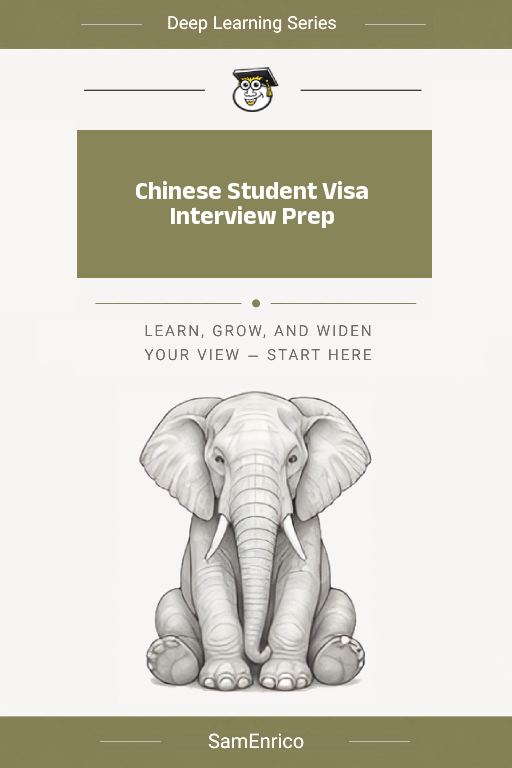
Chinese Student Visa Interview Prep eBook
Prepare for visa interview questions about study p
Prepare for visa interview questions about study plans, finances, and ties to home country.
Formats
Free sample
Chapter 1: The Presumption Game--You are guilty until proven innocent. That is the first thing no one tells you about the US student visa interview.Not guilty of a crime, of course. But guilty of something far more specific in the eyes of US immigration law: the intention to immigrate permanently. Every Chinese student who sits down across from a consular officer begins that 90-second interaction carrying a legal presumption that they intend to stay in the United States forever. The officer does not need to prove this.
The law assumes it. Your job is not to show you are a good student, not to demonstrate you have been admitted to a legitimate university, not even to prove you have enough money. Your job is to rebut a presumption. And most Chinese students walk into that interview room having no idea this legal fiction even exists.This chapter will change that. By the time you finish reading, you will understand exactly what the officer is thinking, why the system is structured against you from the moment you sit down, and—most importantly—how to flip the script so that the presumption works in your favor rather than against you.
This is not theory. This is the foundation upon which every successful visa interview is built. Without mastering the content of this chapter, the remaining eleven chapters of this book will only take you halfway. With it, you will understand why certain answers work and others fail, why some documents matter more than others, and why a student with weaker grades but a clearer rebuttal of immigrant intent will always be approved over a student with perfect scores who cannot articulate why they are coming back.The Legal Fiction That Changes Everything The Immigration and Nationality Act, Section 214(b) is the most important piece of text you have never read. It states, in language that has been interpreted by consular officers for nearly seven decades, that every applicant for a non-immigrant visa is presumed to be an intending immigrant unless they prove otherwise.
Let me repeat that because it is counterintuitive to everything you have been taught about how interviews work: You do not start with a blank slate. You do not start with the officer assuming you are telling the truth. You start from a position of legal disadvantage. The officer's default assumption is that you want to move to the United States permanently, and everything you say and present must overcome that assumption.This is radically different from how most countries operate. If you apply for a student visa to Canada, the United Kingdom, Australia, or most of Europe, the presumption is reversed.
Those immigration systems assume you intend to comply with the terms of your visa unless evidence suggests otherwise. The United States is different. It has always been different. And the reason is rooted in American immigration history—a country built by immigrants that has simultaneously always worried about who comes and who stays. For Chinese applicants, this presumption is applied with particular intensity because of overstay rates that, while still low for students relative to other visa categories, are higher than the State Department would like.Here is what 214(b) actually means for you as a Chinese student applicant.
The officer is not evaluating whether you are a good person. They are not evaluating whether your university is legitimate. They are not even evaluating whether your parents have enough money, though that matters. The sole legal question the officer is trying to answer is this: Does this applicant have sufficient ties to China to compel their return after their studies? Everything else—your grades, your English ability, your university's ranking—is secondary to this single question.
If the officer concludes that you do not have sufficient ties, you will be denied even if you have a full scholarship to Harvard. If the officer concludes that you do have sufficient ties, you will be approved even if your university is mediocre. The presumption creates a world where return intent matters more than academic merit.What a 214(b) Denial Really Means—And What It Does Not Mean If you are denied under 214(b), you will receive a small white slip of paper. The officer will say something brief like "I am not convinced you will return to China." They will return your passport without a visa stamp. And you will walk out of the consulate feeling as though you have been judged unworthy.
That feeling is understandable, but it is based on a misunderstanding of what just happened.A 214(b) denial is not a judgment on your character. The officer does not think you are a liar. They do not think you are a bad person. They do not think you are unworthy of a US education. The denial means only one thing: based on the two to three minutes of conversation they had with you, and based on the documents you presented, they were not convinced that you will return to China after your studies.
That is all. It is not a life sentence. It is not a mark that follows you forever. It is not a reflection of your academic potential or your personal integrity. It is a judgment about the strength of your presentation in a single, high-pressure interaction.Here is what else a 214(b) denial is not.
It is not permanent. Many Chinese students who are denied reapply after strengthening their case and are approved. The law explicitly allows this. There is no waiting period, though practical wisdom suggests waiting until you have materially changed your circumstances—a stronger financial picture, a clearer study plan, more convincing ties to China. It is not appealable in any meaningful sense.
There is no court that will review the officer's decision. Consular officers have near-absolute discretion, and the law does not require them to explain their reasoning in detail. But the absence of an appeal does not mean the absence of a second chance. It just means your second chance comes in the form of a new application, not a legal fight.It is also not a secret. The State Department publishes denial rates by country and visa category.
For Chinese F-1 applicants, the denial rate hovers between 15 and 25 percent depending on the year and the consulate. That means between one in four and one in seven Chinese students who apply are denied. If you are denied, you are not alone. You are not exceptional in your failure. You are part of a statistical reality that the system produces every single day.
The question is not whether denial is possible. The question is whether you will be among the 75 to 85 percent who are approved, and that outcome is largely within your control if you understand what the officer is actually looking for.The Consular Officer's Reality: Three Minutes, One Hundred Applicants, No Margin for Error To understand why the presumption matters so much, you must understand the person sitting across from you. The average consular officer in Guangzhou, Beijing, Shanghai, or Shenyang conducts between 80 and 120 interviews per day. Each interview is scheduled for three minutes, but effective time is often closer to ninety seconds once…
This is the end of the free sample. Get the eBook to keep going. Buy now
About this book
Details
- Author
- Barrios Cassie
- Publisher
- SamEnrico
- Language
- English
- Genre
- Non-Fiction, Student's Shortcut, Interview
- Released
- 2026-05-30
- Pages (approx.)
- 145
- Available as
- eBook, Audiobook

Read better in the ZLOADR app
Your eBooks on your phone or tablet. Sign in with your SamEnrico account and start reading.
More by Barrios Cassie
 Caregiving For Parent With Macular DegenerationBarrios Cassie$11.99
 Golden Milk Turmeric GuideBarrios Cassie$11.99
 Cash Only Recovery PlanBarrios Cassie$11.99
 Authority Influence TechniqueBarrios Cassie$11.99
 Stress and Cortisol Driven Binge EatingBarrios Cassie$11.99
 Cholesterol Exercise GuideBarrios Cassie$11.99
 Avalanche Survivor TacticsBarrios Cassie$11.99
 Nocturnal Panic AttacksBarrios Cassie$11.99
 The Hammer of Hastings: Harold Godwinson's Last StandBarrios Cassie$11.99
 The Forge of Hephaestus: The Lame God Who Shaped OlympusBarrios Cassie$11.99
 How to Produce Home Automation KitsBarrios Cassie$11.99
 How to Become a Railroad-maintenance ClerkBarrios Cassie$11.99
You may also like
 Hong Kong Handover 1997Dunn Johnnie$11.99
 Zumba For Postnatal Recovery CourseNeal Christian$11.99
 Zumba for BeginnersLadner Nikia$11.99
 YouTube Comment Mining GuideHumes Pandora$12.99
 Worry Box MeditationCarlin Rudy$11.99
 Workplace Stress MeditationNguyen Lynn$11.99
 Workplace Stress and Sleep RepairHawley Ivory$11.99
 Workplace Perfectionism CureDelaney Jeffry$11.99
 Workplace Injustice Anger GuideWallen Isabelle$11.99
 Work Addiction and Burnout LinkGreenwood Ester$11.99
 Women in Yoga and WellnessBeattie Galina$11.99
 Women in Stand Up ComedyChun Evangeline$11.99