
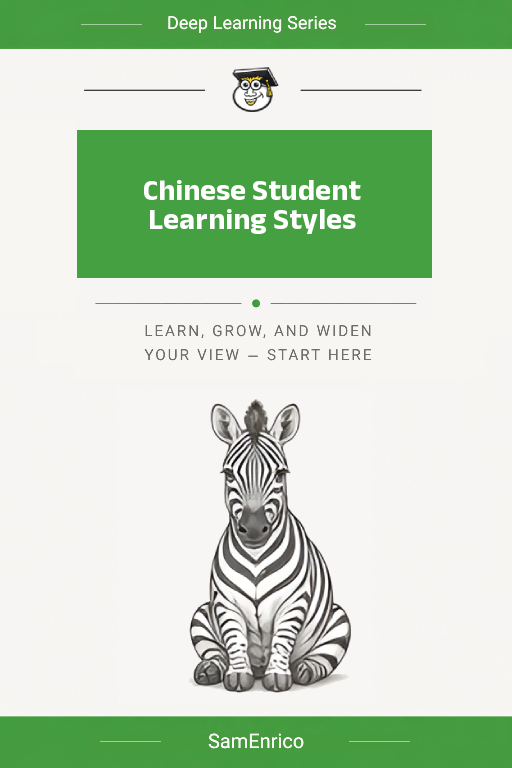
Non-FictionSide Hustle ArchitectLearning Styles
Chinese Student Learning Styles eBook
Adapts teaching methods to match common Chinese le
Adapts teaching methods to match common Chinese learning preferences including visual, rote, and exam-focused approaches while introducing Western methods.
Formats
Free sample
Chapter 1: The Silent Straight-A Student...--–- The email arrived at 11:47 PM on a Tuesday. Sarah, a veteran high school history teacher in Chicago with fourteen years of classroom experience and a shelf full of “Teacher of the Year” nomination certificates, stared at her screen in disbelief. The message was from the parent of one of her Chinese international students, a boy named Kevin. Kevin never spoke in class. Never raised his hand.
Never came to office hours. He sat in the second row, took obsessive notes in impossibly small handwriting, and nodded along to everything Sarah said. His participation grade was a flat zero. But his exam scores? Perfect.
Absolutely perfect. The email read: “Dear Teacher Sarah, my son Kevin says you think he is not learning because he does not talk. But he has memorized every slide from your lectures. He can recite your Power Points from memory. He is not lazy.
He is being polite. Please explain why talking equals learning in America. Sincerely, Mr. Zhang.”Sarah read the email three times. Then she read it again.
She felt something she had not felt in years as a teacher: confusion mixed with a creeping sense that her entire pedagogical framework might have a blind spot the size of the Pacific Ocean. She had always believed that participation meant speaking. That silence meant disengagement. That students who did not ask questions did not have questions. But Kevin’s exam scores told a different story.
And his father’s question hung in the air like a challenge she could not answer: Why does talking equal learning?This book is for Sarah. And for every teacher, professor, tutor, and instructional designer who has ever stood in front of a classroom full of Chinese students and wondered why the silence feels so loud. This book is also for Kevin—for the millions of Chinese learners whose cultural scripts are misread as deficits, whose quiet diligence is mistaken for passivity, and whose remarkable academic performance is dismissed as mere “rote memorization” by educators who do not understand what they are seeing.This first chapter does three things. First, it introduces the central paradox that drives this entire book: how can students labeled as passive, rote-dependent, and uncreative consistently outperform their Western peers on international assessments? Second, it dismantles the stereotype of the “rote learner” by showing that memorization, in the Chinese educational tradition, is not the opposite of understanding but often the vehicle for it.
Third, it previews the book’s core argument: that the conflict between “Chinese” and “Western” learning styles is not a battle to be won but a synthesis to be built.The Paradox That Should Not Exist In 2018, the Programme for International Student Assessment (PISA) released its latest round of scores. The results were, by now, predictable to anyone who follows international education. Beijing, Shanghai, Jiangsu, and Zhejiang (the four Chinese provinces that participated) ranked first in reading, first in mathematics, and first in science. Singapore, Hong Kong, and Macao—all Confucian-heritage cultures—also occupied the top tiers. The United States?
Fifteenth in reading, thirty-seventh in mathematics, and eighteenth in science. The United Kingdom floated somewhere in the middle.Every three years, these results provoke the same cycle of reactions. Western media outlets run headlines about a “learning crisis.” Policymakers fly to Shanghai to observe classrooms. Educational consultants sell expensive workshops on “what China is doing right.” And then, almost immediately, the skepticism begins. Yes, the skeptics say, but those scores come from rote learning.
Chinese students memorize. They don’t think critically. They’re trained for tests, not for innovation. Give them a problem that requires creativity, and they’ll fall apart.There is only one problem with this skepticism. It is almost entirely wrong.The paradox is this: if Chinese students are truly just “rote learners”—passive vessels filled with disconnected facts—how do they consistently outperform Western students on assessments that explicitly test problem-solving, reading comprehension, and scientific reasoning?
PISA is not a multiple-choice trivia test. It asks fifteen-year-olds to interpret unfamiliar texts, design experiments, and apply mathematical concepts to real-world situations. These are not tasks that yield to mindless repetition. Something else is going on.This book argues that the “Chinese Learner Paradox” exists only because Western observers have misunderstood what they are seeing. They mistake a different process for an inferior one.
They mistake silence for emptiness. They mistake memorization for mindlessness. And in doing so, they miss the sophisticated, intentional, and deeply effective learning strategies that Chinese students actually employ.A Brief History of the Exam That Changed Everything To understand why Chinese students learn the way they do, you have to go back more than a thousand years. The Imperial Examination System, known as Keju, was established during the Sui Dynasty (581–618 CE) and refined during the Tang Dynasty (618–907 CE). It was, in many ways, the most revolutionary educational institution in human history before the modern era.
For the first time, a major empire created a standardized system of examinations to select government officials based on merit rather than birth. A peasant’s son could, theoretically, rise to become a chancellor. The promise was intoxicating: study hard, pass the exams, and lift your entire family out of poverty.But the exams were brutal. Candidates spent years—sometimes decades—memorizing the Confucian classics: the Four Books and Five Wonders. They practiced calligraphy until their fingers bled.
They wrote essays on moral philosophy under timed conditions. The pass rate was minuscule. At the highest level, the palace examinations, perhaps one percent of candidates succeeded. Failure was not merely disappointing; it was shameful. Families mortgaged land to support sons through years of study.
Villages pooled resources to send their brightest young men to the district exams. The entire culture organized itself around a single, all-consuming goal: examination success.The Keju system was abolished in 1905, but its ghost never left. It evolved, transformed, and reincarnated as the Gaokao—the National College Entrance Examination that every Chinese high school student takes at the end of their third year. The Gaokao is not “like” the SAT or the A-levels. It is something far more intense.
It lasts two to three days. It covers Chinese language, mathematics, a foreign language (usually English), and either science (physics, chemistry, biology) or humanities (history, geography, politics). The questions are grueling. They require not just recall but application, synthesis, and speed. A single point can determine whether a student attends a top-tier university or a mediocre one.
A single point can change the trajectory of a life.The sociologist David L. Kirp once called the Gaokao “the most consequential exam on earth.” He was not exaggerating. Every year, more than ten million students sit for the exam. Police escort the test papers in armored vehicles. Air traffic is rerouted to prevent noise during the listening comprehension section.
Parents camp outside exam centers for days. Students who collapse from stress—and some do—are carried out on stretchers and given no extra time.This is not a bug in the Chinese educational system. It is the feature. The Gaokao creates a specific kind of learner: one who is precise, fast, endurance-tested, and hyper-focused on demonstrable outcomes. Western…
This is the end of the free sample. Get the eBook to keep going. Buy now
About this book
Details
- Author
- Portillo Terra
- Publisher
- SamEnrico
- Language
- English
- Genre
- Non-Fiction, Side Hustle Architect, Learning Styles
- Released
- 2026-06-01
- Pages (approx.)
- 146
- Available as
- eBook, Audiobook

Read better in the ZLOADR app
Your eBooks on your phone or tablet. Sign in with your SamEnrico account and start reading.
More by Portillo Terra
 MBSR For Low Self Esteem HandbookPortillo Terra$11.99
 Trigger Tracking Journal GuidePortillo Terra$11.99
 Sound Visualization Frequency CalmPortillo Terra$11.99
 Global E Commerce Regional TrendsPortillo Terra$11.99
 The That's Not All Persuasion TrickPortillo Terra$11.99
 The Crimson Tide: How a Single Dye Changed the WorldPortillo Terra$11.99
 Understanding Osteosclerosis Abnormalities of Nervous System and MeningesPortillo Terra$17.99
 XGBoost OperatorPortillo Terra$11.99
 How to Become a Type CopyistPortillo Terra$11.99
 Crowdfunding Terms of Service GuidePortillo Terra$12.99
You may also like
 Hong Kong Handover 1997Dunn Johnnie$11.99
 Zumba For Postnatal Recovery CourseNeal Christian$11.99
 Zumba for BeginnersLadner Nikia$11.99
 YouTube Comment Mining GuideHumes Pandora$12.99
 Worry Box MeditationCarlin Rudy$11.99
 Workplace Stress MeditationNguyen Lynn$11.99
 Workplace Stress and Sleep RepairHawley Ivory$11.99
 Workplace Perfectionism CureDelaney Jeffry$11.99
 Workplace Injustice Anger GuideWallen Isabelle$11.99
 Work Addiction and Burnout LinkGreenwood Ester$11.99
 Women in Yoga and WellnessBeattie Galina$11.99
 Women in Stand Up ComedyChun Evangeline$11.99