
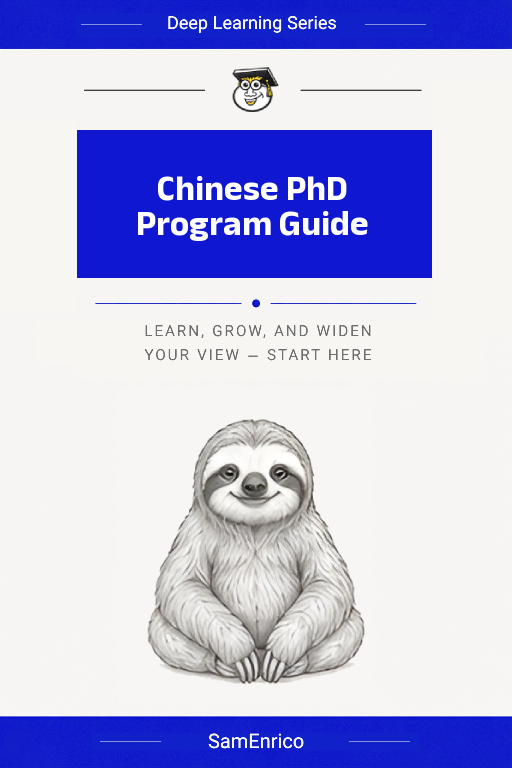
Chinese PhD Program Guide eBook
Secure supervisor acceptance before applying, prep
Secure supervisor acceptance before applying, preparing research proposals and publication records for 3-4 year doctoral programs.
Formats
Free sample
Chapter 1: The Gatekeeper's Gambit--Every year, thousands of international applicants submit what they believe are flawless Ph D applications to Chinese universities. They spend months polishing research proposals, translating transcripts, and securing recommendation letters. They click "submit" with confidence, believing their qualifications will speak for themselves.Then they wait. And wait. And eventually receive a form rejection email that offers no explanation.I was one of these applicants.
In 2017, I applied to four top-tier Chinese Ph D programs with a strong Master's degree, two conference papers, and what I thought was a compelling research proposal. I received four rejections. No interviews. No feedback. Just silence and the quiet humiliation of having spent six months on nothing.A year later, after completely reversing my strategy, I received acceptances from three of those same four universities.
The only thing that had changed was not my qualifications—it was my understanding of how the Chinese system actually works.What I learned, and what this book will teach you, is that the Chinese Ph D admission process is fundamentally different from its Western counterparts in ways that most international applicants never discover until it is too late. The rules are different. The power dynamics are different. And the single most important factor determining your success has nothing to do with the application you submit through the online portal.This chapter reveals the hidden structure of Chinese doctoral admissions. By the time you finish reading, you will understand why cold applications fail, who really holds the power to admit you, and why securing a supervisor's acceptance before you apply is not optional—it is the only strategy that works.The Silent Revolution You Never Heard About Until approximately 2013, doctoral admissions in China operated on a model familiar to anyone who has taken a high-stakes exam: centralized written tests administered by the Ministry of Education, followed by interviews for those who scored above a cutoff.
The system was exam-centric, bureaucratic, and relatively transparent. Your score determined your fate.That system is now dead.Over the past decade, more than ninety percent of top-tier Chinese universities—including Tsinghua, Peking, Fudan, Shanghai Jiao Tong, Zhejiang University, and the University of Science and Technology of China—have abandoned centralized written exams entirely. In their place, they have adopted a system called "application-review" (申请-考核制, shēn qǐng kǎo hé zhì).If you come from a Western academic background, this term might sound familiar. After all, most Western Ph D programs also use an application-review model. You submit materials.
A committee reviews them. You are admitted or rejected. What could be different?The difference lies not in the name but in the distribution of power. In a Western application-review system, an admissions committee comprised of multiple faculty members evaluates applications collectively. Individual professors may express preferences, but the committee makes the final decision.
In many Western programs, you are admitted to the university or department first, and only then do you find a supervisor.The Chinese application-review system inverts this power structure entirely.The Supervisor Is Not a Reviewer—The Supervisor Is the Gatekeeper Here is the single most important sentence in this entire book: In the Chinese Ph D admission system, the prospective supervisor admits you, and the admissions committee ratifies that decision.Read that sentence again. It is the opposite of what you assume if you are trained in Western academic culture.Let me illustrate with a concrete example from a top-five Chinese university. In a typical admissions cycle, a professor might receive two hundred applications through the official portal. The professor will pre-select perhaps ten candidates whose backgrounds align with their research needs. Those ten candidates will receive informal invitations to apply—because the professor has already decided to take them.
The remaining one hundred and ninety applications will be rejected without ever being read by a human being.The admissions committee's role is not to choose among applicants. The committee's role is to verify that the applicants pre-selected by supervisors meet minimum university requirements: degree authentication, language scores, and basic eligibility. As long as those requirements are met, the committee approves the supervisor's decision.This is why cold applications—submitting through the portal without prior contact—have a near-zero success rate. You are not being evaluated on your merits. You are being filtered out because you were not pre-selected.I have spoken with admissions staff at four Chinese universities who confirmed this pattern privately.
One administrator at a Double First-Class university told me, "We receive thousands of applications every year. We read exactly those that professors have told us to expect. The rest go into the system and are never opened. There is simply no time."Why This Inversion Exists: The Logic of Compressed Doctorates To understand why Chinese doctoral admissions work this way, you must understand the structure of the Chinese Ph D itself. In the United States, a typical Ph D takes five to seven years.
The first two years are usually dedicated to coursework, teaching assistantships, and exploratory research. Only in the third or fourth year does a student begin producing publishable work.The Chinese Ph D is compressed into three to four years total. There is no two-year buffer for coursework. There is no extended period for exploring different research directions. In most Chinese doctoral programs, students are expected to complete their coursework within the first two semesters, pass their proposal defense by the end of the second semester, and submit their first journal paper by the end of the second year.This compressed timeline creates a specific imperative for supervisors: they cannot afford to train students from scratch.
Every incoming Ph D student must be "plug-and-play"—ready to contribute to ongoing research projects immediately, with existing technical skills, publication experience, and research maturity.Consider the mathematics of a supervisor's career. A typical Chinese professor might supervise three to five Ph D students simultaneously. Each student has three to four years to produce the two to three journal papers required for graduation. If a student requires six months to learn basic laboratory techniques or programming skills, that student's entire publication timeline is jeopardized. The supervisor's own promotion and grant renewal depend on student publications.
The risk is not abstract—it is career-determining.This is why your existing publication record matters so much. It is not about prestige. It is about proof. A first-author SCI paper in a relevant journal demonstrates that you already know how to formulate a hypothesis, design experiments, analyze data, write a manuscript, and navigate peer review. From a supervisor's perspective, you are not a student who needs training—you are a collaborator who can start producing immediately.The Real Timeline Nobody Tells You About Most international applicants believe the Ph D application timeline begins when the university portal opens in November or December.
This belief is incorrect by approximately six months.The real admissions timeline for Chinese Ph D programs operates on a parallel track that is invisible to applicants who only watch official deadlines.March to July (Eighteen Months Before Enrollment): Successful applicants begin identifying potential supervisors. They read recent papers, track grant funding, and audit lab websites. They do not send emails yet. They are gathering intelligence.August to…
This is the end of the free sample. Get the eBook to keep going. Buy now
About this book
Details
- Author
- Spangler Geraldo
- Publisher
- SamEnrico
- Language
- English
- Genre
- Non-Fiction, Student's Shortcut
- Released
- 2026-05-29
- Pages (approx.)
- 141
- Available as
- eBook, Audiobook

Read better in the ZLOADR app
Your eBooks on your phone or tablet. Sign in with your SamEnrico account and start reading.
More by Spangler Geraldo
 Self Esteem For New Moms Body RecoverySpangler Geraldo$11.99
 Combat Medic Stress GuideSpangler Geraldo$11.99
 Grandchildren 529 PlanningSpangler Geraldo$11.99
 Teen Mom TrialsSpangler Geraldo$11.99
 Mistake Shame Anger GuideSpangler Geraldo$11.99
 Creative Community GuideSpangler Geraldo$11.99
 Mao's Last Dancer EscapeSpangler Geraldo$11.99
 Client Bankruptcy CommunicationSpangler Geraldo$11.99
 Whispers of the Last Kelp ForestsSpangler Geraldo$11.99
 The Bardic Chronicles: Druids, Kings, and the Oral Legacy of Celtic WisdomSpangler Geraldo$11.99
 The Mineral Guide to AnkeriteSpangler Geraldo$11.99
 How to Become a Briquetting-machine OperatorSpangler Geraldo$11.99
You may also like
 Hong Kong Handover 1997Dunn Johnnie$11.99
 Zumba For Postnatal Recovery CourseNeal Christian$11.99
 Zumba for BeginnersLadner Nikia$11.99
 YouTube Comment Mining GuideHumes Pandora$12.99
 Worry Box MeditationCarlin Rudy$11.99
 Workplace Stress MeditationNguyen Lynn$11.99
 Workplace Stress and Sleep RepairHawley Ivory$11.99
 Workplace Perfectionism CureDelaney Jeffry$11.99
 Workplace Injustice Anger GuideWallen Isabelle$11.99
 Work Addiction and Burnout LinkGreenwood Ester$11.99
 Women in Yoga and WellnessBeattie Galina$11.99
 Women in Stand Up ComedyChun Evangeline$11.99