
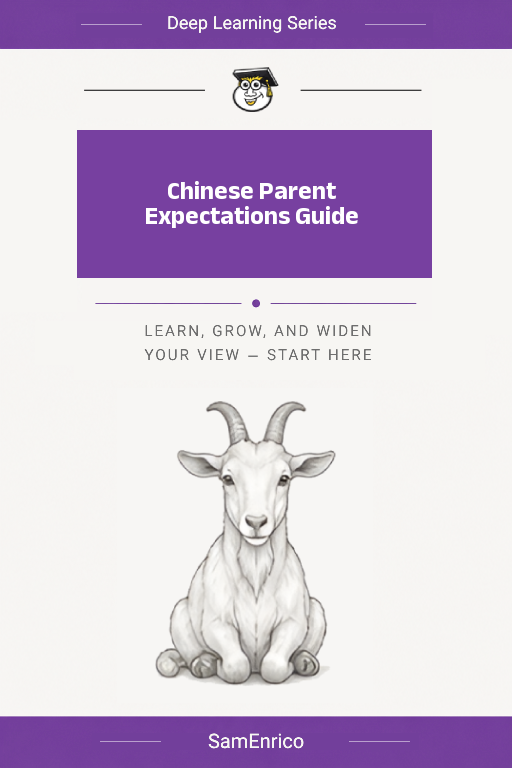
Non-FictionSide Hustle ArchitectParent Management
Chinese Parent Expectations Guide eBook
Understand what Chinese parents want from English
by Landis Cara
Understand what Chinese parents want from English tutors including exam results, speaking confidence, and visible progress. Align your teaching with their goals.
Formats
Free sample
Chapter 1: The Iron Hammer...--When a fourteen-year-old boy named Leo sat across from me for the first time, his mother did most of the talking. She spoke for seventeen minutes without interruption—a rapid stream of Mandarin that I understood only in fragments, though her hands told the full story. They gestured, chopped the air, pressed against her chest, and finally clenched into fists resting on the table. Her son stared at his sneakers. When she finished, she looked at me and said in careful English: "He is not stupid.
He is lazy. Fix him."I had been tutoring English in Shanghai for only three months, and I made my first mistake immediately. I turned to Leo and asked, "What do you enjoy reading?" He looked at his mother. She looked at me. The silence lasted eight seconds—an eternity in a negotiation—and then she said, "We are not here for enjoyment.
His Zhongkao is in nine months. Last mock exam, he scored 62. We need 85. Can you do this or not?"That was the moment I understood something that no teacher training program had ever mentioned. I had been hired not to inspire a love of English, not to foster curiosity, not to make learning "fun." I had been hired to raise a number.
And if I could not promise to raise that number, the conversation was over.This chapter is for every tutor who has ever been caught off guard by the intensity of a Chinese parent's focus on exam results. It is for the well-intentioned teacher who believes that engagement must come before achievement, and for the freelancer who has lost a client because they suggested a "creative writing project" instead of a grammar drill. By the end of this chapter, you will understand why Chinese parents prioritize measurable outcomes over enjoyable experiences—and more importantly, you will know exactly how to align your teaching with that priority without burning out or betraying your own pedagogical values.The Three Iron Hammers To understand Chinese parents, you must first understand the exams that structure their children's lives. These are not ordinary tests. They are not the periodic assessments or benchmark quizzes that Western educators use to check for understanding.
They are what Chinese families call "iron hammers"—instruments that can either shatter a child's future or forge it into something strong enough to withstand a lifetime of competition.The first iron hammer is the Zhongkao, taken at age fifteen. This exam determines which high school a student will attend. In China's stratified educational system, high schools are ruthlessly ranked. The top tier schools send eighty to ninety percent of their graduates to prestigious universities. The bottom tier schools send five percent.
A single test score on a single day decides which track a child enters. Parents know that a child who scores 85 on the Zhongkao has a fundamentally different future than a child who scores 70. That fifteen-point gap is not an abstract metric. It is the difference between a university degree and a vocational certificate, between a white-collar career and a factory floor, between marrying well and struggling to find a partner.The second iron hammer is the Gaokao, taken at eighteen. This is the exam that international media has obsessively documented—the nine-hour marathon that determines university placement across China's entire system.
But what Western observers often miss is not the scale of the exam but its finality. A student's Gaokao score is not one factor among many in university admissions. It is the only factor. There are no personal essays that can compensate for a low score. No letters of recommendation.
No consideration of "well-roundedness." A student who scores two points below the cutoff for their desired university does not get a thoughtful review. They simply do not get in. The Chinese saying is brutal but accurate: "One exam determines your life."The third iron hammer is the suite of international exams—IELTS, TOEFL, SAT, A-Levels, IB—that open doors to overseas study. For Chinese families with financial resources, studying abroad is the ultimate escape hatch: a way to bypass the domestic exam system entirely and access universities that are ranked higher, more prestigious, and less brutally competitive than even China's best institutions. But these exams have their own iron logic.
An IELTS score of 6.5 admits a student to a good university. A score of 6.0 does not. That half-point difference, smaller than the width of a pencil mark on a bubble sheet, determines whether a family's investment of 300,000 RMB per year in overseas tuition is possible or wasted.These three iron hammers are not distant threats that loom somewhere in the future. Chinese parents begin preparing their children for the Zhongkao in primary school. They discuss Gaokao trajectories when their children are learning multiplication tables.
They research IELTS requirements while their teenagers are still years away from being eligible to take the test. This is not anxiety. This is strategic planning in a system where the margin for error is essentially zero.Why "Fun" Is Not a Selling Point Here is a truth that many Western-trained tutors find uncomfortable: when a Chinese parent hears you say that your lessons are "fun," they do not feel reassured. They feel concerned.Consider what the word "fun" communicates in the context of Chinese education. Fun is what happens at birthday parties.
Fun is what children do when the serious work is finished. Fun is a reward, not a method. When a tutor leads with "fun," the parent hears: "This person does not understand the stakes. This person will waste my child's limited time on activities that do not raise scores. This person is treating my child's future as a game."I once watched a highly qualified American tutor—a woman with a master's degree in TESOL and ten years of classroom experience—lose a contract in less than fifteen minutes because she used the word "enjoy" three times in her opening pitch.
She said: "I want your daughter to enjoy learning English." The mother nodded politely. She said: "We'll use games and activities that she'll enjoy." The mother's expression tightened. She said: "When students enjoy the process, they learn faster." The mother stood up, thanked her for her time, and walked out. Later, the mother explained to me: "She didn't ask about my daughter's exam scores. She didn't ask about her weak subjects.
She talked about enjoyment as if we were booking a vacation. I cannot trust someone who does not understand what is at stake."This does not mean that your lessons must be dreary or punitive. It means that "fun" cannot be your primary value proposition. Chinese parents are not paying you to entertain their children. They are paying you to increase a number—a test score, a class rank, a percentile.
Any activity that does not directly contribute to that number is, from the parent's perspective, wasted time.The tutors who thrive in this market understand how to reframe engaging activities as strategic interventions. A word game becomes "rapid vocabulary retrieval practice for the reading section." A speaking activity becomes "mock interview conditioning for the oral exam." A creative writing exercise becomes "sentence structure drilling with immediate…
This is the end of the free sample. Get the eBook to keep going. Buy now
About this book
Details
- Author
- Landis Cara
- Publisher
- SamEnrico
- Language
- English
- Genre
- Non-Fiction, Side Hustle Architect, Parent Management
- Released
- 2026-06-01
- Pages (approx.)
- 144
- Available as
- eBook, Audiobook

Read better in the ZLOADR app
Your eBooks on your phone or tablet. Sign in with your SamEnrico account and start reading.
More by Landis Cara
 Building Relationships With Strategic PartnersLandis Cara$11.99
 Gut Brain Axis and OCDLandis Cara$11.99
 Stress and Aging Parent RelationshipsLandis Cara$11.99
 Mindful Breathing TechniquesLandis Cara$11.99
 The Phantom of the Outback: Australia’s Highway Killer EnigmaLandis Cara$11.99
 How to Start a Bolt Business (Beginners Guide)Landis Cara$11.99
 How to Produce Bassinets and CradlesLandis Cara$11.99
 Director of Site MerchandisingLandis Cara$11.99
You may also like
 Hong Kong Handover 1997Dunn Johnnie$11.99
 Zumba For Postnatal Recovery CourseNeal Christian$11.99
 Zumba for BeginnersLadner Nikia$11.99
 YouTube Comment Mining GuideHumes Pandora$12.99
 Worry Box MeditationCarlin Rudy$11.99
 Workplace Stress MeditationNguyen Lynn$11.99
 Workplace Stress and Sleep RepairHawley Ivory$11.99
 Workplace Perfectionism CureDelaney Jeffry$11.99
 Workplace Injustice Anger GuideWallen Isabelle$11.99
 Work Addiction and Burnout LinkGreenwood Ester$11.99
 Women in Yoga and WellnessBeattie Galina$11.99
 Women in Stand Up ComedyChun Evangeline$11.99