
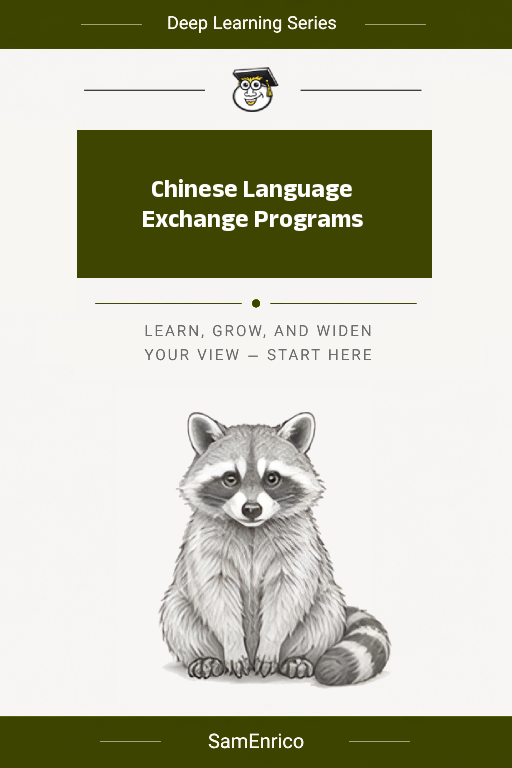
Chinese Language Exchange Programs eBook
Find language partners through campus clubs or app
by Counts Jamar
Find language partners through campus clubs or apps like HelloTalk, improving Chinese skills while helping locals learn English.
Formats
Free sample
Chapter 1: The Tuition You Already Own--–- The first time I walked into a Chinese language classroom, I was handed a textbook with a smiling family eating dumplings under a perfectly blue sky. The first sentence I learned was, “Nǐ hǎo, wǒ jiào Adam.” The second sentence was, “Wǒ hěn hǎo, xièxiè.” For three weeks, I practiced tones in a sterile room with eleven other nervous foreigners while our patient teacher, Laoshi Wang, wrote character after character on a whiteboard. I was learning Chinese, technically. But when I stepped outside the classroom and tried to order coffee, the woman at the counter looked at me like I had just recited a poem from the Tang Dynasty. She had no idea what I said.
I had no idea what she said back. The textbook had not prepared me for her. The classroom had not prepared me for the real world. That was the day I realized I had been paying for the wrong kind of education.This book is about the education you should have been getting all along. It is not another textbook.
It is not a phrasebook, a grammar guide, or a set of flashcards. It is a manual for the oldest, most effective, and most overlooked method of learning a language on the planet: exchange. Specifically, Chinese language exchange, where you teach English in return for Mandarin. And here is the secret that no language school will tell you: you already own the most valuable asset in this transaction. Your English is not a crutch.
It is currency. It is the tuition fee you have been paying with stress and boredom, when you could have been paying it with conversation.Why Traditional Classrooms Fail You Before You Start Let us begin with an uncomfortable truth. The vast majority of Chinese language programs are designed for one thing: passing tests. They are built around HSK vocabulary lists, grammar points that appear on standardized exams, and dialogues that sound like they were written by a committee of robots trying to simulate human interaction. “How are you?
I am fine, thank you. And you?” This is not how anyone speaks in any language. No Chinese person has ever asked me “Nǐ hǎo ma?” and waited for me to recite a three-part response. They ask “Chīle ma?” (Have you eaten?) or “Zuìjìn zěnmeyàng?” (How have you been lately?) or simply launch into rapid-fire Mandarin about the weather, their boss, or the rising price of pork.The classroom isolates you from three critical elements of real language: speed, mess, and context. In a classroom, everyone speaks slowly and clearly.
They enunciate. They wait for you to finish. In the real world, people mumble, interrupt, switch topics mid-sentence, and use slang that no textbook dares to print. The classroom presents language as a clean, logical system. The real world presents it as a beautiful disaster.
And the only way to learn the disaster is to live inside it.Moreover, the classroom creates a psychological trap called the performance mindset. You are not there to communicate; you are there to be evaluated. Every sentence you speak is graded, silently or aloud. Every mistake feels like a small failure. Your brain, sensing danger, raises its filters.
You speak less. You hesitate more. You wait until you are “ready.” But you never feel ready, because readiness is not a state you reach in isolation. It is a state you discover in motion.This is where language exchange flips the entire script. When you enter an exchange, you are not a student.
You are a partner. You have something the other person wants: fluent, natural English. And they have something you want: fluent, natural Chinese. The dynamic is horizontal, not vertical. There is no teacher looming over you with a red pen.
There is only mutual need and mutual respect. And that small shift in power changes everything.Your Hidden Asset: Why English Is More Valuable Than You Think If you are reading this book, you likely speak English at a native or advanced level. You might take this for granted. After all, English is everywhere. It is on the internet, in movies, in airports, in the lyrics of pop songs.
But here is what you need to understand: in China, English is not just a language. It is a career accelerator, a status marker, and for millions of people, a source of deep anxiety.Consider the numbers. China has roughly 400 million English learners. That is more than the entire population of the United States. These learners range from schoolchildren drilling vocabulary to professionals who need English for international business to retirees who want to travel or simply prove something to themselves.
The demand for English conversation partners is almost infinite. And the supply of native speakers willing to exchange their time for Chinese practice is very, very small.This imbalance is your leverage. Every Chinese learner you meet on Hello Talk, Tandem, or at a university English Corner is looking for exactly what you have: a real, live human being who speaks English naturally, without a textbook script. They are tired of memorizing dialogues about “going to the library.” They want to know how to argue, flirt, complain, and joke in English. They want the slang, the idioms, the cultural references, the rhythm of real speech.
You have all of that. You have been speaking it since childhood.The exchange model recognizes this asset and puts it to work. Instead of paying a language school hundreds or thousands of dollars for artificial practice, you pay with what you already own. You spend thirty minutes teaching English—explaining the difference between “since” and “for,” or why Americans say “gonna” instead of “going to”—and in return, you get thirty minutes of authentic Chinese conversation. No money changes hands.
No grades are assigned. Just two people helping each other cross a bridge.This is not a feel-good metaphor. It is a practical economic reality. I have watched beginners with six months of self-study find dedicated Chinese partners simply because they offered patient, clear English correction. I have seen intermediate learners jump to advanced fluency because their partners sent them voice notes every day.
And I have watched advanced learners become so integrated that they forgot they were ever “exchanging” at all. The common thread was never their level of Chinese. It was their willingness to teach English.The Psychology of Lowered Filters: How Teaching Unlocks Learning There is a concept in second language acquisition called the affective filter. It is an invisible wall in your brain that rises when you feel anxious, embarrassed, or judged. When the filter is high, language input cannot get through.
You hear words, but they do not stick. You try to speak, but the sentences come out tangled. When the filter is low, you absorb language like a sponge. Mistakes feel like data, not disasters. You experiment.
You guess. You learn.Traditional classrooms raise the affective filter. Tests, cold calls, and public corrections all signal to your brain that this is a high-stakes environment. Language exchange, done well, lowers the filter dramatically. But here…
This is the end of the free sample. Get the eBook to keep going. Buy now
About this book
Details
- Author
- Counts Jamar
- Publisher
- SamEnrico
- Language
- English
- Genre
- Non-Fiction, Student's Shortcut
- Released
- 2026-06-01
- Pages (approx.)
- 142
- Available as
- eBook, Audiobook

Read better in the ZLOADR app
Your eBooks on your phone or tablet. Sign in with your SamEnrico account and start reading.
More by Counts Jamar
 Body Image And Self Esteem For New DadsCounts Jamar$11.99
 Empty Quarter Lead NavigatorCounts Jamar$11.99
 NICU Nurse Emotional GuideCounts Jamar$11.99
 Pension Maximization GuideCounts Jamar$11.99
 Creative Affirmations GuideCounts Jamar$11.99
 Real Housewives SecretsCounts Jamar$11.99
 Loud Noise Anger TriggerCounts Jamar$11.99
 Reclamation Demand LetterCounts Jamar$11.99
 The Celtic Fire: Volcanoes and the Birth of a CivilizationCounts Jamar$11.99
 Hashtag Revolution: The Untold Story of the First Viral UprisingCounts Jamar$11.99
 The Mineral Guide to AnataseCounts Jamar$11.99
 Growing CtenantheCounts Jamar$11.99
You may also like
 LSE Online Program LengthAgee Letisha$11.99
 Harvard Extension School for Working AdultsRoush Yer$11.99
 LSE Online Reading ListAshford Ludivina$11.99
 LSE Online Language RequirementsWhitten Daphine$11.99
 LSE Online Class SizeHughey Garret$11.99
 LSE Online Alumni MentorshipWild Lyla$11.99
 London School of Economics Alumni NetworkDutton Chantal$11.99
 Harvard Extension School Student SupportCantrell Christene$11.99
 Harvard Extension School Library AccessSantana Adah$11.99
 Harvard Extension School Degree CompletionBray Wyatt$11.99
 Harvard Extension School Course AuditingAbbott Craig$11.99
 Harvard Extension School Extension DiplomaNew Joane$11.99