
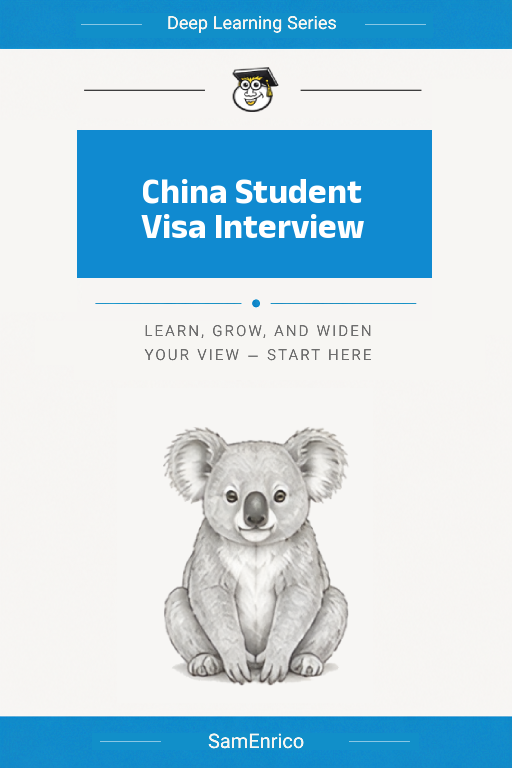
Non-FictionStudent's ShortcutInterview Prep
China Student Visa Interview eBook
Prepare for visa interview questions about study p
Prepare for visa interview questions about study plans, finances, and ties to home country.
Formats
Free sample
Chapter 1: The Sticker Lie--–- Every year, thousands of students treat their Chinese student visa like a golden ticket. They gather their documents, memorize a few polite answers about loving dumplings and the Great Wall, and walk into the consulate believing that the visa officer is simply checking boxes. They are wrong. And many of them will be refused not because they lack money or intelligence, but because they fundamentally misunderstand what is happening on the other side of that glass window.The visa sticker in your passport is not permission. It is not a reward for good grades or a prize for being accepted into a university.
It is, in the cold language of immigration law, a risk assessment document. Every visa officer in every Chinese embassy and consulate worldwide has one job: to determine whether you, the applicant, represent a tolerable risk of overstaying, working illegally, or becoming a public burden. Nothing more. Nothing less.This chapter will dismantle the most dangerous myth in student visa preparation: that the interview is about proving your love for China. It is not.
It is about proving that your future is so logically anchored in your home country that staying in China would make no sense for you. Once you understand this, everything changes. Your answers become sharper. Your documents become weapons instead of shields. And you stop making the seven fatal mistakes that get 30% of first-time applicants rejected.The Architecture of a Visa Sticker Before you can convince a visa officer to approve you, you must understand what you are actually applying for.
Most students cannot clearly explain the difference between an X1 and an X2 visa beyond "one is longer." That vagueness kills credibility.The X1 visa is for study programs lasting longer than 180 days – typically bachelor's, master's, or doctoral degrees. But here is the critical detail that even some university advisors get wrong: the X1 visa is not a residence permit. It is a single-entry gateway that expires 30 days after you enter China. Within those 30 calendar days, you must apply to the local Public Security Bureau (PSB) for a Residence Permit. Failure to do so results in fines starting at 500 RMB per day of overstay, and after 10 days, deportation with a five-year re-entry ban.The X2 visa is for short-term study – language courses, summer programs, or exchange semesters lasting less than 180 days.
Unlike the X1, the X2 is a complete visa. No conversion is required. You enter, you study, you leave. Simple.Why does this distinction matter for your interview? Because the visa officer will probe whether you understand the legal framework you are entering.
A student who says "I'm getting an X1 to study for two years" but cannot explain the 30-day conversion rule signals unpreparedness. And unpreparedness looks like risk.The Golden Three: Documents That Actually Matter You will see long checklists online. Bank statements, tax returns, notarized affidavits, property deeds, family photos, travel itineraries, hotel bookings, and sometimes even character reference letters from professors. Most of this is noise.After analyzing hundreds of refusal letters and interviewing former visa officers, a clear pattern emerges: three documents determine 80% of approval decisions. Call them the Golden Three.First: The JW201 or JW202 Form.
This is the official visa application for study in China, issued by the Chinese Ministry of Education. The JW201 is for scholarship students (government or university-funded). The JW202 is for self-funded students. Without this form, your admission letter is worthless. The officer needs to see that the Chinese government has already vetted your enrollment.
Check the issue date – expired JW forms (typically valid for six months from issuance) are an auto-refusal. No exceptions.Second: The Official Admission Letter. Not the email acceptance. Not the PDF. The original, stamped, sealed admission letter from your university.
This document must include your full name, passport number, program start and end dates, and the university's official stamp. If any of these elements are missing, the officer will assume fraud.Third: The Foreigner Physical Examination Form. This is the document that most students mishandle. You must complete the examination at a hospital designated by the Chinese embassy in your country – not your family doctor, not a walk-in clinic. The form requires a specific 33mm x 48mm photograph (check the embassy website for exact specifications).
And every page must bear the hospital's official stamp. Missing stamps, wrong photo sizes, or examinations done at non-designated hospitals are the leading cause of "administrative processing" delays that can last months.Beyond the Golden Three, you need a passport with at least six months of validity beyond your intended departure date from China. If your passport expires in eight months and you are applying for a two-year program, you will be refused. Renew your passport first.The Officer's Mental Model: You Are a Hypothesis Here is what the person behind the glass is actually thinking. Walk through the consulate doors with this in your mind.The visa officer receives training that frames every applicant as a hypothesis to be tested.
The null hypothesis – the default assumption – is that you intend to immigrate illegally. This sounds harsh, but it is the operational reality of every immigration system on earth. The officer's job is to gather enough evidence to reject that null hypothesis. Your job is to provide that evidence.The officer is looking for two specific red flags above all others.Red Flag One: Immigrant Intent. Do you plan to overstay your visa?
Do you intend to work illegally? Do you have family members in China who might sponsor you to stay? Do you have a romantic partner in China? Have you previously overstayed any visa anywhere? The officer is not nosy; they are risk-assessing.
Every answer that suggests a "pull" toward China – as opposed to a "pull" back to your home country – increases your risk score.Red Flag Two: Financial Instability. Do you have enough money to cover tuition and living expenses without working illegally? Is your funding legitimate, or did someone deposit a large sum last week to make you look rich? If your parents are sponsoring you, do they have a verifiable income stream? The officer does not want you to be wealthy; they want you to be stable.
A student with modest but consistent savings is safer than a student with a sudden, unexplained windfall.Notice what is missing from this list. The officer does not care if you love Chinese food. They do not care if you have watched every Jackie Chan movie. They do not care if your grandfather fought in the Korean War alongside Chinese soldiers. These cultural answers – which students offer constantly, thinking they are charming – actually hurt you.
They signal that you do not understand what the interview is about. And misunderstanding the interview is a form of risk.The Seven Fatal Mistakes (And Why Smart Students Make Them)Intelligent, well-prepared students make these mistakes every day. The problem is not a lack of intelligence but a lack of correct framing. Here are the seven errors that get otherwise qualified applicants refused.Mistake #1: Memorizing a Script. Students write out answers, memorize them word-for-word, and then deliver them like a robot reciting poetry.
The officer notices immediately. Your eyes shift upward as you recall. Your pacing becomes unnatural. When asked a follow-up question…
This is the end of the free sample. Get the eBook to keep going. Buy now
About this book
Details
- Author
- Major Loriann
- Publisher
- SamEnrico
- Language
- English
- Genre
- Non-Fiction, Student's Shortcut, Interview Prep
- Released
- 2026-06-01
- Pages (approx.)
- 156
- Available as
- eBook, Audiobook

Read better in the ZLOADR app
Your eBooks on your phone or tablet. Sign in with your SamEnrico account and start reading.
More by Major Loriann
 Pinterest Perfect Life RecoveryMajor Loriann$11.99
 Congressional Staff ManagementMajor Loriann$11.99
 Dysthymia Diagnosis Self Help GuideMajor Loriann$11.99
 Executive Kidnapping Rapid Response Field ManualMajor Loriann$11.99
 BPH Medication Management GuideMajor Loriann$11.99
 The Last Days of the Titanic’s Unsinkable SecretMajor Loriann$11.99
 The Lost Crown of the Himalayas: Unlocking the Secrets of Ancient TibetMajor Loriann$11.99
 Photography Studio BusinessMajor Loriann$11.99
 How to Become a Cathode Ray Tube Salvage ProcessorMajor Loriann$11.99
 Nearshoring Strategy GuideMajor Loriann$12.99
 Understanding Congenital Heart DisorderMajor Loriann$17.99
You may also like
 Hong Kong Handover 1997Dunn Johnnie$11.99
 Zumba For Postnatal Recovery CourseNeal Christian$11.99
 Zumba for BeginnersLadner Nikia$11.99
 YouTube Comment Mining GuideHumes Pandora$12.99
 Worry Box MeditationCarlin Rudy$11.99
 Workplace Stress MeditationNguyen Lynn$11.99
 Workplace Stress and Sleep RepairHawley Ivory$11.99
 Workplace Perfectionism CureDelaney Jeffry$11.99
 Workplace Injustice Anger GuideWallen Isabelle$11.99
 Work Addiction and Burnout LinkGreenwood Ester$11.99
 Women in Yoga and WellnessBeattie Galina$11.99
 Women in Stand Up ComedyChun Evangeline$11.99