
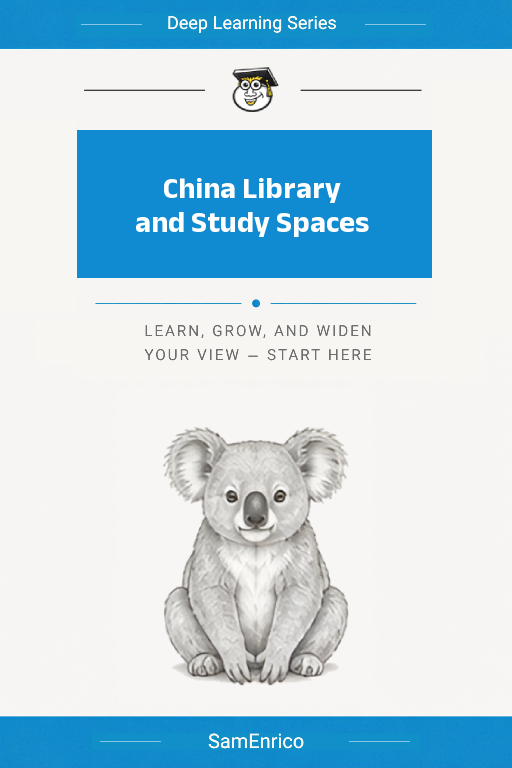
Non-FictionStudent's ShortcutStudy Facilities
China Library and Study Spaces eBook
Find 24-hour study rooms, library borrowing rights
by Penny Jay
Find 24-hour study rooms, library borrowing rights, and group study areas at Chinese universities.
Formats
Free sample
Chapter 1: The Silent Crisis...--–- In the autumn of 2024, a second-year engineering student at Shanghai's Tongji University named Chen Wei arrived at the main library at 6:00 AM to claim a seat for his postgraduate entrance exam preparation. He found seventy-three students already in line, many having camped since 4:30 AM with camping chairs and thermal mugs. By 7:15 AM, when the doors opened, every single one of the 2,400 seats across six floors was occupied. The latecomers—nearly two hundred of them—spent the next hour wandering between floors, peering over shoulders, checking the booking app obsessively for cancellations that rarely came. By 9:00 AM, most had surrendered, retreating to dormitory study lounges or off-campus coffee shops where a single latte cost as much as a week of cafeteria meals.This scene repeats itself daily across China's universities, from Peking University in the north to Sun Yat-sen University in the south, from the start of the semester to the bitter end of finals week.
The problem is not that Chinese students lack libraries. The problem is that the libraries they have were designed for a different era—an era when students borrowed books and returned home to study, when group projects meant a whispered conversation in a stairwell, when "24-hour study" meant pulling an all-nighter in your dorm room with a desk lamp and a pot of instant coffee.But China's higher education landscape has transformed so dramatically and so quickly that the very concept of what a library should be has become unmoored from what libraries actually are. Between 2000 and 2026, the number of university students in China nearly quadrupled, from roughly 5 million to over 45 million. The number of university libraries increased, but not nearly at the same rate. And the nature of studying itself changed: students no longer simply read and wrote; they collaborated on presentations, recorded podcasts, edited videos, held online meetings with international partners, and demanded round-the-clock access to spaces that felt safe, comfortable, and technologically equipped.This book is about that gap—the chasm between what Chinese university libraries currently offer and what students desperately need.
It is also about the extraordinary efforts underway to bridge that gap, from the "Space Reconstruction" movement sweeping through library science departments to the individual students who have learned to game booking systems, petition for 24-hour rooms, and build shadow libraries of scanned textbooks when course reserves fall short.Chapter 1 establishes the historical and theoretical context for everything that follows. We will examine how Chinese university libraries evolved from imperial collections to Mao-era repositories to today's contested spaces. We will introduce the two frameworks that guide modern library design: the EDUCAUSE Learning Space Rating System from the West and China's indigenous "空间再造" (Space Reconstruction) movement. We will analyze how national funding initiatives, particularly the "Double First Class" university construction project, have poured billions of renminbi into library renovations—and why that money has not always solved the right problems. Finally, we will frame the library not as a static repository of books but as a dynamic service platform that competes with coffee shops, dormitory lounges, and even students' own bedrooms for study time and attention.The Historical Arc: From Repository to Arena To understand where Chinese university libraries are going, we must first understand where they have been.
The library as an institution in China has undergone four distinct phases since the founding of the People's Republic in 1949, each leaving its mark on the buildings, policies, and assumptions that persist today.Phase One: The Soviet Model (1950-1966)In the early years of the PRC, China looked to the Soviet Union for educational models. University libraries were designed as centralized repositories of approved knowledge, with strict hierarchical access. Faculty had borrowing privileges; graduate students had limited access; undergraduates were often restricted to in-library use only. The physical layout reflected this hierarchy: faculty reading rooms on upper floors with comfortable chairs and natural light, undergraduate areas in basements with long communal tables and harsh fluorescent lighting. The cardinal sin was not overdue books but the mishandling of politically sensitive materials.
Libraries closed at 9:00 PM sharp, and the idea of overnight study was unheard of—students who needed to study late did so in their dormitories, which were segregated by gender and often housed eight to a room.Phase Two: The Cultural Revolution Interruption (1966-1976)During the Cultural Revolution, higher education in China effectively collapsed. Universities closed, libraries were shuttered or vandalized, and countless volumes were destroyed as "feudal remnants" or "bourgeois poison." The generation of students who should have entered university during these years did not. When universities reopened in 1977, they faced a catastrophic shortage of everything: classrooms, dormitories, faculty, and—crucially for our purposes—library collections. The libraries that remained were understaffed, underfunded, and often still operating under access policies from the 1950s. But something else had changed: the students of 1977 were older, more motivated, and far more demanding than their predecessors.
They had spent years in factories and fields, dreaming of the chance to study. They would not accept 9:00 PM closing times and basement tables.Phase Three: The Expansion Era (1978-2000)As China's economy liberalized and universities expanded, library construction boomed. Nearly every major university built a new central library or substantially renovated an existing one during this period. These buildings were grand, symbolic structures—often placed at the geographic center of campus, with imposing facades and monumental staircases. Inside, however, they remained largely traditional: open stacks replaced closed stacks in many cases, but the dominant model was still "browsing and borrowing." Study space was an afterthought, usually limited to a single reading room per floor with fixed seating.
The assumption, inherited from the Soviet model and never seriously questioned, was that students would do most of their studying elsewhere—in dormitories, classrooms, or department lounges.This assumption began to erode in the late 1990s, for three reasons. First, the expansion of university enrollment meant that dormitories became more crowded, not less; a typical undergraduate room in 1999 housed six to eight students, with each student allotted a desk the size of a laptop (which few yet owned). Second, the rise of the postgraduate entrance exam, or "kaoyan," created a new kind of student: one who needed months of sustained, distraction-free study. Dormitories, with their constant social interruptions and shared spaces, were impossible for this purpose. Third, the first wave of international students began arriving on Chinese campuses, bringing with them expectations of Western-style library amenities: group study rooms, extended hours, and comfortable seating.Phase Four: The Learning Hub (2000-Present)The 21st century has seen a radical reconceptualization of what a university library should be.
The term "learning hub" or "learning commons" entered Chinese library science vocabulary around 2010, borrowed from North American and European models. The core idea is simple but transformative: the library is no longer primarily about collections; it is primarily about users. Books are still important, but they are no longer the center of the library universe. Instead, the library becomes a platform for a wide range of academic activities: individual study, group collaboration, media production, data analysis, and even social interaction.This shift required physical changes that were far more expensive and politically difficult than university administrators anticipated. You cannot simply…
This is the end of the free sample. Get the eBook to keep going. Buy now
About this book
Details
- Author
- Penny Jay
- Publisher
- SamEnrico
- Language
- English
- Genre
- Non-Fiction, Student's Shortcut, Study Facilities
- Released
- 2026-05-30
- Pages (approx.)
- 154
- Available as
- eBook, Audiobook

Read better in the ZLOADR app
Your eBooks on your phone or tablet. Sign in with your SamEnrico account and start reading.
More by Penny Jay
 Double Depression Treatment GuidePenny Jay$11.99
 WeChat Moments Comparison CurePenny Jay$11.99
 Family Liaison in Executive Abduction GuidePenny Jay$11.99
 Congressional Ethics Rules GuidePenny Jay$11.99
 Gleason Score Interpretation ManualPenny Jay$11.99
 The Atlantic’s Silent Pioneers: How Cold War Submarines Launched AI’s First LeapPenny Jay$11.99
 Glitch in the System: The 2000 Election Night That Almost Broke AmericaPenny Jay$11.99
 Labor Strike Contingency PlanPenny Jay$12.99
 Understanding Congenital Herpes SimplexPenny Jay$17.99
 Principal Electrical EngineerPenny Jay$11.99
 How to Become a Cd-storage-and-materials Make-up HelperPenny Jay$11.99
You may also like
 Hong Kong Handover 1997Dunn Johnnie$11.99
 Zumba For Postnatal Recovery CourseNeal Christian$11.99
 Zumba for BeginnersLadner Nikia$11.99
 YouTube Comment Mining GuideHumes Pandora$12.99
 Worry Box MeditationCarlin Rudy$11.99
 Workplace Stress MeditationNguyen Lynn$11.99
 Workplace Stress and Sleep RepairHawley Ivory$11.99
 Workplace Perfectionism CureDelaney Jeffry$11.99
 Workplace Injustice Anger GuideWallen Isabelle$11.99
 Work Addiction and Burnout LinkGreenwood Ester$11.99
 Women in Yoga and WellnessBeattie Galina$11.99
 Women in Stand Up ComedyChun Evangeline$11.99