
Non-FictionForecast & OutlookExport Controls
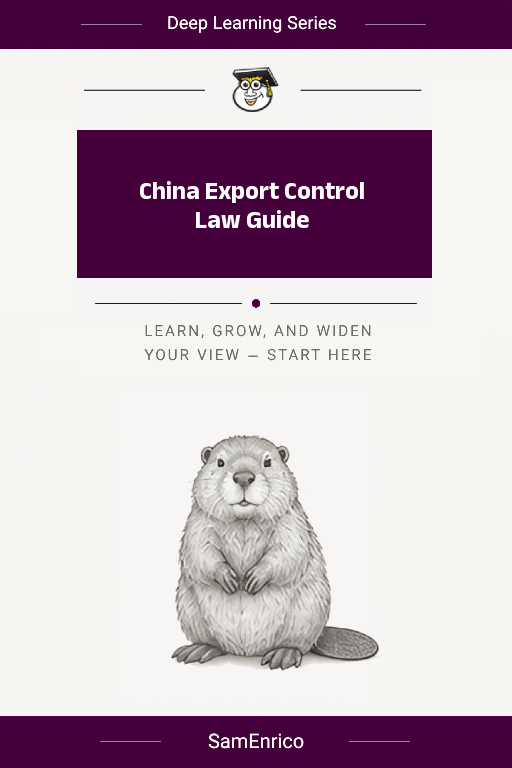
China Export Control Law Guide eBook
Discover dual-use item controls, cross-border tran
Discover dual-use item controls, cross-border transfer review, and countermeasures for foreign restrictions.
Formats
Free sample
Chapter 1: The Day Beijing Changed the Rules--On December 3, 2025, a mid-level civil servant in an unmarked office building west of Beijing’s Forbidden City pressed “send” on an internal memorandum that would become Announcement No. 62. Within seventy-two hours, three American defense contractors lost access to rare earth magnets critical for guided missile systems. A German automotive parts supplier halted production at two factories in Bavaria. A Japanese trading house received a summons to appear before a Chinese court in Shanghai.
And in boardrooms from Tokyo to Toronto, compliance officers who had never previously opened a Chinese legal text began asking the same question: what just happened?The answer was not a single event but the culmination of a five-year transformation that most Western executives had largely ignored. Between 2020 and 2025, China dismantled a fragmented, reactive, and administratively obscure export control system and replaced it with something entirely new: a unified, proactive, and aggressively extraterritorial legal regime designed to protect Chinese supply chain security and retaliate against foreign sanctions. Announcement No. 62 was merely the public face of a deeper structural shift that had been underway since the Export Control Law of 2020 first appeared in the National People’s Congress Gazette.This chapter tells the story of that transformation. It traces how China moved from a patchwork of sector-specific regulations to a cohesive legal framework that now rivals the United States’ Export Administration Regulations in complexity and reach.
It explains why Beijing pivoted from passive rule-taker to active rule-maker in global trade governance. And it sets the foundation for every subsequent chapter by answering the most important question any compliance professional faces: why should I care about Chinese export controls today, when I did not need to five years ago?The short answer is that the rules of the game have changed permanently. The longer answer requires understanding the pre-2020 chaos, the 2020 turning point, the 2021 counter-sanctions architecture, and the 2024-2025 operationalization that made extraterritorial enforcement real. By the end of this chapter, readers will recognize that China’s export control regime is no longer a peripheral concern for multinational compliance—it is a primary sovereign regulator whose rules demand the same attention as those from Washington and Brussels.The Pre-2020 Landscape: A System Waiting for a Shock Before 2020, China’s export controls resembled a medieval wall built by multiple contractors who never spoke to one another. Separate legal instruments governed nuclear items, missile technology, chemical weapons precursors, biological agents, and conventional military equipment.
Each regime operated under different ministries, different licensing procedures, and different enforcement philosophies. The Ministry of Commerce handled dual-use items. The China Atomic Energy Authority controlled nuclear exports. The Ministry of Industry and Information Technology supervised certain advanced technologies. And the State Administration of Science, Technology and Industry for National Defense managed military-specific transfers.The result was a system that foreign companies could navigate only with difficulty and domestic companies often ignored entirely.
Transparency was minimal. Published lists of controlled items existed but were frequently outdated. Licensing timelines varied unpredictably. Enforcement was rare and, when it occurred, inconsistent. A 2018 study by the Stockholm International Peace Research Institute noted that China had prosecuted fewer than a dozen export control violations in two decades, compared to hundreds annually in the United States.This fragmentation was not accidental.
It reflected China’s historical posture as a rule-taker rather than a rule-maker in global trade. For decades, Beijing’s priority was access to foreign markets and technology, not controlling outbound flows. Export controls were viewed primarily as non-proliferation obligations to be minimally satisfied, not strategic tools to be actively wielded. When the United States imposed sanctions on Chinese companies like ZTE and Huawei in the late 2010s, Beijing’s initial response was diplomatic protest, not legal countermeasure.But the trade wars of 2018-2020 changed everything. The Trump administration’s tariffs, entity list designations, and extraterritorial enforcement of US export controls on Chinese technology companies demonstrated something that Beijing had not fully appreciated: export controls could be used as weapons of economic statecraft.
The US model—the Foreign Direct Product rule, the de minimis threshold, the entity lists, the extraterritorial reach—was not merely a regulatory framework. It was a battle plan for technology decoupling.China’s leadership concluded that passive reliance on WTO dispute resolution was insufficient. If the United States could use its export control regime to strangle Chinese technology companies, China needed its own regime to retaliate, deter, and protect. The Export Control Law of 2020 was the first answer to that strategic imperative.The Export Control Law of 2020: The Unifying Framework The Export Control Law (ECL), effective December 1, 2020, was not a technical amendment to existing regulations. It was a constitutional document for a new legal order.
At forty-nine articles spanning six chapters, the ECL established unified legal authority over all exports of controlled items from China, regardless of whether those items were dual-use, military, nuclear, missile-related, or otherwise sensitive.Three features of the ECL fundamentally changed the compliance landscape. First, the law defined “export” broadly to include not only physical shipment from Chinese territory but also the provision of controlled items to foreign entities anywhere—including within China. This “deemed export” concept, which would be significantly expanded in 2025 as detailed in Chapter 4, meant that showing a foreign engineer a controlled manufacturing process or sharing technical specifications via email could constitute an export requiring a license.Second, the ECL asserted extraterritorial jurisdiction. Article 44 stated that the law applied to acts outside China that harmed Chinese national security or interests. This was deliberately ambiguous—it provided the legal authority for extraterritorial enforcement without specifying the precise mechanisms.
As clarified in Chapter 5 of this book, the specific mechanisms (the Foreign Direct Product rule and the 0.1% de minimis threshold) would later be detailed in the 2024 Dual-Use Regulation. But the 2020 law made clear that China would no longer limit its control to items physically leaving its borders.Third, the ECL established a unified licensing system. No longer would companies navigate multiple ministries with overlapping jurisdiction. The Ministry of Commerce (MOFCOM) became the central licensing authority for dual-use items, with its Bureau of Industry, Security, Export Control (BISIEC) serving as the primary point of contact. The law also introduced mandatory Internal Compliance Programs (ICPs) for exporters of controlled items, a requirement that would be fleshed out in subsequent regulations and is covered in depth in Chapter 8.Despite these groundbreaking provisions, the ECL of 2020 was not immediately operational.
It was an enabling statute, not a self-executing regulation. The specific rules—the lists of controlled items, the licensing procedures, the extraterritorial enforcement mechanisms—would come later. For two years, the law sat largely dormant as Chinese regulators drafted implementing regulations and foreign companies waited to see whether Beijing would enforce its new authority.The Anti-Foreign Sanctions Law of 2021: The Counterattack If the ECL was China’s shield, the Anti-Foreign Sanctions Law of June 2021 was its sword. Enacted in response to US and EU sanctions over Xinjiang, Hong Kong, and technology competition, this short but powerful law gave China the legal machinery to retaliate directly against foreign sanctions.The law’s core mechanism is simple but devastating: when a foreign country imposes sanctions on Chinese entities or individuals, MOFCOM can issue a “blocking order” prohibiting Chinese…
This is the end of the free sample. Get the eBook to keep going. Buy now
About this book
Details
- Author
- Petersen Shantelle
- Publisher
- SamEnrico
- Language
- English
- Genre
- Non-Fiction, Forecast & Outlook, Export Controls
- Released
- 2026-05-29
- Pages (approx.)
- 147
- Available as
- eBook, Audiobook

Read better in the ZLOADR app
Your eBooks on your phone or tablet. Sign in with your SamEnrico account and start reading.
More by Petersen Shantelle
 Purpose Rediscovery After Burnout GuidePetersen Shantelle$11.99
 Nose Shape Self Esteem WorkbookPetersen Shantelle$11.99
 Hawks Professional CodePetersen Shantelle$11.99
 Early Rising Child SolutionsPetersen Shantelle$11.99
 Apologizing Effectively in Hard TalksPetersen Shantelle$11.99
 The Shadow of the Hangman: Japan's Post-War Copycat KillingsPetersen Shantelle$11.99
 Surgical Physician AssistantPetersen Shantelle$11.99
 Understanding Merkle TumorsPetersen Shantelle$17.99
 Job To Be Done Prompt TemplatesPetersen Shantelle$12.99
 How to Start a Spring (Light Gauge) Manufacturing BusinessPetersen Shantelle$11.99
You may also like
 Hong Kong Handover 1997Dunn Johnnie$11.99
 Zumba For Postnatal Recovery CourseNeal Christian$11.99
 Zumba for BeginnersLadner Nikia$11.99
 YouTube Comment Mining GuideHumes Pandora$12.99
 Worry Box MeditationCarlin Rudy$11.99
 Workplace Stress MeditationNguyen Lynn$11.99
 Workplace Stress and Sleep RepairHawley Ivory$11.99
 Workplace Perfectionism CureDelaney Jeffry$11.99
 Workplace Injustice Anger GuideWallen Isabelle$11.99
 Work Addiction and Burnout LinkGreenwood Ester$11.99
 Women in Yoga and WellnessBeattie Galina$11.99
 Women in Stand Up ComedyChun Evangeline$11.99