
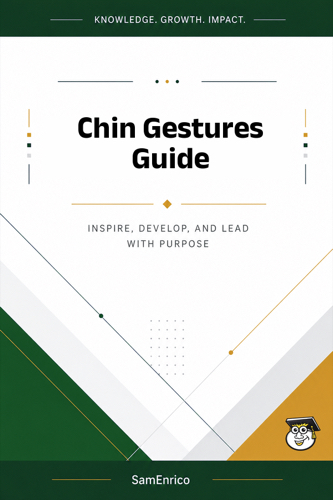
Non-FictionSelf-HelpChinEvaluation
Chin Gestures Guide eBook
Read chin resting, stroking, or jutting for evalua
by Zarate Dara
Read chin resting, stroking, or jutting for evaluation or defiance.
Formats
Free sample
Chapter 1: The Seven-Millisecond Tell--–- Your chin has already betrayed you three times today. You didn't notice. Neither did the person sitting across from you. But the betrayal happened nonetheless—a subtle tightening of the jaw when your boss mentioned the “new opportunity,” a micro-stroke of your chin when your partner asked if you were really fine, a barely perceptible jut when the stranger in the elevator took too long to exit. These movements lasted less than the time it takes a hummingbird to beat its wings once.
And yet they spoke volumes about your true feelings—feelings your mouth would never dare utter.This is not speculation. This is neurology.The human chin is the most expressive, most overlooked, and most truthful part of the body. Unlike your words, which pass through the editorial filter of your prefrontal cortex, your chin operates on a faster circuit. It answers to the limbic system—the ancient, reptilian core of your brain that prioritizes survival over social grace. When you feel threatened, your jaw clenches before you know why.
When you feel curious, your chin tilts forward before you decide to listen. When you feel defiant, your chin juts out like the prow of a warship before your conscious mind has even registered the provocation.This book is about those moments. It is about the seven milliseconds between a feeling and its expression—a window so narrow that most people never see it, yet so revealing that those who learn to watch it gain an almost supernatural ability to read the room, close the deal, spot the lie, and defuse the conflict.But before we can decode the chin's language, we must understand why the chin speaks at all. And that story begins not in a psychology lab, but on the African savanna, two million years ago, where our ancestors learned a terrible lesson about vulnerability.The Evolutionary Bargain The human chin is a biological anomaly. No other primate has one.
Gorillas have sloping lower jaws. Chimpanzees have receding mandibles. Neanderthals had robust jaws but no distinct chin projection. Only Homo sapiens possesses that bony prominence at the bottom of the face—a triangular ridge of bone that serves no obvious mechanical purpose. You don't need a chin to chew, to speak, or to breathe.
And yet, every human being on every continent has one.For decades, anthropologists debated the chin's purpose. Some theorized it evolved to withstand chewing stress. Others suggested it emerged as a secondary sexual characteristic, like a peacock's tail. The leading theory today is more surprising: the chin evolved as a social signal—a billboard for the emotions brewing inside the skull behind it.Consider what happens when you clench your jaw. The masseter muscles, which attach from your cheekbones to the angles of your lower jaw, bulge visibly.
When you jut your chin forward, the mentalis muscle (the one that allows you to pout) contracts, pushing the lower lip up and creating a distinct projection. When you pull your chin back, the platysma muscle—a broad sheet that runs from your collarbone to your jaw—stretches, creating horizontal neck bands. Each of these movements is visible from across a room. Each one announces your internal state to anyone who knows how to look.The chin, in other words, is not a vestigial leftover of evolution. It is a communication device—one so effective that natural selection preserved it in every human population on Earth.But the chin's evolutionary story has a darker chapter.
The chin is also the face's most vulnerable point. A direct strike to the chin transmits force directly to the brainstem, causing immediate loss of consciousness. Boxers know this. Bouncers know this. And your reptilian brain knows this instinctively.
Which creates a fascinating paradox: the chin is simultaneously a broadcast tower for emotion and a glass jaw. Every time you expose your chin by tilting your head back, you are performing an act of trust. Every time you tuck your chin, you are performing an act of self-protection.This duality—the chin as both signal and vulnerability—is the key to understanding every gesture in this book. When you see someone's chin move, you are watching a negotiation between two ancient imperatives: the need to communicate and the need to survive.The Three Brains Theory To understand why chin movements are so truthful—and so fast—you need a basic map of the human brain. Neuroscientists often describe the brain as three distinct structures layered atop one another, like a house built on an older foundation.
This model, sometimes called the "Triune Brain," was popularized by physician and neuroscientist Paul Mac Lean in the 1960s. While modern neuroscience has refined the details, the model remains invaluable for understanding nonverbal behavior.The Reptilian Brain. At the core of your skull sits the brainstem and cerebellum—structures we share with lizards, snakes, and birds. This ancient system governs survival: heart rate, breathing, body temperature, and the fight-or-flight response. It does not think.
It does not feel. It reacts. When a sudden noise makes you flinch, that's your reptilian brain. When your jaw clenches before you know you're angry, that's also your reptilian brain. This system operates in milliseconds.
It is faster than thought, faster than feeling, and—crucially for our purposes—faster than your ability to hide your true reactions.The Limbic System. Wrapped around the reptilian brain is the limbic system—the seat of emotion, memory, and social bonding. This is where fear, pleasure, anger, and affection originate. The limbic system includes the amygdala (which processes threats), the hippocampus (which stores memories of past dangers and rewards), and the hypothalamus (which regulates emotional responses). When you stroke your chin because a thought feels satisfying, that's the limbic system driving a comfort-seeking behavior.
When you pull your chin back because someone made you feel small, that's the limbic system activating a protection reflex. The limbic system operates in tenths of a second—slightly slower than the reptilian brain, but still far faster than conscious thought.The Neocortex. The outermost layer of the brain—the wrinkled gray matter that makes humans unique—is the neocortex. This is the thinking brain. Language, planning, abstract reasoning, and self-control all live here.
When you decide to hide your anger with a smile, that's your neocortex overriding your limbic system. When you consciously relax your jaw to appear calm, that's your neocortex at work. The neocortex is powerful, but it is slow. It operates in seconds—an eternity compared to the reptilian brain and the limbic system.Here is the critical insight that every body language book relies upon: information flows from the bottom up, but not from the top down. Your reptilian brain reacts instantly.
Your limbic system adds emotional flavor a fraction of a second later. Your neocortex becomes aware of the reaction after the fact—and then attempts to manage it, mask it, or explain it away. But the damage is already done. The chin has already moved. The truth has already leaked.This is why people cannot simply "control" their body language.
By the time you decide to hide your feelings, the feelings have already announced themselves. You might as well try…
This is the end of the free sample. Get the eBook to keep going. Buy now
About this book
Details
- Author
- Zarate Dara
- Publisher
- SamEnrico
- Language
- English
- Genre
- Non-Fiction, Self-Help, Chin, Evaluation
- Released
- 2026-06-09
- Pages (approx.)
- 145
- Available as
- eBook, Audiobook

Read better in the ZLOADR app
Your eBooks on your phone or tablet. Sign in with your SamEnrico account and start reading.
More by Zarate Dara
 Shop Window Sticker AdsZarate Dara$11.99
 Nicotine Pouches Cessation GuideZarate Dara$11.99
 Canva Brand Identity for ArtistsZarate Dara$11.99
 The Last Masterpiece: The Unseen Works of Jean-Michel BasquiatZarate Dara$11.99
 Learn to Play the TarogatoZarate Dara$11.99
 Fichtelite MiningZarate Dara$11.99
 AI Candidate Summary GenerationZarate Dara$12.99
 How to Start a Banquet Catering Business (Beginners Guide)Zarate Dara$11.99
You may also like
 Hong Kong Handover 1997Dunn Johnnie$11.99
 Zumba For Postnatal Recovery CourseNeal Christian$11.99
 Zumba for BeginnersLadner Nikia$11.99
 YouTube Comment Mining GuideHumes Pandora$12.99
 Worry Box MeditationCarlin Rudy$11.99
 Workplace Stress MeditationNguyen Lynn$11.99
 Workplace Stress and Sleep RepairHawley Ivory$11.99
 Workplace Perfectionism CureDelaney Jeffry$11.99
 Workplace Injustice Anger GuideWallen Isabelle$11.99
 Work Addiction and Burnout LinkGreenwood Ester$11.99
 Women in Yoga and WellnessBeattie Galina$11.99
 Women in Stand Up ComedyChun Evangeline$11.99