
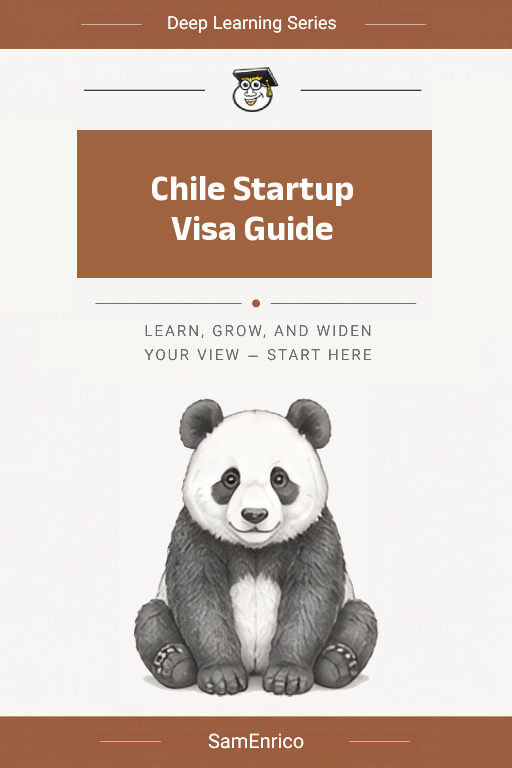
Non-FictionStartup GuideFounder Immigration
Chile Startup Visa Guide eBook
Apply for Chile Startup Visa under Start-Up Chile
by Cano Arvilla
Apply for Chile Startup Visa under Start-Up Chile program. Equity-free funding and one-year residence.
Formats
Free sample
Chapter 1: The Earthquake Advantage--The 8.8-magnitude earthquake that struck Chile on February 27, 2010, lasted just three minutes. It killed 525 people, displaced 1.5 million, and caused an estimated $30 billion in damages. But from the rubble of collapsed buildings and tsunami-swept coastal towns emerged something unexpected: a nation’s realization that its greatest resource was not copper, wine, or salmon—but human ingenuity.In the weeks following the disaster, as international aid poured in and rescue workers pulled survivors from debris, a quieter reckoning was taking place inside Chile’s economic ministries. For decades, the country had relied on a simple formula: extract natural resources, export them, and enjoy the stability that came with being Latin America’s most predictable economy. But the earthquake exposed a deeper structural fragility.
Chile was a consumer of innovation, not a producer of it. Its brightest graduates left for Silicon Valley, Barcelona, or Berlin. Its venture capital market was virtually nonexistent. And its economy, while stable, lacked the dynamism to generate the next generation of high-growth companies.The government’s response was characteristically Chilean: pragmatic, data-driven, and unafraid of radical experimentation. In early 2011, less than a year after the earthquake, they launched a program called Start-Up Chile (SUP).
The premise was audacious. They would invite 200 foreign entrepreneurs to Santiago, give them $40,000 each in equity-free funding, provide a one-year work visa, and ask for almost nothing in return—except that they stay, build, and share their knowledge with the local ecosystem.Critics called it madness. Why would Chile give away money to foreigners? What was the return on investment? And how could a small South American nation compete with the gravitational pull of Silicon Valley?Twelve years, 2,500 startups, and one Harvard Business School case study later, the answers are clear.
Start-Up Chile has generated an estimated 50millioninannualeconomicimpactforthecountry.Alumnihavegoneontoraiseover50 million in annual economic impact for the country. Alumni have gone on to raise over 50millioninannualeconomicimpactforthecountry.Alumnihavegoneontoraiseover1 billion in follow-on funding. Unicorns like Not Co (plant-based food, valuation 1.5billion)and Buk(HRsoftware,1.5 billion) and Buk (HR software, 1.5billion)and Buk(HRsoftware,1 billion+) credit the program as their launchpad. And the once-desperate need for foreign innovation has transformed into a self-sustaining ecosystem with dozens of local venture capital firms, accelerators, and thousands of trained founders.But here is what most applicants never understand until it is too late: Chile is not writing charity checks. The 15,000to15,000 to 15,000to100,000 grant you are applying for is not free money.
It is an investment. And like any sophisticated investor, Chile expects a return.The Mutual Value Proposition Before you submit a single document, record a one-minute video, or book a flight to Santiago, you must internalize one truth. You are not doing Chile a favor by applying to this program. And Chile is not doing you a favor by accepting you. You are entering a business partnership.The Chilean government has calculated the economics of Start-Up Chile with precision.
Every foreign founder who relocates to Santiago spends money on rent, food, transportation, and entertainment. That spending injects capital into the local economy. Every local hire you make adds a salaried worker to Chile’s tax base. Every workshop you teach, every talk you give, every startup you mentor increases the technical and entrepreneurial capacity of the local workforce. And every successful company that uses Chile as a regional headquarters creates a permanent economic asset that pays taxes, employs people, and generates exports for years after the program ends.This is not charity.
It is venture capital at a national scale.The Harvard Business School case study on Start-Up Chile, written by Professor Karim Lakhani and published in 2015, quantified this dynamic. The study found that for every dollar Chile invested in the program, the country received approximately 1.50to1.50 to 1.50to2.00 in direct economic returns—a 50 to 100 percent return on investment. But the indirect returns, the study noted, were even larger. The alumni network alone has generated hundreds of millions of dollars in follow-on funding, much of which flows through Chilean banks and legal systems. The knowledge transfer from foreign founders to local entrepreneurs has compressed what would have been decades of ecosystem development into a single decade.So when you read the program materials and see phrases like "contribute to the local ecosystem" or "demonstrate impact in Chile," do not treat them as bureaucratic filler.
They are the core of the value exchange. Chile is not asking for equity in your company. It is asking for something potentially more valuable: your time, your expertise, and your willingness to build from its soil.The 2010 Earthquake as a Metaphor The earthquake story is not just a colorful origin tale. It is a metaphor for the mindset that successful applicants bring to the program.Chileans are pragmatists. They have survived military dictatorships, hyperinflation, natural disasters, and the boom-and-bust cycles of commodity dependence.
They do not romanticize failure the way Silicon Valley does, but they respect resilience. The founders who thrive in Start-Up Chile are not the ones with the most polished pitch decks or the most impressive pedigrees. They are the ones who show up, adapt, and execute despite obstacles.Sebastián, the pseudonym of a founder I interviewed for this book, learned this lesson the hard way. He applied to Start-Up Chile twice and was rejected both times. His startup—a machine learning platform for agricultural supply chains—was technically sophisticated.
His team had pedigrees from Stanford and Google. But his applications read like someone who saw Chile as a pit stop on the way to Miami or New York. He described the country as "a convenient location" and his impact as "potential future hiring."After the second rejection, Sebastián did something unexpected. He booked a flight to Santiago on a tourist visa, rented a desk at a co-working space in the Bellas Artes neighborhood, and spent three months attending every Start-Up Chile event he could find. He did not pitch his startup.
He asked questions. He offered to help other founders debug their code. He learned Spanish—not enough to be fluent, but enough to order coffee and make small talk with local entrepreneurs.When he applied a third time, his application was different. He did not just describe his startup’s technical complexity. He named specific Chilean farmers who had agreed to pilot his platform.
He did not just promise future hiring. He listed the names of three Chilean developers who had already agreed to join his team if he was accepted. And when the evaluators asked him in the live interview why he wanted to come to Chile, he answered: "Because I already have. And I want to stay."He was accepted two weeks later.The earthquake metaphor runs deeper than resilience, however. It also speaks to opportunity creation.
The 2010 earthquake destroyed thousands of buildings, but it also created a massive reconstruction boom. Engineers, architects, and construction firms flooded into Chile from around the world. New technologies were deployed. New companies were formed. The disaster, in other words, did not just cause destruction.
It created space for innovation.The same dynamic applies to Start-Up Chile. The program was born from a crisis of confidence—Chile’s realization that it could not rely on natural resources forever. That crisis…
This is the end of the free sample. Get the eBook to keep going. Buy now
About this book
Details
- Author
- Cano Arvilla
- Publisher
- SamEnrico
- Language
- English
- Genre
- Non-Fiction, Startup Guide, Founder Immigration
- Released
- 2026-05-30
- Pages (approx.)
- 139
- Available as
- eBook, Audiobook

Read better in the ZLOADR app
Your eBooks on your phone or tablet. Sign in with your SamEnrico account and start reading.
More by Cano Arvilla
 Legacy Of Resilience WorkbookCano Arvilla$11.99
 The Construction Site ConnectionCano Arvilla$11.99
 Cyber Monday Compulsion CureCano Arvilla$11.99
 Scott Peterson Letters from PrisonCano Arvilla$11.99
 The Emotion Vocabulary Builder GuideCano Arvilla$11.99
 The Bloodlands: The Thirty Years' War's Crucible of EuropeCano Arvilla$11.99
 Packaging Machine OperatorCano Arvilla$11.99
 Factoring Notification GuideCano Arvilla$12.99
 Understanding Viljoen–smart SyndromeCano Arvilla$17.99
 How to Start a Nickel Business (Beginners Guide)Cano Arvilla$11.99
You may also like
 Hong Kong Handover 1997Dunn Johnnie$11.99
 Zumba For Postnatal Recovery CourseNeal Christian$11.99
 Zumba for BeginnersLadner Nikia$11.99
 YouTube Comment Mining GuideHumes Pandora$12.99
 Worry Box MeditationCarlin Rudy$11.99
 Workplace Stress MeditationNguyen Lynn$11.99
 Workplace Stress and Sleep RepairHawley Ivory$11.99
 Workplace Perfectionism CureDelaney Jeffry$11.99
 Workplace Injustice Anger GuideWallen Isabelle$11.99
 Work Addiction and Burnout LinkGreenwood Ester$11.99
 Women in Yoga and WellnessBeattie Galina$11.99
 Women in Stand Up ComedyChun Evangeline$11.99