
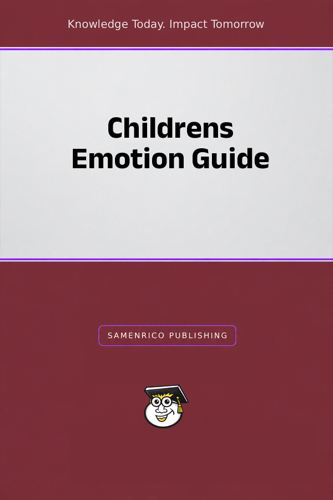
Childrens Emotion Guide eBook
undefined
undefined
Formats
Free sample
Chapter 1: The Puppy and the Owl...--It was a Tuesday afternoon, and four-year-old Mia had just spent twenty minutes building a castle out of wooden blocks. She had balanced the blue tower on top of the red arch, placed the yellow triangle like a flag, and was reaching for the final piece—a tiny green rectangle that would become the drawbridge. Her hand was two inches away when her little brother Leo crawled across the rug, swung his chubby arm, and sent the entire castle crashing into a pile of scattered wood.Mia’s face turned red. Her hands curled into fists. Her mouth opened, and a sound came out that was somewhere between a scream and a sob.
Her mother rushed over and said the words that parents have said for generations: “Don’t be angry. It was an accident. Use your words.”But Mia did not have words. She had heat in her face, tightness in her hands, and a feeling like a balloon inflating inside her chest. She did not know what to call that balloon.
She did not know what to do with it. So she screamed again, and then she cried, and then she felt bad about screaming and crying, and then she felt even worse because she could not explain why she felt bad in the first place.This is not a story about a difficult child. This is a story about a child who had not yet met her Puppy Brain or her Owl Brain. And this chapter is where that meeting happens.The Problem With "Use Your Words"When adults tell a child to “use your words,” they assume three things that are almost never true in the middle of a meltdown. First, they assume the child has words for what they are feeling.
Second, they assume the child can access those words when their body is flooded with heat and tension. Third, they assume the child knows what to do with the feeling once they name it.Let us examine each assumption carefully, because the gap between what adults assume and what children actually experience is the single greatest source of frustration in parenting.Most four-year-olds have an emotional vocabulary of approximately eight words. They know happy, sad, angry, scared, tired, hungry, silly, and maybe “frustrated” if they have been taught it. But anger is not one thing. There is the anger of injustice (Leo knocked down my castle on purpose, even if Mom says it was an accident).
There is the anger of loss (the castle took twenty minutes and now it is gone forever). There is the anger of powerlessness (I cannot hit Leo back because Mom is watching). There is the anger of exhaustion (I did not nap today and everything feels harder). And there is the anger of shame (I screamed and now I feel embarrassed). Each of these angers feels different in the body.
Each requires a different response. But if the only word a child has is “angry,” they cannot tell you which one is happening. They cannot tell themselves which one is happening. The balloon inflates, and they have no way to describe its shape or color or size.The second assumption is even more problematic. When a child’s body enters a state of high emotional arousal, the prefrontal cortex—the part of the brain responsible for language, logic, and self-control—literally goes offline.
This is not a metaphor. It is a neurological fact. The amygdala, which detects threats, hijacks the brain’s resources. Blood flow shifts away from the “thinking centers” and toward the “survival centers.” In plain language: when a child is at a 7, 8, or 9 on the emotion scale, they cannot access their words because the part of the brain that holds words has temporarily powered down. Telling a screaming child to “use your words” is like telling someone who just broke their leg to “use your running skills.” The equipment is not available.The third assumption is the most overlooked.
Even if a child can name the feeling—even if they can say “I am angry” in a calm voice—they still need to know what to do next. Naming a feeling is not the same as regulating a feeling. You can say “I am angry” and still hit your brother. You can say “I am scared” and still refuse to go to bed. The name is the beginning, not the end.
What children need is a bridge from the name to an action that helps. That bridge is what this entire book builds, one chapter at a time.But before we build bridges, we need to understand the two creatures who live inside every child’s brain. Let us meet them properly.Meet Your Puppy Brain Imagine a golden retriever puppy. Not the calm, well-trained dog who sits and stays on command. Imagine the puppy at eight weeks old.
This puppy has enormous paws, floppy ears, and absolutely no impulse control. When the puppy is happy, it wags its whole body and jumps on everyone. When the puppy is scared, it hides under the couch and pees on the rug. When the puppy is excited, it chases its tail in circles until it falls over dizzy. When the puppy is frustrated, it chews the nearest shoe.The puppy does not plan.
The puppy does not reflect. The puppy does not ask “Is this a good idea?” The puppy simply reacts. Reacting is the puppy’s superpower and its greatest weakness. Reacting keeps the puppy safe from immediate danger. Reacting also gets the puppy into trouble constantly.Your child’s Puppy Brain is exactly like that golden retriever.
It is fast, impulsive, emotional, and honest to a fault. When the Puppy Brain sees something unfair, it shouts. When the Puppy Brain feels scared, it runs. When the Puppy Brain wants something, it grabs. The Puppy Brain does not care about tomorrow.
It does not care about consequences. It cares about right now.Here is the most important thing to understand about the Puppy Brain: it is not bad. It is not broken. It is not a mistake. The Puppy Brain evolved to keep humans alive.
If a saber-toothed tiger jumped out of the bushes, you did not want a slow, reflective brain that said, “Hmm, let me consider the potential outcomes of this encounter.” You wanted a fast, reactive brain that screamed, ran, and survived. The Puppy Brain is excellent at survival. It is terrible at friendship, patience, and long-term planning.The problem is that your child’s Puppy Brain is fully online from birth. It is ready to react to everything. The Owl Brain, on the other hand, takes decades to mature.Meet Your Owl Brain Now imagine a great horned owl.
This owl sits in a tree, watching the forest below. The owl does not chase squirrels. The owl waits. The owl observes. The owl notices patterns.
The owl asks questions: “Is that movement a mouse or a leaf? Is that sound a threat or the wind? Should I fly now or wait for better conditions?”The owl is slow, but slowness is the point. The owl pauses before…
This is the end of the free sample. Get the eBook to keep going. Buy now
About this book
Details
- Author
- Pierce Rolando
- Publisher
- SamEnrico
- Language
- English
- Genre
- Non-Fiction, Self-Help
- Released
- 2026-06-08
- Pages (approx.)
- 128
- Available as
- eBook, Audiobook

Read better in the ZLOADR app
Your eBooks on your phone or tablet. Sign in with your SamEnrico account and start reading.
More by Pierce Rolando
 5 HTP Sleep GuidePierce Rolando$11.99
 Migraine Diary and Tracking App GuidePierce Rolando$11.99
 The Empathetic Assertiveness GuidePierce Rolando$11.99
 Eisenhower For Project ManagersPierce Rolando$11.99
 Mangal Pandey Trigger GuidePierce Rolando$11.99
 Trauma Informed Parent AngerPierce Rolando$11.99
 Depression Posture SignalsPierce Rolando$11.99
 Acne Scar Self-Esteem GuidePierce Rolando$11.99
 The Last Transmission: The Titanic’s Unsung HeroPierce Rolando$11.99
 The Maestro's Market: Handel’s Royal MonopolyPierce Rolando$11.99
 Whispers of the Dreaming Sands: The Lost Sleep Temples of the SaharaPierce Rolando$11.99
 The Mineral Guide to PalygorskitePierce Rolando$11.99
You may also like
 Hong Kong Handover 1997Dunn Johnnie$11.99
 Zumba For Postnatal Recovery CourseNeal Christian$11.99
 Zumba for BeginnersLadner Nikia$11.99
 YouTube Comment Mining GuideHumes Pandora$12.99
 Worry Box MeditationCarlin Rudy$11.99
 Workplace Stress MeditationNguyen Lynn$11.99
 Workplace Stress and Sleep RepairHawley Ivory$11.99
 Workplace Perfectionism CureDelaney Jeffry$11.99
 Workplace Injustice Anger GuideWallen Isabelle$11.99
 Work Addiction and Burnout LinkGreenwood Ester$11.99
 Women in Yoga and WellnessBeattie Galina$11.99
 Women in Stand Up ComedyChun Evangeline$11.99