

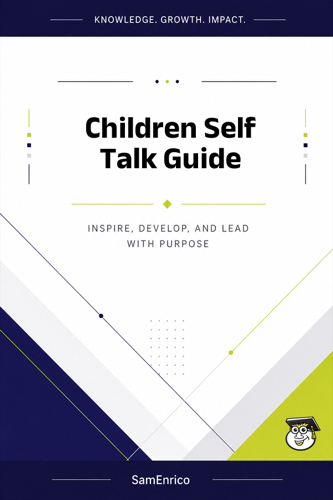
Children Self Talk Guide eBook
Teaches parents to model and teach healthy inner d
Teaches parents to model and teach healthy inner dialogue to kids.
Formats
Free sample
Chapter 1: The Gardeners Among Us--–- The voice that lives inside your child’s head is not born cruel. It is made.Before your child could speak a single word out loud, they were already listening. They listened to the sigh you let out when you burned the toast. They listened to the way you said “I can’t believe I did that again” under your breath. They listened to the pause you took before answering “How was your day?”—and they learned that some feelings are too heavy for words.By the time a child strings together their first sentence, they have already internalized hundreds of hours of emotional data.
Not lectures. Not lessons. Just the quiet, ambient soundtrack of the adults around them reacting to their own mistakes, frustrations, and disappointments. That soundtrack becomes the raw material for the child’s inner voice.And here is the truth that most parenting books will not tell you: that inner voice will speak to your child for the rest of their life. It will speak to them during job interviews, breakups, sleepless nights, and moments of profound doubt.
It will either whisper, “You’ve got this,” or it will hiss, “You never get anything right.”You do not get to choose which voice wins by accident. You choose it by design—or it gets chosen for you by default.This chapter is about understanding the architecture of that inner voice. Not the psychology jargon. Not the abstract theory. The actual, mechanical, daily way that self-talk gets built, brick by brick, inside a developing brain.
And more importantly, what you can do starting tonight to ensure those bricks are laid in the right direction.The Silent Blueprint: How Self-Talk Actually Forms Let us start with a story about two children.Leo is six years old. He is trying to tie his shoes before kindergarten. His fingers fumble. The laces twist. After thirty seconds, he looks at the floor and says, “I can’t do this.
I’m bad at everything.” His mother overhears him and feels a strange chill. She has heard those exact words before—from her own mouth, last week, when she couldn’t figure out how to assemble a bookshelf.Maya is also six years old. She is trying to tie her shoes. Her fingers fumble. The laces twist.
After thirty seconds, she looks at the floor and says, “This is hard. I need to try a different way.” Her father overhears her and smiles. He has heard those exact words before—from his own mouth, yesterday, when he got stuck on a work problem and said, “That didn’t work. What else could I try?”Same age. Same task.
Same fumbling fingers. Radically different inner monologues.The difference is not temperament. It is not genetics. It is not even the quality of parenting in the abstract sense. The difference is modeling—the invisible curriculum of self-talk that children absorb before they have any idea they are even in school.Neuroscience has a name for this process.
It is called observational conditioning, and it works like this: the human brain contains specialized neurons called mirror neurons. When a child watches an adult perform an action or express an emotion, the child’s brain fires in the same pattern as if they were performing that action or feeling that emotion themselves. This is why babies yawn when their parents yawn. It is also why children adopt their parents’ self-talk patterns without ever being explicitly taught.In other words, your child is not learning self-talk from the words you say to them. They are learning self-talk from the words they overhear you say to yourself.This is both terrifying and liberating.
Terrifying because it means your most unguarded moments are the most powerful teaching moments. Liberating because it means you have far more control than you think—not by being perfect, but by being intentional about the voice you model.The Neuroplasticity Promise: Why It Is Never Too Late (But Earlier Is Better)There is a word that sounds intimidating but describes something remarkably hopeful: neuroplasticity.Neuroplasticity is the brain’s ability to reorganize itself by forming new neural connections throughout life. Every time a thought is repeated, the corresponding neural pathway grows stronger, like a walking trail through a forest. The first time someone walks through tall grass, there is barely a trace. The hundredth time, there is a clear path.
The thousandth time, it becomes a dirt road. Eventually, it becomes the default route.Here is what this means for your child’s inner voice. The first time your child says “I can’t do this,” a very faint neural pathway is created. The tenth time, that pathway becomes easier to travel. The hundredth time, it becomes the brain’s automatic route—the path of least resistance.
The child no longer chooses to think “I can’t do this.” The thought simply arrives.But here is the hopeful part. Neuroplasticity works in both directions. Every time your child says “I can’t do this… yet,” they are simultaneously weakening the old pathway and strengthening a new one. It is like choosing to walk a different route through the forest. The old path grows over with weeds.
The new path becomes clearer with every step.Research from the field of developmental cognitive neuroscience shows that the most intense period of neuroplasticity for self-talk-related circuits occurs between ages three and seven. This is not to say that change is impossible later—it is absolutely possible—but the cost of change increases with age. A seven-year-old who has spent four years practicing “I’m stupid” will take longer to rewire than a four-year-old who has only spent one year practicing it. Every repetition is a vote for a neural pathway. The sooner you start voting for the right pathway, the less work you have to do later.This chapter’s first rule, therefore, is simple but non-negotiable: you cannot outsource this work to a later version of yourself.
The child you are parenting today is building the voice they will carry into adulthood. Every single day matters.The Gardener and the Weed: An Original Framework for Self-Talk Many books about self-talk use the metaphor of “two wolves”—one good, one bad—fighting inside you. That metaphor has problems. It frames self-talk as a battle, which implies that the negative voice is equally powerful and must be defeated. It also carries cultural baggage that does not belong in a modern parenting book.Let us replace it with a metaphor that is original to this book and better suited to the work of parenting: The Gardener and the Weed.Imagine that every child’s mind is a garden.
In that garden, two things grow automatically: flowers and weeds. The flowers represent kind, resilient, growth-oriented self-talk. The weeds represent harsh, critical, fixed self-talk. Here is the crucial insight: both grow without being invited. Weeds do not need encouragement.
They sprout from every minor frustration, every comparison, every small failure. Flowers also sprout, but they are more delicate. They need sunlight, water, and attention.The parent’s job is not to destroy the weeds. That is impossible.…
This is the end of the free sample. Get the eBook to keep going. Buy now
About this book
Details
- Author
- Schulze Lorretta
- Publisher
- SamEnrico
- Language
- English
- Genre
- Non-Fiction, Self-Help, Parenting
- Released
- 2026-06-08
- Pages (approx.)
- 115
- Available as
- eBook, Audiobook

Read better in the ZLOADR app
Your eBooks on your phone or tablet. Sign in with your SamEnrico account and start reading.
More by Schulze Lorretta
 Titanic Rudder and PropellerSchulze Lorretta$11.99
 Verdun Meat Grinder AnalysisSchulze Lorretta$11.99
 The Anger and Parenting GuideSchulze Lorretta$11.99
 Self Compassion for Binge Eating DisorderSchulze Lorretta$11.99
 Vaccine Disagreement With RelativesSchulze Lorretta$11.99
 Menopause Body Image GuideSchulze Lorretta$11.99
 Cannabis Social AnxietySchulze Lorretta$11.99
 The Abyssal Symphony: How Samuel Coleridge-Taylor Conquered the Classical Music WorldSchulze Lorretta$11.99
 Circus of the Unexpected: How a Hip-Hop Dancer and a Tightrope Walker Revolutionized Modern CircusSchulze Lorretta$11.99
 How to Start a Edible Nuts (retail) Business (Beginners Guide)Schulze Lorretta$11.99
 How to Produce Taps and DiesSchulze Lorretta$11.99
 International Franchise Territory MappingSchulze Lorretta$12.99
You may also like
 Hong Kong Handover 1997Dunn Johnnie$11.99
 Zumba For Postnatal Recovery CourseNeal Christian$11.99
 Zumba for BeginnersLadner Nikia$11.99
 YouTube Comment Mining GuideHumes Pandora$12.99
 Worry Box MeditationCarlin Rudy$11.99
 Workplace Stress MeditationNguyen Lynn$11.99
 Workplace Stress and Sleep RepairHawley Ivory$11.99
 Workplace Perfectionism CureDelaney Jeffry$11.99
 Workplace Injustice Anger GuideWallen Isabelle$11.99
 Work Addiction and Burnout LinkGreenwood Ester$11.99
 Women in Yoga and WellnessBeattie Galina$11.99
 Women in Stand Up ComedyChun Evangeline$11.99