
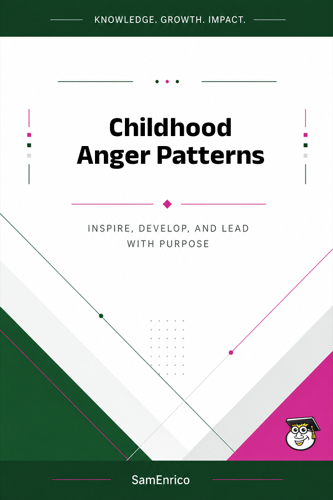
Non-FictionSelf-Help / Family Patterns
Childhood Anger Patterns eBook
Recognizes how family of origin modeled anger and
by Bryson Tania
Recognizes how family of origin modeled anger and creates new patterns.
Formats
Free sample
Chapter 1: The Anger Inheritance--–- Every family has a secret language. Yours might be spoken in raised voices at the dinner table, or in the heavy silence that follows a slammed door. It might be whispered through tears in the kitchen after everyone else has gone to bed, or shouted across a living room in words you swore you would never repeat. This language is not English or Spanish or Mandarin. It is the language of anger—and you learned it before you learned to tie your shoes.You did not arrive at your current relationship with anger by accident.
You were not born knowing how to rage, or freeze, or plead. Infants come into the world with a single, undifferentiated distress signal: crying. They do not know the difference between hunger-fueled frustration and the hot, shamed fury of being dismissed. They learn that difference from the faces, voices, and bodies around them. By the time you were five years old, your nervous system had already been trained—like a small, loyal animal—to recognize which emotions were safe to show and which ones would get you punished, ignored, or loved.This chapter is about that training.
It is about the blueprint you did not choose, the family anger script that has been running underneath your conscious thoughts for decades. And it begins with a question that might feel uncomfortable, even unfair: What was the law of the land regarding anger in your childhood home?The Unwritten Constitution of Every Family Every family operates under an unwritten constitution. This document is never signed, never debated, and never posted on the refrigerator. But everyone in the household knows its articles by heart. The constitution dictates who is allowed to be angry, at whom, for how long, and with what consequences.
It determines whether anger is treated as a dangerous weapon to be hidden, a natural weather pattern to be endured, or a tool of control to be wielded against the weak.In some homes, the constitution reads like this: Anger belongs to Dad. When Dad is angry, everyone else becomes very quiet and very small. Mom apologizes even when she has done nothing wrong. The children learn to read the slightest shift in facial expression—the tightening of the jaw, the narrowing of the eyes—because those micro-expressions predict the storm. There is no such thing as a child’s anger in this house.
Children who express frustration are sent to their rooms, spanked, or told they are “being dramatic.”In other homes, the constitution reads differently: Anger does not exist. When Mom is upset, she does not raise her voice. Instead, she stops speaking entirely. She moves through the kitchen like a ghost, washing dishes with her back turned, answering questions with monosyllables. The children learn that silence is the most terrifying sound in the world.
They learn to apologize preemptively, to fill the empty air with promises to be good, to do anything to make the ice thaw. Years later, in their own adult relationships, they will panic when a partner goes quiet—not because anything is wrong in the present, but because their nervous system remembers the glacier.In still other homes, the constitution says: Anger is a sickness. When Grandma is angry, she cries. She holds her chest and says her heart is racing. She reminds everyone of her high blood pressure.
The children learn that expressing anger is dangerous—not because someone will hurt them, but because someone will get hurt. They learn to swallow their own frustration, to smile when they want to scream, to become caretakers before they are old enough to ride a bike. And they learn to resent everyone they take care of.These three constitutions—the Volcano, the Glacier, and the Swamp—are not rare. They are not even unusual. They are the standard operating systems of millions of families across every culture, every income level, and every education background.
And if you are reading this book, chances are excellent that one of them (or a hybrid of two) was the law of your childhood land.The Volcano Family: Explosive, Unpredictable, and Terrifying Let us begin with the most recognizable pattern: the Volcano. In Volcano families, anger is loud, frequent, and disproportionate to the trigger. A child leaves a wet towel on the bathroom floor. The response is not a calm reminder but a full-volume tirade about respect, responsibility, and ingratitude. A parent comes home from a bad day at work.
Within minutes, everyone in the house is walking on eggshells, waiting for the eruption.The defining feature of the Volcano is not the volume of the yelling—though that is certainly memorable. The defining feature is unpredictability. The same behavior that was ignored yesterday triggers an explosion today. The child never knows which version of the parent will walk through the door. This unpredictability is more damaging than the yelling itself, because it trains the nervous system to remain in a state of constant low-grade vigilance.
You cannot relax when the volcano might blow at any moment. You learn to monitor facial expressions, tone of voice, and body language with the hyperawareness of a spy in enemy territory.Children raised in Volcano families often develop one of two survival strategies. The first is fawning: becoming hyper-attuned to the angry parent’s needs, anticipating their moods, and bending oneself into whatever shape might prevent the next eruption. These children grow into adults who apologize constantly, over-explain their decisions, and feel responsible for everyone else’s emotional state. The second strategy is fighting back: learning to meet anger with anger, volume with volume, and eventually becoming a volcano oneself.
These children grow into adults who explode first and ask questions later, who mistake intimidation for strength, and who cannot tell the difference between assertiveness and aggression.Neither strategy is a character flaw. Both are brilliant adaptations to an impossible environment. But both become maladaptive in adult relationships, where partners and children are not enemies to be managed or dominated, but equals to be loved.Consider Sarah, a forty-two-year-old marketing director who came to therapy after her teenage son told her, “Mom, you scare me when you get loud.” Sarah was raised in a classic Volcano home. Her father yelled about everything—grades, messes, tone of voice, the way she chewed her food. Sarah swore she would never be like him.
And she wasn’t. She never called her son names. She never threw things. But when she was frustrated, her voice rose. Her face flushed.
The boy who loved her learned to read her micro-expressions the same way she had learned to read her father’s. The pattern had skipped a generation in form but not in function.Sarah is not a bad mother. She is a woman running software she never chose, on hardware that was installed before she had language. The same is true for you.The Glacier Family: Cold, Silent, and Invisible If the Volcano is defined by noise, the Glacier is defined by its absence. Glacier families do not yell.
They do not slam doors. They do not throw things. Instead, they withdraw. When conflict arises, one or both parents…
This is the end of the free sample. Get the eBook to keep going. Buy now
About this book
Details
- Author
- Bryson Tania
- Publisher
- SamEnrico
- Language
- English
- Genre
- Non-Fiction, Self-Help / Family Patterns
- Released
- 2026-06-07
- Pages (approx.)
- 120
- Available as
- eBook, Audiobook

Read better in the ZLOADR app
Your eBooks on your phone or tablet. Sign in with your SamEnrico account and start reading.
More by Bryson Tania
 NASCAR Crew Chief GuideBryson Tania$11.99
 No More Walking on EggshellsBryson Tania$11.99
 Name Recall for Volunteer LeadersBryson Tania$11.99
 Brad Paisley Guitar AceBryson Tania$11.99
 Sleep For Students MemoryBryson Tania$11.99
 Youth Peer Counseling GuideBryson Tania$11.99
 Medical Complications ListBryson Tania$11.99
 Veles’ Shadow: The Spy Who Crossed the UnderworldBryson Tania$11.99
 The Vanishing Code: How a WWII Spy’s Lost Cipher Changed Modern CryptographyBryson Tania$11.99
 Understanding Cushing's SyndromeBryson Tania$11.99
 How to Produce a Force TouchBryson Tania$11.99
 A Collector's Handbook to the Bsa 4Bryson Tania$11.99
You may also like
 Hong Kong Handover 1997Dunn Johnnie$11.99
 Zumba For Postnatal Recovery CourseNeal Christian$11.99
 Zumba for BeginnersLadner Nikia$11.99
 YouTube Comment Mining GuideHumes Pandora$12.99
 Worry Box MeditationCarlin Rudy$11.99
 Workplace Stress MeditationNguyen Lynn$11.99
 Workplace Stress and Sleep RepairHawley Ivory$11.99
 Workplace Perfectionism CureDelaney Jeffry$11.99
 Workplace Injustice Anger GuideWallen Isabelle$11.99
 Work Addiction and Burnout LinkGreenwood Ester$11.99
 Women in Yoga and WellnessBeattie Galina$11.99
 Women in Stand Up ComedyChun Evangeline$11.99