
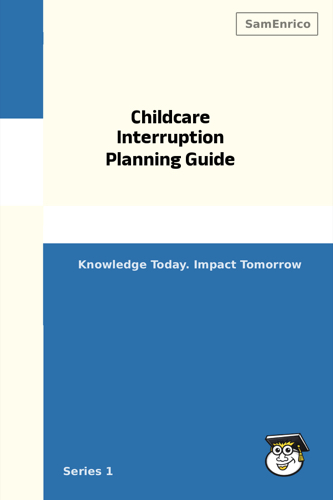
Non-FictionSelf-HelpParenting at Work
Childcare Interruption Planning Guide eBook
Coordinates childcare coverage during critical wor
Coordinates childcare coverage during critical work blocks.
Formats
Free sample
Chapter 1: The Three Craters--You are about to read a sentence that will either save your career or make you roll your eyes. There is no middle ground.Your childcare is not a system. It is a house of cards, and a single sneeze can bring it down.Not your child's sneeze, necessarily. The sneeze of a nanny. The sneeze of a center director who decides at 6:00 AM that she has the flu.
The sneeze of the economy—a staffing shortage, a budget cut, a pandemic, a snow day that the school district announced at 10:00 PM the night before. The sneeze of your own exhaustion when you realize you have no backup plan and your spouse is already on a plane.Every working parent knows this feeling. But almost no one has a name for the specific events that cause it. We call them "bad mornings" or "those days" or, if we are being generous with ourselves, "the universe testing me." But naming is the first act of control. If you cannot name your enemy, you cannot defend against it.This chapter names the three enemies.After analyzing thousands of childcare interruptions across hundreds of families, a clear pattern emerges.
Every crisis—no matter how chaotic or unique it feels in the moment—falls into one of three distinct categories. I call them the Three Craters, because each one leaves a hole in your workday that takes days or weeks to climb out of. And here is the brutal truth that most parenting books will not tell you: you are almost certainly vulnerable to all three. The question is not whether you will experience them. The question is which one will be your primary crater, the one that keeps you up at night, the one that has already cost you promotions, money, and peace of mind.By the end of this chapter, you will know exactly which crater is yours.
You will also know the early warning signs that most parents ignore until it is too late. And you will complete a pre-mortem exercise—a tool borrowed from military strategy and project management—that will force you to imagine the worst-case version of your crater and work backward to today. This is not pessimism. This is preparation. And preparation is the only thing that stands between you and the next 6:00 AM text message that makes your stomach drop.Let us begin with the crater that strikes without warning, spreads without mercy, and has, in the last five years alone, reshaped the entire landscape of working parenthood.Crater One: The Health Shutdown It is 4:47 AM.
Your two-year-old is crying. Not the usual "I lost my pacifier" cry. This one is different. You know it the moment you hear it. You walk into the room and the first thing you notice is the smell.
Then you touch her forehead and it is not warm. It is hot. Not fever-hot. Something else. Something that makes you reach for the thermometer before you have even turned on the light.One hundred and two point four.You text the nanny: "Mild fever.
Will keep you posted." She texts back forty-five minutes later: "I'm so sorry. I can't do fevers. My daughter has a heart condition." You have no backup. Your first meeting is at 8:00 AM with a client who has already rescheduled twice. Your spouse has a deposition.
You have seventeen minutes to decide who stays home and who gets fired.This is Crater One. And it is the most common, most unpredictable, and most professionally devastating of the three.The Health Shutdown includes any interruption caused by illness—of the child, of the provider, or of the entire community. This is not just the common cold, though that alone accounts for an estimated 29 million missed workdays annually in the United States. It includes the stomach bug that takes down a nanny and a child simultaneously. It includes hand, foot, and mouth disease, which sounds harmless and is absolutely not.
It includes pink eye, strep throat, influenza, RSV, and the endless parade of viruses that circulate through every daycare center like a rotating cast of villains. It includes the provider who wakes up with a migraine, the relative who was supposed to watch the kids but now has COVID, and the center that closes for a week because three staff members tested positive for something.And here is what most parents do not understand: health shutdowns are not random. They follow patterns. Predictable, trackable, actionable patterns.The first pattern is seasonality. Pediatric offices see the same surges every year—respiratory viruses in late fall and winter, enteroviruses in late summer and early fall, allergies in spring that are not contagious but still require a child to stay home if the fever crosses the threshold.
If you are surprised by a February flu outbreak, you are not paying attention. The data is public. The school district knows. The pediatrician knows. You can know too.The second pattern is provider vulnerability.
Some caregivers call out more than others. Centers with high turnover rates have more closures. Individual nannies with young children of their own have more fevers to manage. Home-based providers with no backup staff have no margin for error. Most parents never ask the questions that would reveal these vulnerabilities before they sign a contract.
They never ask: "How many sick days did you take last year?" They never ask: "What happens when you are sick—do you have a substitute?" They never ask because asking feels rude. But silence is not politeness. Silence is risk.The third pattern is exclusion policy. Every center, every school, every provider has a written policy about when a child cannot attend. Most parents have never read theirs.
They signed it during enrollment and forgot it existed. But those policies vary wildly. Some centers exclude for any fever over 100.4 degrees. Some exclude until 24 hours fever-free without medication. Some exclude for vomiting once.
Some exclude for vomiting twice. Some exclude for a runny nose if it is green. Some exclude for a rash that "might be contagious." The difference between a 24-hour exclusion and a 48-hour exclusion could be the difference between missing one meeting and missing an entire product launch.The pre-mortem for Crater One is simple to describe and brutal to execute. Ask yourself: what is the single worst health-related interruption that could happen to your family in the next twelve months? Not the likely one.
The worst one. Your child gets hand-foot-mouth and is excluded for ten days. Your nanny gets COVID and is out for two weeks. Your center closes because three staff members have the flu. Now work backward.
What would you need to have in place today to survive that scenario? Write it down. That is your action list.Most parents will not do this exercise. They will tell themselves it is pessimistic. They will tell themselves it probably will not happen.
They are wrong. It will happen. Maybe not this year. Maybe not next. But the numbers do not lie.
Every child gets sick. Every provider gets sick. Every center closes eventually. The only question is whether you will be prepared when it happens to…
This is the end of the free sample. Get the eBook to keep going. Buy now
About this book
Details
- Author
- Wilkinson Maisha
- Publisher
- SamEnrico
- Language
- English
- Genre
- Non-Fiction, Self-Help, Parenting at Work
- Released
- 2026-06-11
- Pages (approx.)
- 145
- Available as
- eBook, Audiobook

Read better in the ZLOADR app
Your eBooks on your phone or tablet. Sign in with your SamEnrico account and start reading.
More by Wilkinson Maisha
 Music Theory Essay GuideWilkinson Maisha$11.99
 Indian Festival Schedule GuideWilkinson Maisha$11.99
 The Franz Kafka Jewish IdentityWilkinson Maisha$11.99
 Professional Anger Expression MethodsWilkinson Maisha$11.99
 The Healing Hands of Imhotep: Ancient Egypt’s Medical RevolutionWilkinson Maisha$11.99
 QuickBooks 1099 Preparation GuideWilkinson Maisha$12.99
 Restaurant Chain M&AWilkinson Maisha$12.99
 How to Start a Optical Goods (wholesale) Business (Beginners Guide)Wilkinson Maisha$11.99
 Avionics RepairWilkinson Maisha$11.99
You may also like
 Hong Kong Handover 1997Dunn Johnnie$11.99
 Zumba For Postnatal Recovery CourseNeal Christian$11.99
 Zumba for BeginnersLadner Nikia$11.99
 YouTube Comment Mining GuideHumes Pandora$12.99
 Worry Box MeditationCarlin Rudy$11.99
 Workplace Stress MeditationNguyen Lynn$11.99
 Workplace Stress and Sleep RepairHawley Ivory$11.99
 Workplace Perfectionism CureDelaney Jeffry$11.99
 Workplace Injustice Anger GuideWallen Isabelle$11.99
 Work Addiction and Burnout LinkGreenwood Ester$11.99
 Women in Yoga and WellnessBeattie Galina$11.99
 Women in Stand Up ComedyChun Evangeline$11.99