
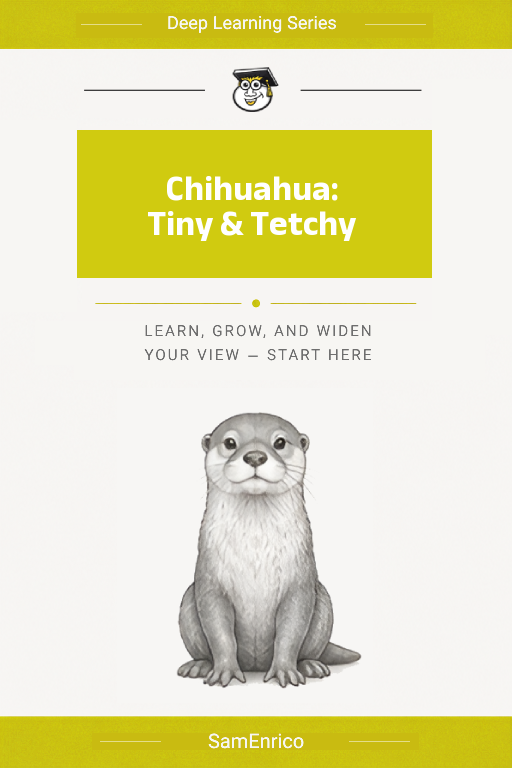
Non-FictionInformativeEducational
Chihuahua: Tiny & Tetchy eBook
This publication, published by SamEnrico, covers C
by Spinks Julio
This publication, published by SamEnrico, covers Chihuahua: Tiny & Tetchy
Formats
Free sample
Chapter 1: Buried With You--–- The first thing you need to understand about your Chihuahua is that she was bred to die with you. Not metaphorically. Not in the sentimental way that all loyal dogs might be said to share your fate. Literally. Archaeologists have found her ancestors arranged carefully in human graves—at the feet, beside the head, cradled in the arms of the deceased—placed there with the explicit intention that the dog would accompany her owner into the afterlife.
Your tiny, trembling companion carries the weight of that ancient contract in every bone of her three-pound body. When she growls at strangers, when she shadows your every step, when she refuses to let anyone else hold her, she is not being difficult. She is being faithful to a promise her species made a thousand years before you were born.If you have ever wondered why your Chihuahua ignores every other member of your household while tracking your movements like a furry spy, why she sleeps pressed against your neck or curled inside your sweatshirt, why she growls at well-intentioned strangers who reach for her with nothing but affection in their hearts—this chapter holds the answer. The Chihuahua is not a small dog who happens to be loyal. She is a loyal dog who happens to be small.
And that loyalty, forged in the fires of pre-Columbian Mesoamerica, is both her greatest gift and the source of everything owners call "tetchy."This chapter will take you on a journey through the archaeological and cultural history of the breed, from the mute Techichi dogs of the Toltec civilization to the Aztec nobility who revered them as spiritual guides, through the brink of extinction after the Spanish conquest, and finally to the American tourists who "discovered" the breed in the Mexican state of Chihuahua in the 1850s. Along the way, you will learn why your Chihuahua bonds so intensely to one person, why she is suspicious of outsiders, and why that suspicion is not a flaw to be eliminated but a heritage to be honored. By the end of this chapter, you will see your tiny, tetchy companion not as a neurotic mess but as a living artifact of one of history's most profound human-animal relationships. You will understand that her "attitude" is not an accident of breeding but the very trait that kept her kind alive.The Techichi: The Dog That Did Not Bark Long before the Aztecs built Tenochtitlán (the magnificent island city that would become modern-day Mexico City), before the Spanish arrived with horses and steel and smallpox, before the word "Chihuahua" ever appeared on any map, there was the Techichi. This small, mute-bodied dog appears in the archaeological record of Mesoamerica as early as 300 CE, associated primarily with the Toltec civilization of central Mexico.
The Toltecs, who considered themselves master builders, warriors, and artists, also bred these small dogs for purposes that would strike the modern pet owner as deeply unusual—or, depending on your perspective, deeply familiar.The Techichi was not a hunter. It lacked the speed, prey drive, and pack coordination necessary for chasing down game in the highland forests. It was not a herder. It showed no interest in circling and directing larger animals. It was not even a guard dog in the sense we understand today—it was too small to deter intruders physically, and its mute nature meant it could not raise an alarm with barking.
So what was the Techichi for?The answer lies in two functions, both intimately connected to human emotional and spiritual life. First, the Techichi was a "comfort dog" in the most literal possible sense. These small, warm-bodied animals were kept close to their owners at all times—sleeping in their beds, riding inside their cloaks during cold weather, and absorbing the chill of the highland nights. The Toltecs, like many pre-modern peoples, understood something that modern science has only recently validated with clinical studies: physical touch with a warm, living creature reduces stress hormones, lowers blood pressure, improves immune function, and extends lifespan. Your Chihuahua's insistence on burrowing under your blanket, pressing her cold nose against your armpit, and refusing to sleep anywhere except in direct contact with your body is not a quirky habit.
It is a ten-thousand-year-old survival instinct, passed down from ancestors who kept their humans alive through sheer proximity and shared warmth.But the second function of the Techichi is even more revealing for understanding your dog's tetchy personality. The Techichi was a funerary dog. Archaeological excavations throughout central Mexico have uncovered Techichi skeletons carefully arranged alongside human remains, often placed at the feet or beside the head of the deceased. These dogs were not accidental burials. They were intentionally interred—sometimes sacrificed, sometimes allowed to die naturally and then placed in the grave—to accompany their owners into the afterlife.
The Toltecs and later the Aztecs believed that the soul's journey after death was perilous, filled with obstacles, hostile forces, and treacherous crossings. A loyal dog, one who had bonded completely to a single human during life, could guide that human's soul safely through the underworld. The dog was not merely a pet. It was a psychopomp—a guide of souls.Consider what this means for the Chihuahua's genetic inheritance. For centuries—perhaps as many as fifteen hundred years—the only dogs who reproduced were those who formed an almost obsessive attachment to one person.
Dogs who divided their loyalty among multiple humans, who were friendly and welcoming to strangers, who did not shadow their owner relentlessly—these dogs were not selected for burial companionship. They did not pass on their genes. Instead, the breeding pool consisted exclusively of dogs who were capable of intense, single-minded, death-defying devotion. The dog who would follow one person into the grave. That is the creature sleeping on your lap right now.
That is the creature growling at your mother-in-law. That is the creature who trembles when you leave the room as if you have already died and left her behind.The Aztec Refinement: Nobility, Ritual, and the Soft Spot When the Aztec Empire rose to power in the 14th century, they inherited the Techichi from the Toltecs and refined both the breed and its cultural significance. The Aztecs, unlike the Toltecs, left extensive written records—codices painted on bark paper and deerskin—that describe the role of small dogs in their society. These documents reveal that the Techichi—now called itzcuintli in Nahuatl, the Aztec language—had become even more specialized. They were no longer merely funerary companions.
They were status symbols, spiritual intermediaries, and medical resources, all wrapped into one tiny, trembling package.Aztec nobility kept Techichi in large numbers, breeding for specific physical and behavioral traits: extremely small size (the better to carry in a cloak or place in a grave), a soft spot on the skull (the molera, which we will discuss in detail in Chapter 4), and a calm, watchful temperament that combined intense loyalty with quiet vigilance. The soft spot, which many modern Chihuahua owners panic about when they first feel it on their puppy's head, was considered a spiritual marker. The Aztecs believed that the molera…
This is the end of the free sample. Get the eBook to keep going. Buy now
About this book
Details
- Author
- Spinks Julio
- Publisher
- SamEnrico
- Language
- English
- Genre
- Non-Fiction, Informative, Educational
- Released
- 2026-06-02
- Pages (approx.)
- 150
- Available as
- eBook, Audiobook

Read better in the ZLOADR app
Your eBooks on your phone or tablet. Sign in with your SamEnrico account and start reading.
More by Spinks Julio
 Home Decor Envy GuideSpinks Julio$11.99
 Parent Morning Survival GuideSpinks Julio$11.99
 HIIT Overtraining PreventionSpinks Julio$11.99
 Climber Fear Release HypnosisSpinks Julio$11.99
 Smell Trigger RecoverySpinks Julio$11.99
 Judge Imposter SyndromeSpinks Julio$11.99
 Persuasion For Healthcare ProsSpinks Julio$11.99
 Burn Psychosocial SupportSpinks Julio$11.99
 The Day the Sky Turned Black: The Great American Eclipse of 1878Spinks Julio$11.99
 The Ball That United an Empire: The Ancient Mesoamerican Football Legends of the Maya and AztecsSpinks Julio$11.99
 How to Produce Satellite ReceiversSpinks Julio$11.99
 How to Become a Photo Mask InspectorSpinks Julio$11.99
You may also like
 Hong Kong Handover 1997Dunn Johnnie$11.99
 Zumba For Postnatal Recovery CourseNeal Christian$11.99
 Zumba for BeginnersLadner Nikia$11.99
 YouTube Comment Mining GuideHumes Pandora$12.99
 Worry Box MeditationCarlin Rudy$11.99
 Workplace Stress MeditationNguyen Lynn$11.99
 Workplace Stress and Sleep RepairHawley Ivory$11.99
 Workplace Perfectionism CureDelaney Jeffry$11.99
 Workplace Injustice Anger GuideWallen Isabelle$11.99
 Work Addiction and Burnout LinkGreenwood Ester$11.99
 Women in Yoga and WellnessBeattie Galina$11.99
 Women in Stand Up ComedyChun Evangeline$11.99