
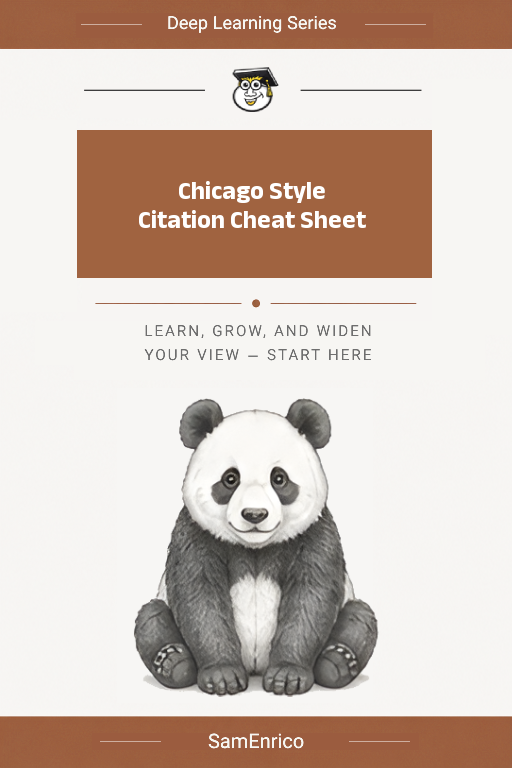
Chicago Style Citation Cheat Sheet Audiobook
Differentiate between notes-bibliography and autho
Differentiate between notes-bibliography and author-date systems quickly.
Formats
Free sample
Chapter 1: The Footnote Paradox--–- Every student who has ever faced a blank page knows the feeling. You have your sources spread across the desk—books flagged with sticky notes, articles bookmarked on your browser, a PDF of a primary source that took three database searches to find. You have a thesis statement that actually makes sense (for once). You have an outline that your professor called "promising." And then you hit the first quotation. Your fingers hover over the keyboard.
Your cursor blinks in that space right after the closing quotation mark. And your mind goes completely, utterly blank.Footnote or parenthesis? Number or name and year? Do you put the period inside or outside? Where does the date go?
What if you cite the same source twice in a row? What if you have three authors? What if you have eleven? What if the source is a website that might disappear tomorrow? What if you're quoting a translation?
What if—and this is the nightmare scenario—your professor says you can use "either system" without specifying which one? The cursor keeps blinking. The clock keeps ticking. And somewhere deep in your academic soul, you wonder: Why does this have to be so complicated?The answer is not "because professors are cruel" or "because the Chicago Manual of Style has a thousand pages for a reason." The answer is simpler and more fascinating than that. The two citation systems in Chicago style exist for two completely different philosophical reasons.
They were not designed by a committee trying to confuse students. They evolved from two distinct academic traditions that value different things: one values commentary and narrative depth, the other values chronology and data transparency. Once you understand these philosophies, the rules stop feeling arbitrary. They start feeling inevitable. You will never again ask "which system do I use?" because you will understand why historians write one way and psychologists write another.This chapter is not about memorizing templates.
The templates come in Chapter 4. This chapter is about something more important: the intellectual DNA of the two systems. By the time you finish reading these pages, you will be able to look at any academic paper and identify the citation system within three seconds. You will know, instinctively, whether to reach for a footnote number or an open parenthesis. And you will never, ever mix the two systems in…
This is the end of the free sample. Get the Audiobook to keep going. Buy now
About this book
Details
- Author
- Beckman Adella
- Publisher
- SamEnrico
- Language
- English
- Genre
- Non-Fiction, Student's Shortcut
- Released
- 2026-05-29
- Pages (approx.)
- 147
- Available as
- eBook, Audiobook

Listen in the VoxFlicks app
Audiobooks and audio dramas wherever you go. Sign in with your SamEnrico account and press play.
More by Beckman Adella
 Retail Worker Stress GuideBeckman Adella$11.99
 Addressing Teen Substance UseBeckman Adella$11.99
 Atomic Habit Formation GuideBeckman Adella$11.99
 Fasting for Heart HealthBeckman Adella$11.99
 Amazon Review Research GuideBeckman Adella$11.99
 Self Talk for Depression LiftBeckman Adella$11.99
 Joe Biden ScrantonBeckman Adella$11.99
 Bipolar Alternative Treatment GuideBeckman Adella$11.99
 HGH And Cold ExposureBeckman Adella$11.99
 The Southern Cross and the Stars: New Zealand's Scientific LeapBeckman Adella$11.99
 The Hellfighters' Last Stand: The Battle of Chateau-ThierryBeckman Adella$11.99
 Love in the Shadows: The Secret Affair That Shook a KingdomBeckman Adella$11.99
You may also like
 Hong Kong Handover 1997Dunn Johnnie$11.99
 Zumba For Postnatal Recovery CourseNeal Christian$11.99
 Zumba for BeginnersLadner Nikia$11.99
 YouTube Comment Mining GuideHumes Pandora$12.99
 Worry Box MeditationCarlin Rudy$11.99
 Workplace Stress MeditationNguyen Lynn$11.99
 Workplace Stress and Sleep RepairHawley Ivory$11.99
 Workplace Perfectionism CureDelaney Jeffry$11.99
 Workplace Injustice Anger GuideWallen Isabelle$11.99
 Work Addiction and Burnout LinkGreenwood Ester$11.99
 Women in Yoga and WellnessBeattie Galina$11.99
 Women in Stand Up ComedyChun Evangeline$11.99