
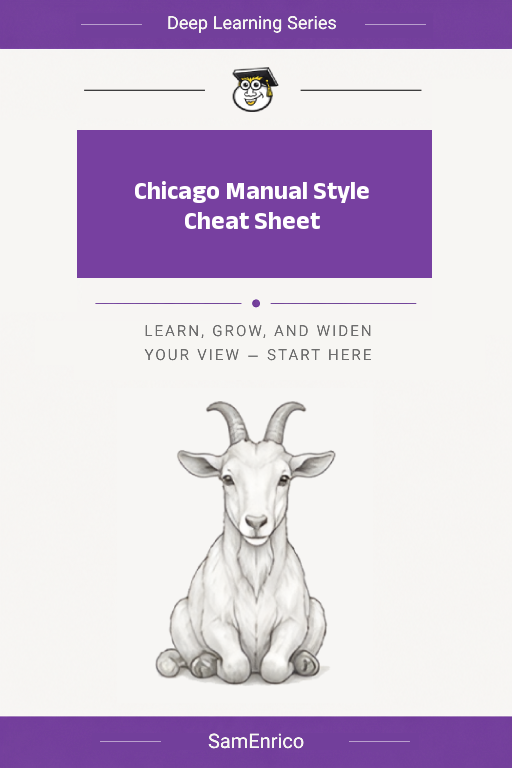
Non-FictionStudent's ShortcutChicago
Chicago Manual Style Cheat Sheet
Use notes-bibliography and author-date systems for
Use notes-bibliography and author-date systems for history, arts, and social sciences.
Formats
About this book
Free sample
Chapter 1: The Skeleton Key--Every citation, no matter how complex, is built from just four ingredients. If you can learn to see these four elements in any source—whether it is a leather-bound medieval manuscript, a peer-reviewed sociology article, or a tweet from a politician—you will never be confused by the Chicago Manual of Style again. This chapter gives you the skeleton key that unlocks both citation systems, saves you hours of frustration, and eliminates the single most common mistake that costs students points on their papers.Let me say that again because it matters: every single citation in the history of academic writing contains the same four pieces of information. The only thing that changes between the Notes-Bibliography system (used by historians and art historians) and the Author-Date system (used by sociologists and political scientists) is the order in which those four pieces appear and the punctuation that separates them. That is it.
That is the whole secret.The four universal elements are: Author, Title, Publication, and Date. You can remember them by the acronym AT PD, or simply think of them as the four pillars. Every time you look at a book, a journal article, a website, or a chapter in an edited collection, your job is to extract these four pieces of information and then arrange them according to the rules of whichever system your professor has assigned.This chapter will teach you to identify those four elements in any source, understand why the two systems arrange them differently, and avoid the most expensive mistake in academic citation: confusing the Bibliography (used in Notes-Bibliography) with the Reference List (used in Author-Date). By the end of this chapter, you will be able to look at any source and instantly know which pieces of information you need and where they go.The Four Pillars of Every Citation Let me introduce each pillar with a concrete example. Imagine you are holding Michael Pollan's book The Omnivore's Dilemma: A Natural History of Four Meals.
Here is how the four pillars appear in that source:Pillar One: Author. This is the person or organization responsible for…
This is the end of the free sample. Get the eBook to keep going. Buy now
Contents
- Chapter 1
- Chapter 2
- Chapter 3
- Chapter 4
- Chapter 5
- Chapter 6
- Chapter 7
- Chapter 8
- Chapter 9
- Chapter 10
- Chapter 11
- Chapter 12
Details
- Author
- Lovejoy Adriane
- Publisher
- SamEnrico
- Language
- English
- Genre
- Non-Fiction, Student's Shortcut, Chicago
- Released
- 2026-06-01
- Pages (approx.)
- 147
- Available as
- eBook, Audiobook

Read better in the ZLOADR app
Your eBooks on your phone or tablet. Sign in with your SamEnrico account and start reading.
More by Lovejoy Adriane
 Meaning Making EmotionLovejoy Adriane$11.99
 Gambling Addiction For Retail WorkersLovejoy Adriane$11.99
 The Do Defer Delegate Drop GuideLovejoy Adriane$11.99
 Postpartum Pelvic Recovery PlanLovejoy Adriane$11.99
 Hole in the Floor HeistLovejoy Adriane$11.99
 Whole Body Breathing TechniqueLovejoy Adriane$11.99
 Rupert Spira NondualityLovejoy Adriane$11.99
 Revenue Recognition For StartupsLovejoy Adriane$11.99
 The Tsars and the Silk Road: Russia's Trade EmpireLovejoy Adriane$11.99
 Quetzalcoatl's Feathered Rebellion: The Serpent God Who Defied the SunLovejoy Adriane$11.99
 Mastering The Art of ItalyLovejoy Adriane$11.99
 Export Control Minority FirmsLovejoy Adriane$12.99
You may also like
 Hong Kong Handover 1997Dunn Johnnie$11.99
 Zumba For Postnatal Recovery CourseNeal Christian$11.99
 Zumba for BeginnersLadner Nikia$11.99
 YouTube Comment Mining GuideHumes Pandora$12.99
 Worry Box MeditationCarlin Rudy$11.99
 Workplace Stress MeditationNguyen Lynn$11.99
 Workplace Stress and Sleep RepairHawley Ivory$11.99
 Workplace Perfectionism CureDelaney Jeffry$11.99
 Workplace Injustice Anger GuideWallen Isabelle$11.99
 Work Addiction and Burnout LinkGreenwood Ester$11.99
 Women in Yoga and WellnessBeattie Galina$11.99
 Women in Stand Up ComedyChun Evangeline$11.99