
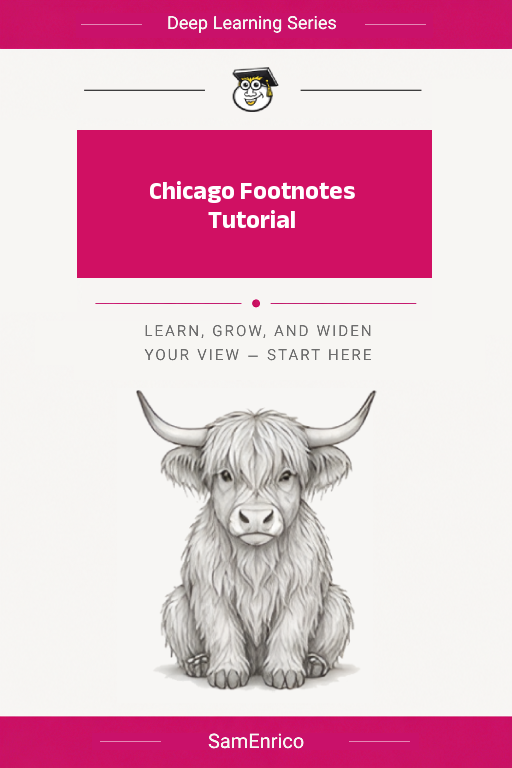
Chicago Footnotes Tutorial eBook
Insert footnotes and format subsequent citations i
by Hiatt Celina
Insert footnotes and format subsequent citations in Chicago style.
Formats
Free sample
Chapter 1: The Footnote Fallacy--Most students believe footnotes are punishment.They see the superscript number hovering at the end of a sentence like an accusation. They imagine a professor wielding a red pen, circling every missing period, every misplaced comma. They open the Chicago Manual of Style—all 1,200 pages of it—and feel their soul leave their body.Here is the truth those students never discover until their third or fourth year of graduate school: footnotes are not a burden. They are a weapon.A well-placed footnote does not just cite a source. It argues.
It winks at the reader. It says, "I know something you don't know, and I'm going to show you exactly where I found it." The footnote is where scholars become magicians—performing tricks of evidence, context, and wit that would clutter and destroy the main text if attempted there.This book exists because the Chicago Notes-Bibliography system is the most powerful citation system ever devised, and almost no one teaches it correctly. They teach it as a set of arbitrary rules to be memorized and regurgitated. They do not teach it as a logic system—a beautiful, efficient, and deeply rational way of connecting a reader to a source with the fewest possible keystrokes.This chapter will change your relationship with footnotes forever. By the time you finish these pages, you will understand not just what Chicago style is, but why it works the way it works.
You will see the logic beneath the rules. And you will never again ask someone "How do I cite this?" because you will have learned to think like the system itself.The Two Chicagos You Didn't Know Existed Before you can master footnotes, you must accept a shocking fact: there are two Chicago styles.The University of Chicago Press publishes one manual—The Chicago Manual of Style, now in its 18th edition (2024)—but that single book describes two completely different citation systems that serve two completely different academic worlds.The first is called the Author-Date system. You have seen it before even if you did not know its name. In Author-Date, citations appear inside parentheses within the main text, like this: (Smith 2020, 45). A reference list at the end of the paper provides the full publication details.
This system dominates the sciences and social sciences—sociology, psychology, economics, biology, and many others. Why? Because scientists want the reader to see the year of publication immediately. A paper from 2025 carries different weight than a paper from 1985. Parenthetical citations make that year visible at a glance.The second system is called the Notes-Bibliography system.
This is the one this book teaches. Instead of parentheses in the text, you insert a superscript number at the end of the sentence or clause that needs a citation. That number points to a footnote at the bottom of the page (or an endnote at the back of the document). Inside that footnote, you write the citation. At the very end of the paper, you include a Bibliography listing every source you cited.Notes-Bibliography dominates the humanities—history, literature, philosophy, art history, classics, religious studies, and many others.
Why? Because humanists do not just cite sources. They argue with them. They translate them. They offer competing interpretations.
They add context that would break the flow of a sentence if crammed into parentheses.Consider this example. Imagine you are writing a history paper about the French Revolution, and you want to cite a famous book while also noting that the author has been criticized for ignoring the role of women.In Author-Date, you would write something like this in the main text:Scholars have debated the causes of the Terror (see Jones 1987, 112–15; for a critique of Jones's gender blindness, see Smith 1995, 45).That works, but it is ugly. The sentence chokes on its own parentheticals. The reader is yanked out of your argument and forced to navigate a cluttered aside.In Notes-Bibliography, you write this in the main text:Scholars have debated the causes of the Terror.^1Then, in footnote 1 at the bottom of the page, you write:See Jones, The Terror Explained, 112–15. For a critique of Jones's gender blindness, see Smith, Women and Revolution, 45.The main text remains clean.
The argument flows. And the footnote becomes a space for genuine scholarly conversation—a place where you can signal to your reader that you have read the critiques, that you are aware of the debates, and that you are inviting them into that conversation if they wish to go deeper.That is the power of the footnote. And that is why this book exists.The Three-Part Harmony You Will Never Forget The entire Notes-Bibliography system rests on three elements. I call this the Three-Part Harmony, and once you understand it, Chicago style will never confuse you again.Here are the three parts:The Full Note – The first time you cite a source in your paper, you write a complete citation in the footnote. This includes the author's full name, the full title, the publication information (place, publisher, year), and the specific page number you are citing.The Shortened Note – The second, third, and every subsequent time you cite that same source, you write a much shorter citation: just the author's last name, a shortened version of the title, and the new page number.The Bibliography – At the end of your paper, you provide a complete list of every source you cited.
The Bibliography entry contains the same information as the Full Note, but formatted differently (author's last name first, periods instead of commas, no parentheses, and total page range instead of a specific page).Here is how the Three-Part Harmony works in practice.Imagine you are writing a paper about Abraham Lincoln. The first time you cite a biography by David Herbert Donald, your footnote looks like this:David Herbert Donald, Lincoln (New York: Simon & Schuster, 1995), 45.That is the Full Note.Later in the same paper, you cite the same book again. Now your footnote looks like this:5. Donald, Lincoln, 112.That is the Shortened Note. Notice how much shorter it is: just the author's last name, a shortened title (the full title was just one word, so it stays the same), and the new page number.At the end of your paper, your Bibliography entry looks like this:Donald, David Herbert.
Lincoln. New York: Simon & Schuster, 1995.Notice the differences: the author's name is inverted (last name first). Periods separate the elements instead of commas. No parentheses around the publication information. And the Bibliography does not include a page number because it lists the entire book, not a specific page.The Three-Part Harmony creates an efficient system.
The Full Note provides complete information the first time a source appears. The Shortened Note keeps subsequent citations brief and unobtrusive. The Bibliography serves as a master index where readers can find any source's full details alphabetically by the author's last name.This is not arbitrary. This is design. And once you internalize it, you will stop fearing Chicago style and start appreciating its elegance.The One Mistake That Will Cost You Points Before we go further, I need to warn you about the single most common mistake students make when learning Chicago style.They do…
This is the end of the free sample. Get the eBook to keep going. Buy now
About this book
Details
- Author
- Hiatt Celina
- Publisher
- SamEnrico
- Language
- English
- Genre
- Non-Fiction, Student's Shortcut
- Released
- 2026-05-28
- Pages (approx.)
- 136
- Available as
- eBook, Audiobook

Read better in the ZLOADR app
Your eBooks on your phone or tablet. Sign in with your SamEnrico account and start reading.
More by Hiatt Celina
 Thunberg Sailing AtlanticHiatt Celina$11.99
 Student Social Anxiety GuideHiatt Celina$11.99
 Nicotine Cessation Mobile Apps GuideHiatt Celina$11.99
 The Self Kindness PracticeHiatt Celina$11.99
 The Collaborative Problem ReversalHiatt Celina$11.99
 Daniel Webster LibertyHiatt Celina$11.99
 Habit Visualization GuideHiatt Celina$11.99
 Customer Service Burnout ShieldHiatt Celina$11.99
 The Southern Lights: New Zealand's Pioneers of the StarsHiatt Celina$11.99
 The Last Charge of the Red Lancers: Love and Valor on the Steppes (1812)Hiatt Celina$11.99
 How to Become a Sanding-machine OperatorHiatt Celina$11.99
 Contract Risk AnalysisHiatt Celina$11.99
You may also like
 LSE Online Program LengthAgee Letisha$11.99
 Harvard Extension School for Working AdultsRoush Yer$11.99
 LSE Online Reading ListAshford Ludivina$11.99
 LSE Online Language RequirementsWhitten Daphine$11.99
 LSE Online Class SizeHughey Garret$11.99
 LSE Online Alumni MentorshipWild Lyla$11.99
 London School of Economics Alumni NetworkDutton Chantal$11.99
 Harvard Extension School Student SupportCantrell Christene$11.99
 Harvard Extension School Library AccessSantana Adah$11.99
 Harvard Extension School Degree CompletionBray Wyatt$11.99
 Harvard Extension School Course AuditingAbbott Craig$11.99
 Harvard Extension School Extension DiplomaNew Joane$11.99