
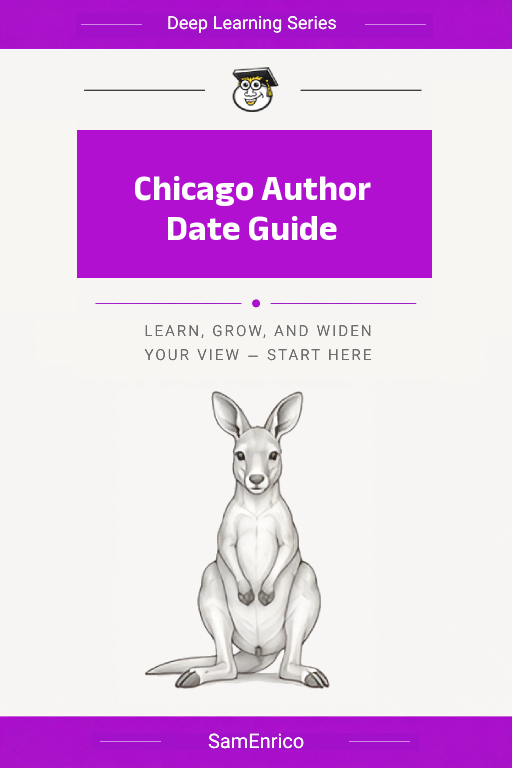
Chicago Author Date Guide eBook
Use parenthetical citations in Chicago style for s
Use parenthetical citations in Chicago style for social sciences fast.
Formats
Free sample
Chapter 1: The Year Is King--–It was 3:47 on a Tuesday morning, and Maya’s cursor blinked on an empty screen. Her literature review was due in fourteen hours. She had twenty-seven tabs open, eight PDFs downloaded, and one small problem: she had no idea how to cite any of it correctly.She had written a beautiful paragraph synthesizing three studies on economic mobility. It was thoughtful, nuanced, and precisely the kind of academic writing her professor loved. Then she realized she had no idea where the period went.
Did the citation go inside the sentence? Outside? Before the quote? After? She had spent forty-five minutes—forty-five minutes—googling variations of “Chicago style parentheses period before or after” and still wasn’t sure she had it right.Maya is not lazy.
She is not a bad writer. She is not incompetent. She is, however, a victim of the single greatest failure in academic publishing: the assumption that citation rules are intuitive.They are not.And nowhere is this failure more damaging than in the Chicago Manual of Style’s Author-Date system, which most social science students are expected to learn by osmosis, trial and error, or frantic late-night searches through forums where strangers argue about serial commas.This book exists to fix that. But before we fix anything, we have to understand the single most important concept in the entire Author-Date system. It is not complicated.
It is not technical. It is, however, the key that unlocks everything else.Here it is: In Author-Date, the year is king.Not the author’s first name. Not the title. Not the publisher. Not the footnote number.
The year.Everything about this citation system flows from that simple truth. And once you understand why the year matters more than almost anything else, you will never again confuse Chicago Author-Date with Chicago Notes-Bibliography, APA, MLA, or any of the other competing systems that haunt graduate students’ nightmares.So let us begin at the beginning. Not with rules. Not with templates. But with a question that most citation guides are too embarrassed to ask: why does any of this exist in the first place?The Secret History of Citation Systems Most students assume citation rules were handed down from on high by a committee of sadistic librarians.
The truth is both less dramatic and more useful. Citation systems emerged organically from the needs of specific academic communities. Different fields ask different questions. Different questions require different answers. And the way you cite a source is, in fact, an answer to an unspoken question.What question?
Try this: What do you want your reader to know first about this source?Humanities scholars—historians, literary critics, philosophers—often care most about the authority of the source. They want to know: Who said this? What is their reputation? Is this a primary source from the period or a secondary interpretation? That is why the Notes-Bibliography system (Chicago’s other child) uses superscript numbers leading to footnotes or endnotes.
The number is deliberately unobtrusive. It says, “Trust me, I have a source, but the identity of that source is less important than the argument I am making right now.”Social scientists care about something else entirely. When an economist reads a paper about labor markets or a political scientist analyzes voting behavior, their first question is not “Who said this?” but rather “How recent is this?”Think about it. If you are writing about the effect of minimum wage increases on employment, a study from 1972 might be historically interesting, but a study from 2024 is evidence. If you are analyzing public opinion about climate change, a poll from 1995 is obsolete.
The field moves fast. Data decays. Theories get updated.Social science readers want to know, in the first second of encountering your citation, whether you are building on current research or citing something your grandmother might have read in college.That is why the Author-Date system puts the year immediately after the author’s name.Look at these two citations:(Kahneman 2011)(Kahneman 1973)The first tells you the research is relatively recent—within the last fifteen years or so. The second tells you it is foundational but possibly dated. You learn this information before you even know the page number, before you know the title, before you know anything else.
The year is the first piece of data after the author’s identity.In Notes-Bibliography, by contrast, the year might be buried in a footnote at the bottom of the page, separated from the author’s name by a comma and a title and a publisher and a city. The reader has to hunt for it.The Author-Date system says: I will not make you hunt. Here is the year. Right here. Judge my evidence now.Scholarly Skimming: Why Your Professors Read Backwards Let me introduce a concept that will change how you think about citation forever: scholarly skimming.Professors and journal reviewers do not read your paper the way you read a novel.
They do not start at the first word and proceed linearly to the last. Instead, they perform what researchers Booth, Colomb, and Williams (the authors of The Craft of Research) call “foreground reading.” They scan for key information: thesis statements, topic sentences, data visualizations, and—you guessed it—citations.Here is what happens in a typical professor’s brain when they open your paper:First, they look at the title and abstract. Does this paper address something interesting? Second, they glance at the conclusion. Does the author actually make a claim?
Third, they scan the reference list. Do they cite the right people? The current debates? The key studies in the field?Only after passing these three tests will they read the paper carefully.Think about that. Your reference list is read before most of your actual prose.Now, imagine you are that professor.
You scan a reference list and see twenty citations. Fifteen are from the last five years. Five are from the 1990s. You immediately think: This student is up to date. They are engaged with current research.
I trust them.Now imagine you scan a reference list and see twenty citations. Three are from the last five years. Twelve are from the 1980s. Five are from the 1960s. You think: This student has not done recent reading.
Their literature review is incomplete. I am skeptical of their claims.The difference between these two impressions is not the quality of the writing. It is not the strength of the argument. It is the currency of the evidence. And the Author-Date system is designed to make currency immediately visible.When you use narrative citation—Smith (2024) argues that X—the reader sees the date before they even finish reading the author’s name.
When you use parenthetical citation—X is true (Smith 2024, 15)—the reader sees the date before they process the page number. The system constantly, relentlessly, foregrounds the question: Is this evidence current?Footnotes cannot do this. In Notes-Bibliography, the reader has to look down to the bottom of the page, find the corresponding number, and then read the citation. That glance down takes half a second. But half a second, repeated dozens of times per page, adds…
This is the end of the free sample. Get the eBook to keep going. Buy now
About this book
Details
- Author
- Broughton Herta
- Publisher
- SamEnrico
- Language
- English
- Genre
- Non-Fiction, Student's Shortcut
- Released
- 2026-06-01
- Pages (approx.)
- 141
- Available as
- eBook, Audiobook

Read better in the ZLOADR app
Your eBooks on your phone or tablet. Sign in with your SamEnrico account and start reading.
More by Broughton Herta
 Bipolar Recovery Storytelling ManualBroughton Herta$11.99
 Early Adopter Feedback LoopBroughton Herta$11.99
 Carson Posthumous LegacyBroughton Herta$11.99
 Workplace Stress Journal MethodBroughton Herta$11.99
 Addressing Wedding Planning ConflictsBroughton Herta$11.99
 The Popularity Myth GuideBroughton Herta$11.99
 John Calhoun NullifierBroughton Herta$11.99
 Retail Worker Burnout FixBroughton Herta$11.99
 Habit MeditationBroughton Herta$11.99
 The Double Life of Benjamin Franklin: Spy Master of the American RevolutionBroughton Herta$11.99
 Constantine's Legacy: The Byzantine BulwarkBroughton Herta$11.99
 The Unseen Victory: How a 12-Year-Old Chess Prodigy Defied the OddsBroughton Herta$11.99
You may also like
 LSE Online Program LengthAgee Letisha$11.99
 Harvard Extension School for Working AdultsRoush Yer$11.99
 LSE Online Reading ListAshford Ludivina$11.99
 LSE Online Language RequirementsWhitten Daphine$11.99
 LSE Online Class SizeHughey Garret$11.99
 LSE Online Alumni MentorshipWild Lyla$11.99
 London School of Economics Alumni NetworkDutton Chantal$11.99
 Harvard Extension School Student SupportCantrell Christene$11.99
 Harvard Extension School Library AccessSantana Adah$11.99
 Harvard Extension School Degree CompletionBray Wyatt$11.99
 Harvard Extension School Course AuditingAbbott Craig$11.99
 Harvard Extension School Extension DiplomaNew Joane$11.99