
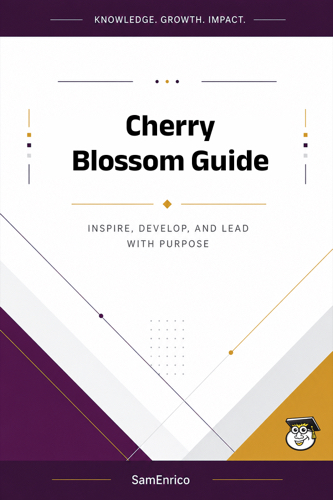
Non-FictionSelf-HelpCherry BlossomBeauty
Cherry Blossom Guide eBook
Sit under imagined pink blossom tree as petals dri
by Barclay Kacy
Sit under imagined pink blossom tree as petals drift down gently.
Formats
Free sample
Chapter 1: The Impossible Pink...--Imagine a tree that does not exist. Its branches spread above you, not against a sky of any particular color — dawn, perhaps, or the soft grey of an afternoon threatening rain. The blossoms are the palest pink, five petals each, gathered in clusters so dense that from below they resemble clouds more than flowers. Now add movement. A single petal detaches.
It does not fall so much as drift, turning once, twice, caught in an air current so gentle you cannot feel it on your skin. The petal takes one second to travel from branch to shoulder. In that second, something in your chest untightens.You have not moved. You have not gone anywhere. And yet you are already under the tree.This book is not about cherry blossoms in the way that a field guide is about birds or a cookbook is about eggs.
Those books assume you want to identify, categorize, or transform your subject into something else. This book assumes something stranger: that you want to sit still while the subject transforms you. The cherry blossom does not need your help. It will bloom whether you watch or not. It will fall whether you catch it or not.
But the act of sitting under the tree — even an imagined tree, even a tree built from memory and wish and the particular ache of a Tuesday afternoon — changes the sitter. That is the secret that no travel guide will tell you. You do not need to go to Japan. You do not need a plane ticket, a camera, or a picnic blanket. You need only the willingness to look up and let the first petal fall.The Global Fever And yet, of course, people travel.
Every spring, millions board planes, trains, and buses to stand in crowds under real trees. Washington D.C.'s Tidal Basin receives 1.5 million visitors during peak bloom. Tokyo's Ueno Park sees more than two million in a single week. In Stockholm, where winter lingers like an unwelcome guest, the cherry blossoms at Kungsträdgården mark not just spring but survival — the specific Nordic joy of removing a coat in public for the first time in six months. In Seoul, the Yeouido Spring Flower Festival draws families who spread mats among 1,800 trees along the Han River, the blossoms so thick that from a distance the riverbank looks perpetually on fire with pale pink flame.What are they all looking for?
The easy answer is beauty. But beauty is everywhere — in sunsets, in mountain ranges, in the face of a sleeping child. Cherry blossoms offer something more specific: beauty with a deadline. A single Somei Yoshino tree blooms for approximately seven days. A warm rain can cut that to three.
A sudden wind can end it in an afternoon. This is not a flaw in the tree's design. It is the entire point. The blossom's brevity is its power. You cannot postpone your visit until next weekend and expect to find the same scene.
The tree will not wait. This is the opposite of a museum, where the paintings hold still for centuries. This is a living countdown.Psychologists have studied this phenomenon under the name "scarcity hedonics" — the counterintuitive finding that limited time increases enjoyment. A cookie eaten when you know you cannot have another tastes better than the same cookie eaten from an unlimited pile. A conversation with a friend who is moving away feels more present than a conversation with a friend you will see tomorrow.
The cherry blossom exploits this quirk of human perception ruthlessly. You know the bloom will end. Therefore you pay attention. Therefore you feel more alive.But here is the deeper truth, the one that the scientists measure but cannot explain: the blossom's deadline does not create anxiety in most viewers. It creates peace.
This is the opposite of what scarcity usually produces. When a sale ends at midnight, you feel pressure. When a cherry blossom tree empties its branches, you feel something closer to gratitude. Why? Because the tree is not threatening you.
It is not a countdown to a consequence you can control. It is a countdown to an event you cannot control and never could. The blossom will fall whether you look or not. Looking just lets you witness the falling. And witnessing — pure, non-intervening, non-purchasing witnessing — is one of the few human pleasures that does not diminish with repetition.The First Petal Exercise Before we go any further, stop reading.
This is not a suggestion. Stop. Close your eyes if you are alone. If you are in public, find a wall or a window and look at something neutral — the grain of wood, the pattern of tiles, the sky. Now imagine a single cherry blossom petal, pale pink, falling.
Do not try to control its path. Do not make it fall faster or slower. Just watch it. Where does it land? On your hand?
On the ground? On a book? On a stranger's shoulder? Stay with the image for ten seconds.Now open your eyes. You have just completed the only skill this book requires.
Everything else — the history, the horticulture, the travel advice, the recipes, the grief rituals — is decoration. The core practice is this: you sit, you imagine the tree, you watch a petal fall. That is it. That is the whole method. A child could do it.
A dying person could do it. A person in a windowless office in February could do it. The tree does not care about your circumstances. It will bloom wherever you plant it in your mind.This is not mysticism dressed as self-help. There is a neurological basis for what you just did.
When you vividly imagine a sensory experience — the pink of the petal, the slowness of its descent, the hypothetical landing — your brain activates many of the same regions that would fire during a real experience. The visual cortex lights up. The motor cortex simulates the catching motion. The insula processes the imagined touch of the petal on your skin. Your body does not fully distinguish between a real petal and a vividly imagined one.
This is why athletes visualize shots before taking them. This is why trauma survivors can be triggered by memories alone. And this is why you can sit under an imagined tree and feel, genuinely feel, the peace that real blossoms provide.The implication is radical: you do not need access to nature to benefit from nature. You need only access to your own imagination. For people who live in cities without cherry trees, or who cannot travel during bloom season, or who are bedridden, or who are simply too exhausted to plan a picnic — the imagined tree is not a consolation prize.
It is the real thing. The petals you visualize are neurologically indistinguishable from the petals you might catch in Kyoto. The tree inside your head is a real tree.Why This Book Is Not Like Other Cherry Blossom Books Walk into any bookstore in March, and you will find cherry blossom guides. They have glossy covers. They list the best viewing spots in Tokyo, the most photogenic angles at the Tidal…
This is the end of the free sample. Get the eBook to keep going. Buy now
About this book
Details
- Author
- Barclay Kacy
- Publisher
- SamEnrico
- Language
- English
- Genre
- Non-Fiction, Self-Help, Cherry Blossom, Beauty
- Released
- 2026-06-08
- Pages (approx.)
- 116
- Available as
- eBook, Audiobook

Read better in the ZLOADR app
Your eBooks on your phone or tablet. Sign in with your SamEnrico account and start reading.
More by Barclay Kacy
 The Children's HourBarclay Kacy$11.99
 Road Rage and Cell Phone DistractionBarclay Kacy$11.99
 Vegan Instant Pot GuideBarclay Kacy$11.99
 Retirement Plan Audit RequirementsBarclay Kacy$11.99
 The Shadow of the Habsburgs: Espionage in the Spanish EmpireBarclay Kacy$11.99
 How to Start a Chocolate Business (Beginners Guide)Barclay Kacy$11.99
 Australian Scholarships for AfricansBarclay Kacy$12.99
 AI Tax Prep for Small Business OwnersBarclay Kacy$12.99
 Understanding Neurofibromatosis Type 6Barclay Kacy$17.99
 Mining EngineeringBarclay Kacy$11.99
You may also like
 Hong Kong Handover 1997Dunn Johnnie$11.99
 Zumba For Postnatal Recovery CourseNeal Christian$11.99
 Zumba for BeginnersLadner Nikia$11.99
 YouTube Comment Mining GuideHumes Pandora$12.99
 Worry Box MeditationCarlin Rudy$11.99
 Workplace Stress MeditationNguyen Lynn$11.99
 Workplace Stress and Sleep RepairHawley Ivory$11.99
 Workplace Perfectionism CureDelaney Jeffry$11.99
 Workplace Injustice Anger GuideWallen Isabelle$11.99
 Work Addiction and Burnout LinkGreenwood Ester$11.99
 Women in Yoga and WellnessBeattie Galina$11.99
 Women in Stand Up ComedyChun Evangeline$11.99