
Non-FictionHealth & WellnessCheerleading
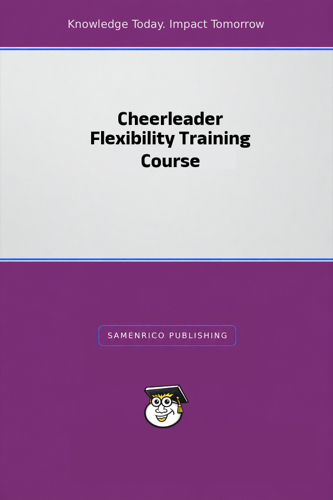
Cheerleader Flexibility Training Course Audiobook
Achieve scorpions and heel stretches with cheerlea
by Jacob Ardith
Achieve scorpions and heel stretches with cheerleading specific routines using this spirit sport flexibility guide.
Formats
Free sample
Chapter 1: The Hidden Anatomy--–- Most cheerleaders believe that if they simply stretch longer or push harder, their heel stretch will eventually rise and their scorpion will eventually deepen. They spend months sitting in oversplits, forcing their back leg to flatten against the floor, and pulling their foot toward their head with grim determination. And yet, for many, the needle does not move. The heel stays stuck at nose height. The scorpion foot remains six inches away from the crown of the head.
The frustration builds, and the inevitable question follows: What am I doing wrong?The answer, as this chapter will reveal, is both surprising and liberating. You are not failing because you lack willpower or because your body is “naturally inflexible.” You are failing because you have been working on the wrong tissues, using the wrong understanding of what flexibility actually is. This chapter will completely reframe how you think about your body, your stretches, and the very nature of a cheerleading skill.The Great Misconception: Flexibility Is Not About Tissue Length For decades, athletes and coaches have operated under a simple assumption: if you cannot touch your toes, your hamstrings are too short. If you cannot do a scorpion, your quadriceps are too tight. The solution, therefore, is to mechanically lengthen those muscles by stretching them for longer periods of time.
This is called the “tissue length model” of flexibility, and it is largely incorrect.Here is the truth that the best-selling cheerleading conditioning guides and sports science literature have established: Flexibility is primarily a neurological and strength-based skill, not a tissue length issue. Your muscles are almost never too short. In fact, the connective tissues that limit range of motion can lengthen significantly with consistent training, but the real gatekeeper is your nervous system. Your brain constantly monitors the position and tension of every muscle in your body through tiny receptors called muscle spindles and Golgi tendon organs. When you stretch, these receptors send signals to your spinal cord and brain.
If the stretch feels too intense or too sudden, your nervous system activates a protective mechanism called the stretch reflex, which causes the muscle to contract rather than relax. You have experienced this countless times: you reach for your toes, feel a sharp pull, and your legs instinctively straighten and resist. That is not your muscle being too short. That is your nervous system saying…
This is the end of the free sample. Get the Audiobook to keep going. Buy now
About this book
Details
- Author
- Jacob Ardith
- Publisher
- SamEnrico
- Language
- English
- Genre
- Non-Fiction, Health & Wellness, Cheerleading
- Released
- 2026-06-08
- Pages (approx.)
- 128
- Available as
- eBook, Audiobook

Listen in the VoxFlicks app
Audiobooks and audio dramas wherever you go. Sign in with your SamEnrico account and press play.
More by Jacob Ardith
 Gambling Addiction and Medication HandbookJacob Ardith$11.99
 Einstein Nobel Prize WaitJacob Ardith$11.99
 The Global Brain Drain IndexJacob Ardith$11.99
 Holiday Grief for ParentsJacob Ardith$11.99
 Echoes of the Ice Palace: The Frozen Secrets of the Titanic’s Last HoursJacob Ardith$11.99
 The Great Pharaoh’s Folly: Egypt’s Doomed Solar BoatJacob Ardith$11.99
 Financial Planning and Analysis ManagerJacob Ardith$11.99
 Spending Across Generations WorkbookJacob Ardith$12.99
 One Page Partnership Marketing PlanJacob Ardith$12.99
 Understanding Balo's Concentric SclerosisJacob Ardith$17.99
 How to Start a Pottery (wholesale) Business (Beginners Guide)Jacob Ardith$11.99
You may also like
 Hong Kong Handover 1997Dunn Johnnie$11.99
 Zumba For Postnatal Recovery CourseNeal Christian$11.99
 Zumba for BeginnersLadner Nikia$11.99
 YouTube Comment Mining GuideHumes Pandora$12.99
 Worry Box MeditationCarlin Rudy$11.99
 Workplace Stress MeditationNguyen Lynn$11.99
 Workplace Stress and Sleep RepairHawley Ivory$11.99
 Workplace Perfectionism CureDelaney Jeffry$11.99
 Workplace Injustice Anger GuideWallen Isabelle$11.99
 Work Addiction and Burnout LinkGreenwood Ester$11.99
 Women in Yoga and WellnessBeattie Galina$11.99
 Women in Stand Up ComedyChun Evangeline$11.99