
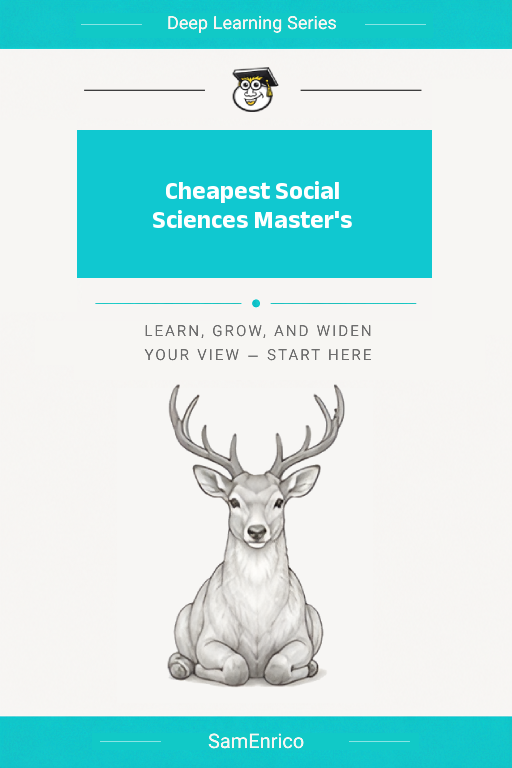
Non-FictionStudent's ShortcutSocial Sciences
Cheapest Social Sciences Master's eBook
Find low-cost sociology, political science, and ps
Find low-cost sociology, political science, and psychology master's programs in Europe.
Formats
Free sample
Chapter 1: The Hundred-Thousand-Dollar Lie--–- The email arrived on a Tuesday afternoon in March. I was twenty-three years old, sitting in my cramped studio apartment in Chicago, staring at an acceptance letter from a well-regarded university. The program was a Master of Arts in Sociology. The cost was $67,000 for one year. Not including living expenses.
Not including books. Not including the interest that would begin accruing the moment I signed.I remember calculating the monthly payment on a napkin. With a standard ten-year repayment plan at six percent interest, I would owe approximately $780 every month for a decade. That was more than my rent. That was more than my car payment.
That was more than the combined cost of food, utilities, and health insurance. I would graduate at twenty-four and spend my entire twenties writing checks to a loan servicer while watching my friends buy homes, start businesses, and build lives.And for what? A degree that would qualify me for jobs paying 55,000to55,000 to 55,000to65,000 per year. A degree that would increase my earning potential by perhaps fifteen thousand dollars annually compared to my bachelor's. A degree that, by any honest financial analysis, would take twenty-two years to break even.I did not accept that offer.
Instead, I spent the next six months doing something that felt irrational: I looked for cheaper options. I discovered that the University of Copenhagen charged no tuition for EU students and only modest fees for internationals. I learned that the University of Hamburg offered English-taught social science programs for a semester fee of €340. I found that the University of Lisbon charged €1,200 per year for a master's in sociology that was virtually identical to the $67,000 version in Chicago.That discovery changed my life. It can change yours, too.This book exists because I made a mistake that I do not want you to make.
I almost borrowed a hundred thousand dollars for a degree that I could have obtained for less than the cost of a used sedan. I almost became another statistic in a system that profits from your confusion, your fear, and your belief that expensive education must be better education.The lie is simple. It is told by university admissions officers, by well-meaning parents, by guidance counselors who have never left the country, and by a culture that equates price with quality. The lie is this: You must pay a fortune for a master's degree in the social sciences. There are no shortcuts.
Europe is for exchange students, not serious scholars. Cheap degrees are worthless degrees.None of that is true. And this chapter will prove it.The Math That Changed My Mind Let us begin with numbers. Not stories. Not testimonials.
Not inspirational quotes. Just arithmetic.Consider two students. Student A attends a private university in the United States. She enrolls in a one-year Master of Arts in Political Science. The published tuition is 65,000.Shedoesnotreceiveascholarship.Sheborrowsthefullamount.Shealsoborrows65,000.
She does not receive a scholarship. She borrows the full amount. She also borrows 65,000.Shedoesnotreceiveascholarship.Sheborrowsthefullamount.Shealsoborrows25,000 for living expenses—a modest estimate for cities like Boston, Washington DC, or Los Angeles. Total debt upon graduation: $90,000.The interest rate on federal graduate student loans is approximately six percent. If she chooses the standard ten-year repayment plan, her monthly payment will be 999.Overthelifeoftheloan,shewillpay999.
Over the life of the loan, she will pay 999.Overthelifeoftheloan,shewillpay119,880—nearly $30,000 in interest alone.Now consider Student B. He attends the University of Cologne in Germany. He enrolls in a two-year Master of Science in Social Research. Tuition: €0. Semester fee: approximately €320 per semester.
Total for two years: €1,280. His living expenses in Cologne are €900 per month, which he covers through a combination of savings, part-time work, and the €12,000 blocked account required for his visa. He graduates with €0 in student debt.Let us project forward ten years.Student A finds a job in Washington DC paying 65,000peryear—arespectablestartingsalaryforapoliticalsciencemaster′sgraduate.Aftertaxes,shetakeshomeapproximately65,000 per year—a respectable starting salary for a political science master's graduate. After taxes, she takes home approximately 65,000peryear—arespectablestartingsalaryforapoliticalsciencemaster′sgraduate.Aftertaxes,shetakeshomeapproximately4,200 per month. Her student loan payment is 1,000.Rentis1,000.
Rent is 1,000.Rentis1,800. She has 1,400leftforfood,transportation,healthinsurance,andsavings.Shedoesnotinvest.Shedoesnottravel.Shedoesnotbuildwealth.Aftertenyears,shehaspaid1,400 left for food, transportation, health insurance, and savings. She does not invest. She does not travel. She does not build wealth.
After ten years, she has paid 1,400leftforfood,transportation,healthinsurance,andsavings.Shedoesnotinvest.Shedoesnottravel.Shedoesnotbuildwealth.Aftertenyears,shehaspaid120,000 and still owes nothing because the principal has been barely touched by her minimum payments.Student B finds a job in Berlin paying €48,000 per year—approximately 20 percent less than Student A's salary, adjusted for European market differences. After taxes, he takes home approximately €2,800 per month. He has no student loan payment. His rent is €800. He has €2,000 left for food, transportation, health insurance, and savings.
He invests €500 per month in a low-cost index fund. After ten years, his investment portfolio is worth approximately $85,000. He has traveled to twenty countries using his semester ticket. He has a down payment for an apartment.The difference is not small. The difference is not marginal.
The difference is the financial equivalent of working an entire extra decade without sleeping.Of course, this is a simplified model. Real life includes variables: promotions, recessions, unexpected expenses, currency fluctuations. But the direction of the math is unmistakable. Debt is not leverage when the return on investment is uncertain. Debt is a weight.
And European social sciences degrees offer the rare opportunity to pursue advanced education without that weight.Why the System Wants You to Borrow If the math is so clear, why do so many students choose the expensive path? Why do American universities continue to raise tuition at rates far exceeding inflation? Why do students willingly sign loan documents that will follow them into their forties?The answer is not complicated. It is not a conspiracy. It is simply the logic of a system optimized for profit rather than for student outcomes.American universities compete on prestige.
Prestige is measured by rankings. Rankings are influenced by spending. Spending requires revenue. Revenue comes from tuition, endowments, and research grants. Tuition is the most reliable revenue stream.
Therefore, universities raise tuition every year because they can. There is no price ceiling because the federal government guarantees student loans, and students have been taught that any price is worth paying for a degree.This creates what economists call a "moral hazard." Universities have little incentive to control costs because students can borrow unlimited amounts. Students have little incentive to compare prices because they believe—falsely—that more expensive degrees lead to better jobs. The result is a death spiral of rising tuition, rising debt, and rising default rates.European universities operate under a completely different logic. Most are public institutions funded by tax revenue.
Their mission is not to maximize profit but to provide education as a public good. Tuition is low or zero because the state pays the cost. International students are welcome because they bring diversity, talent, and economic activity. There is no financial incentive to raise tuition. There is no marketing department convincing you that €0 education is inferior to $65,000 education.Let me be explicit: The system in which you were raised—the system of guidance counselors…
This is the end of the free sample. Get the eBook to keep going. Buy now
About this book
Details
- Author
- Montoya Griselda
- Publisher
- SamEnrico
- Language
- English
- Genre
- Non-Fiction, Student's Shortcut, Social Sciences
- Released
- 2026-05-30
- Pages (approx.)
- 140
- Available as
- eBook, Audiobook

Read better in the ZLOADR app
Your eBooks on your phone or tablet. Sign in with your SamEnrico account and start reading.
More by Montoya Griselda
 Small Talk for Virtual Happy HoursMontoya Griselda$11.99
 Affirmations for Success GuideMontoya Griselda$11.99
 Titanic Turret Clock RecoveryMontoya Griselda$11.99
 The Anger and Defensiveness FixMontoya Griselda$11.99
 Body Image Recovery WorkbookMontoya Griselda$11.99
 Resetting Your Brain From Sugar CravingsMontoya Griselda$11.99
 Acceptance Commitment SADMontoya Griselda$11.99
 Correcting A Boss RespectfullyMontoya Griselda$11.99
 The Last Oracle of Delphi: Decoding the Lost PropheciesMontoya Griselda$11.99
 The Flying Kiwi: Burt Munro and the Art of SpeedMontoya Griselda$11.99
 How to Produce Hockey Protective GearMontoya Griselda$11.99
 How to Start a Echo Sounders Business (Beginners Guide)Montoya Griselda$11.99
You may also like
 Hong Kong Handover 1997Dunn Johnnie$11.99
 Zumba For Postnatal Recovery CourseNeal Christian$11.99
 Zumba for BeginnersLadner Nikia$11.99
 YouTube Comment Mining GuideHumes Pandora$12.99
 Worry Box MeditationCarlin Rudy$11.99
 Workplace Stress MeditationNguyen Lynn$11.99
 Workplace Stress and Sleep RepairHawley Ivory$11.99
 Workplace Perfectionism CureDelaney Jeffry$11.99
 Workplace Injustice Anger GuideWallen Isabelle$11.99
 Work Addiction and Burnout LinkGreenwood Ester$11.99
 Women in Yoga and WellnessBeattie Galina$11.99
 Women in Stand Up ComedyChun Evangeline$11.99