
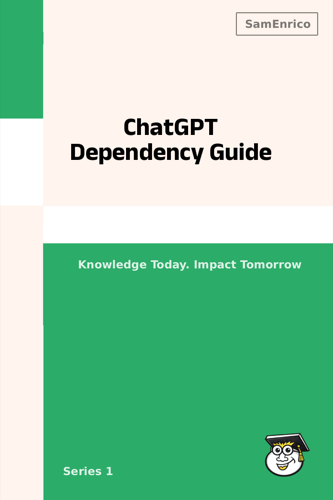
Non-FictionSelf-HelpAI Dependency
ChatGPT Dependency Guide eBook
Use AI tools without losing your own thinking skil
Use AI tools without losing your own thinking skills using this practical digital wellness handbook.
Formats
Free sample
Chapter 1: The Quiet Erosion--It begins not with a bang, but with a blank screen.You sit down to write an email—a simple email, nothing more than a few polite sentences to a colleague. Your fingers hover over the keyboard. The cursor blinks. One second passes. Five.
Thirty. Your mind, which once would have produced four draft sentences in that time, offers nothing. You feel a low-grade anxiety, a whisper of dependence that you cannot quite name. So you open Chat GPT. You type: “Write a brief email to my colleague thanking her for the meeting yesterday.” Two seconds later, the text appears.
You copy, paste, send. Relief.But the relief is a trap.This chapter is about that trap—the quiet, cumulative erosion of your cognitive abilities that happens not when AI fails, but precisely when it works. You will learn what cognitive offloading is, why your brain’s “use-it-or-lose-it” wiring makes you vulnerable to AI dependency, and how to distinguish between using AI as a crutch versus using it as a colleague. By the end of this chapter, you will have taken your first diagnostic step: the 24-Hour AI Fast.The Blank Document Anxiety In early 2024, the Wall Street Journal reported a phenomenon that had previously gone unnamed. Professionals across industries—writers, lawyers, marketers, software engineers—were reporting a strange new form of writer’s block.
They could revise and edit with ease, but they could no longer initiate. A marketing director described sitting in front of her laptop for forty-five minutes, unable to write the opening sentence of a quarterly report. A software engineer confessed that he had not written a “from scratch” function in six months; he only refactored code that Chat GPT had generated. A law firm associate admitted that she now opened Chat GPT before she had even fully defined the legal question.The reporters called it “blank document anxiety.” But it is not anxiety in the clinical sense. It is cognitive atrophy announcing itself.Here is what is happening inside your brain.
When you face a blank page, your prefrontal cortex—the region responsible for planning, initiation, and creative generation—normally activates a network of neurons that fire in a specific sequence. First, you retrieve relevant memories (what do I know about this topic?). Second, you simulate possible responses (what could I say?). Third, you select and sequence words (what will I write first?). This sequence takes energy.
It requires tolerance for discomfort. And it is a skill that improves with practice.Every time you outsource that sequence to Chat GPT, you are not saving energy for later. You are telling your brain that the sequence is no longer necessary. And your brain, ever efficient, begins to prune the neural pathways that supported it.The Science of Cognitive Offloading Cognitive offloading is not a new phenomenon. Your brain has been delegating tasks to external tools for millennia.
When you write a shopping list instead of memorizing items, you are offloading memory to paper. When you use a calculator instead of doing arithmetic in your head, you are offloading computation to a machine. When you set a calendar reminder instead of remembering a meeting time, you are offloading prospective memory to software.These are not inherently bad behaviors. In fact, cognitive offloading is one of the reasons humans have become the dominant species on the planet. We build tools to extend our cognitive capacities beyond their biological limits.
The problem is not offloading itself. The problem is chronic, non-selective offloading of tasks that are essential for maintaining cognitive fitness.To understand why, we need to talk about neuroplasticity—specifically, the “use-it-or-lose-it” principle.Your brain contains approximately 86 billion neurons, each connected to thousands of others via synapses. These connections are not permanent. They are constantly being strengthened, weakened, created, and pruned in response to your behavior. When you perform a mental task repeatedly, the associated synapses become more efficient through a process called long-term potentiation.
Think of it as a path through a forest: the more you walk it, the clearer and wider it becomes.When you stop performing a mental task, the opposite happens. Synaptic pruning—the brain’s housekeeping process—eliminates connections that are no longer being used. The forest path grows over. Weeds and branches reclaim it. Eventually, you cannot even find the trailhead.This is what chronic AI use does to your cognitive pathways.
Every time you ask Chat GPT to draft, summarize, decide, or initiate, you are failing to walk the neural path that would otherwise grow stronger. Over weeks and months, the path becomes harder to find. Over years, it may disappear entirely.The Crutch vs. Colleague Framework Not all AI use is equal. Some uses weaken your cognitive capacities.
Others strengthen them. The difference lies in a single question: Is the AI replacing your thinking or amplifying it?This book introduces a simple binary framework that you will use in every chapter, every exercise, and ultimately every interaction with Chat GPT. I call it the Crutch vs. Colleague model.A Crutch is any AI interaction that replaces a cognitive function you could and should perform yourself. When you ask Chat GPT to “write an email,” “summarize this article,” “create a project plan,” or “explain this concept,” and you do so without first attempting the task yourself, you are using AI as a crutch.
The crutch feels good in the moment. It removes friction. It produces output instantly. But over time, it weakens the very muscles it purports to support.A Colleague is any AI interaction that amplifies a cognitive function you have already engaged. When you write your own draft and then ask Chat GPT to “suggest three alternative openings,” you are using AI as a colleague.
When you summarize an article from memory and then ask Chat GPT to “check my summary for key points I missed,” you are using AI as a colleague. When you generate your own project plan and then ask Chat GPT to “identify potential risks I haven’t considered,” you are using AI as a colleague.The colleague does not replace your thinking. It challenges, expands, refines, and critiques it. The colleague leaves your neural pathways intact—and often strengthens them through the act of comparison and revision.Here is a simple test you can apply to any AI interaction: If Chat GPT disappeared right now, could you still perform the task you just asked it to do? If the answer is yes, you may be using it as a colleague.
If the answer is no—if you feel genuine uncertainty about whether you could write that email, summarize that article, or plan that project without AI—you are almost certainly using it as a crutch. And that feeling of uncertainty is not a reason to keep using the crutch. It is precisely the reason to stop.The Hidden Economy of Mental Effort To understand why crutch use is so seductive, you need to understand how your brain values effort.Neuroscientists have discovered that the brain treats mental effort as a cost. Just as your body prefers to conserve physical energy (which is why sitting is easier than standing, and standing is easier than walking), your…
This is the end of the free sample. Get the eBook to keep going. Buy now
About this book
Details
- Author
- Kaminski Lilian
- Publisher
- SamEnrico
- Language
- English
- Genre
- Non-Fiction, Self-Help, AI Dependency
- Released
- 2026-06-06
- Pages (approx.)
- 147
- Available as
- eBook, Audiobook

Read better in the ZLOADR app
Your eBooks on your phone or tablet. Sign in with your SamEnrico account and start reading.
More by Kaminski Lilian
 The Lebanese Immigrant NetworkKaminski Lilian$11.99
 Sleep Deprived Parent GuideKaminski Lilian$11.99
 HGH and Muscle AgingKaminski Lilian$11.99
 The Delegation Quadrant Eisenhower GuideKaminski Lilian$11.99
 Rhythm of the Forgotten: The Lost Tapes of Nina Simone’s ExileKaminski Lilian$11.99
 India Employment Contract Raise TermsKaminski Lilian$12.99
 Executive Weekly Theme BlocksKaminski Lilian$12.99
 Physician Account ManagerKaminski Lilian$11.99
 Understanding Mcardle DiseaseKaminski Lilian$17.99
 A Beginners Guide to Composite rules shinty-hurling (Volume 1)Kaminski Lilian$11.99
You may also like
 Hong Kong Handover 1997Dunn Johnnie$11.99
 Zumba For Postnatal Recovery CourseNeal Christian$11.99
 Zumba for BeginnersLadner Nikia$11.99
 YouTube Comment Mining GuideHumes Pandora$12.99
 Worry Box MeditationCarlin Rudy$11.99
 Workplace Stress MeditationNguyen Lynn$11.99
 Workplace Stress and Sleep RepairHawley Ivory$11.99
 Workplace Perfectionism CureDelaney Jeffry$11.99
 Workplace Injustice Anger GuideWallen Isabelle$11.99
 Work Addiction and Burnout LinkGreenwood Ester$11.99
 Women in Yoga and WellnessBeattie Galina$11.99
 Women in Stand Up ComedyChun Evangeline$11.99