
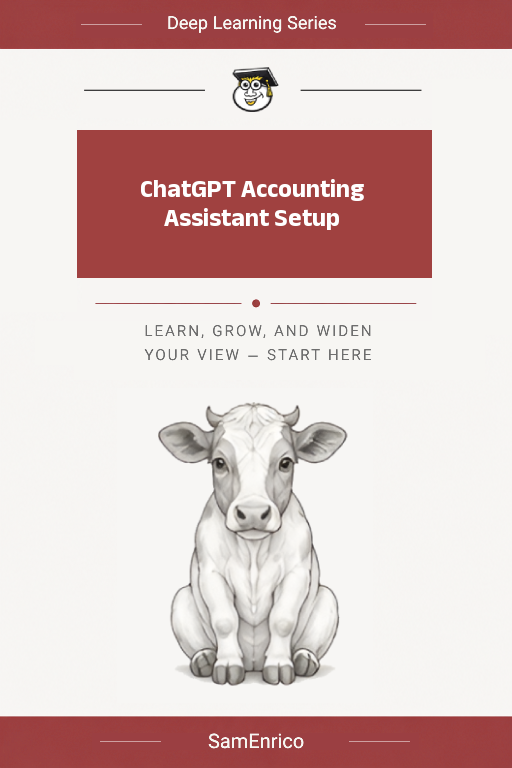
Non-FictionBusiness BriefGenerative AI
ChatGPT Accounting Assistant Setup eBook
Train custom GPT models to answer accounting quest
by Munoz Dale
Train custom GPT models to answer accounting questions draft emails and explain financial variances.
Formats
Free sample
Chapter 1: The Spreadsheet Prison-- Every accountant knows the feeling. It is Sunday evening, the house is quiet, and you are staring at a blinking cursor in Excel. The close was supposed to be done on Friday, but the marketing variance won't reconcile. The controller wants an explanation by 8 a.m. Monday.
You have the data—rows and columns of it—but transforming those numbers into a coherent, defensible narrative takes hours. You open a browser tab to search for "how to explain unfavorable labor efficiency variance" and find generic articles written by people who have never closed a book in their lives. You close the tab. You write something yourself. It feels thin.
You send it anyway.This scene plays out in thousands of accounting departments every month. The problem is not your technical skill. The problem is not that you lack the knowledge. The problem is that the tools you have been given—spreadsheets, email, generic search engines—are fundamentally mismatched to the work you actually do. You are trying to build a house with a hammer and no saw.
You can drive nails all day, but you will never cut a straight line.This book is the saw. It is not a theoretical meditation on artificial intelligence. It is a practical, step-by-step guide to building custom Chat GPT assistants that know your chart of accounts, remember your firm's policies, draft your variance explanations, and never hallucinate a tax rule. By the end of this chapter, you will understand why your current approach to AI is failing and what the four levels of accounting automation look like. More importantly, you will never again open a generic chatbot and ask it an accounting question expecting a reliable answer.The Context Gap: Why Your Chatbot Doesn't Speak Accounting Let us start with a simple test.
Open any free version of a general-purpose AI chatbot—Chat GPT, Claude, or Gemini. Type this exact question: "How should I classify a lease with a five-year term and a bargain purchase option under ASC 842?" The answer you receive will be technically correct in a vacuum. It will cite the standard correctly. It will explain right-of-use assets and lease liabilities. You might even be impressed.Now add one detail: "Our company's capitalization threshold for leases is $25,000, and our internal policy requires that all bargain purchase options be treated as finance leases regardless of the term." Ask the same chatbot the same question again.
It will ignore your internal policy. It has no memory of your threshold. It does not know that your CFO signed a memo in 2022 explicitly overriding the general guidance. The chatbot is not stupid. It is just generic.This is the Context Gap.
General-purpose AI models are trained on public data: accounting standards, textbooks, forum posts, and articles. They know GAAP and IFRS. They know what the Big 4 have published. They do not know your GAAP. They do not know that your chart of accounts uses "5500-01" for marketing expense but "5500-02" for advertising.
They do not know that your company treats software implementation costs differently than the standard allows because of a materiality election.An analogy will help. Imagine you hire a brilliant junior accountant fresh out of school. She passed the CPA exam. She knows the literature. But you hand her a stack of your internal policies and say, "Learn these before you touch anything." She reads them.
She memorizes them. She asks clarifying questions. That is what a custom GPT does. A generic chatbot is the same brilliant junior accountant who never received your policies. She answers every question based on her textbooks, not your reality.The Context Gap is not a bug in AI.
It is a feature of how general-purpose models are built. They are designed to be useful to everyone, which means they are precisely calibrated to be useful to no one in particular when it comes to proprietary, firm-specific knowledge. The only way to close this gap is to build a custom assistant that carries your policies, your thresholds, and your examples into every conversation.The Black Box Problem: When Confidence Masks Catastrophe The Context Gap is frustrating. The Black Box Problem is dangerous. Let me tell you about a real incident that did not make the news but should have.A mid-sized manufacturing company asked a general-purpose AI to review their sales tax filings for the previous six quarters.
The AI confidently produced a memo identifying three "missed exemption opportunities" totaling $47,000. The accounting manager, pressed for time and impressed by the detailed citations, forwarded the memo to the tax team. They spent 12 hours investigating. Every single exemption was invalid. The AI had invented the citations.
It fabricated statute numbers. It hallucinated court cases. The real exposure was zero. The wasted time was real.This is the Black Box Problem. Generative AI is optimized to produce text that looks correct—grammatical, confident, well-structured.
It is not optimized to produce text that is correct. When an AI does not know an answer, it does not raise its hand and say, "I do not know." It invents an answer that sounds plausible. In medical or legal contexts, this is obviously terrifying. In accounting, it is equally unacceptable because accounting is a fiduciary discipline. You are legally responsible for the numbers.
A hallucination does not just waste time; it can lead to misstatements, audit issues, and regulatory problems.Why does hallucination happen? The technical explanation involves probability distributions and next-token prediction. The practical explanation is simpler: the AI has been trained to be helpful, and being helpful sometimes means guessing. When you ask, "What is the penalty for late filing of Form 941 in Ohio?" and the AI cannot find the 2025 rate in its training data, it might interpolate from 2024. That interpolation becomes a confident sentence.
That sentence becomes your action item.The accounting profession has spent centuries building controls, review processes, and standards of evidence. Double-entry bookkeeping, audit trails, separation of duties—every control exists because we do not trust any single source of truth. The Black Box Problem asks you to trust a source that cannot show its work. You cannot audit a neural network the way you audit a spreadsheet. You cannot trace a hallucinated citation back to its source because there is no source.This is not an argument against using AI.
It is an argument for using AI correctly—with grounding, with citations, with testing protocols, and with human review. The custom assistants you will build in this book are designed specifically to reduce hallucination from "likely" to "very unlikely." They achieve this by refusing to answer outside their uploaded knowledge base, by citing specific page numbers, and by admitting ignorance. A generic chatbot cannot do any of these things.The Four Levels of AI Finance Maturity (Corrected for Accountants)Before we build anything, you need a map. Most books on AI for finance present a linear progression: start chatting, then upload files, then build custom GPTs, then fully automate. That map is incomplete and, in one critical respect, dangerous.
Let me give you the corrected version.Level 1: Chat (Basic Q&A)This is what you have already tried. You open a browser, type a question, and…
This is the end of the free sample. Get the eBook to keep going. Buy now
About this book
Details
- Author
- Munoz Dale
- Publisher
- SamEnrico
- Language
- English
- Genre
- Non-Fiction, Business Brief, Generative AI
- Released
- 2026-05-28
- Pages (approx.)
- 139
- Available as
- eBook, Audiobook

Read better in the ZLOADR app
Your eBooks on your phone or tablet. Sign in with your SamEnrico account and start reading.
More by Munoz Dale
 Unexpected Employee Departure Root Cause AnalysisMunoz Dale$11.99
 Spouse Grief Therapy GuideMunoz Dale$11.99
 The Selenium Brain ProtectionMunoz Dale$11.99
 Binge Eating In Perimenopause GuideMunoz Dale$11.99
 Non 24 Hour Disorder GuideMunoz Dale$11.99
 Hypersexuality Recovery GuideMunoz Dale$11.99
 Cannabis Use Disorder JournalMunoz Dale$11.99
 Bundeskartellamt Merger FinesMunoz Dale$11.99
 Voice Anxiety Before TalkingMunoz Dale$11.99
 The Alchemist of Florence: Botticelli’s Divine ImaginationMunoz Dale$11.99
 Operation Gold Phoenix: The Secret Mission Behind the 2008 Beijing OlympicsMunoz Dale$11.99
 How to Produce Baby RattlesMunoz Dale$11.99
You may also like
 Hong Kong Handover 1997Dunn Johnnie$11.99
 Zumba For Postnatal Recovery CourseNeal Christian$11.99
 Zumba for BeginnersLadner Nikia$11.99
 YouTube Comment Mining GuideHumes Pandora$12.99
 Worry Box MeditationCarlin Rudy$11.99
 Workplace Stress MeditationNguyen Lynn$11.99
 Workplace Stress and Sleep RepairHawley Ivory$11.99
 Workplace Perfectionism CureDelaney Jeffry$11.99
 Workplace Injustice Anger GuideWallen Isabelle$11.99
 Work Addiction and Burnout LinkGreenwood Ester$11.99
 Women in Yoga and WellnessBeattie Galina$11.99
 Women in Stand Up ComedyChun Evangeline$11.99