
Charitable Giving Guide eBook
Donate money or time to causes that reflect your p
Donate money or time to causes that reflect your purpose.
Formats
Free sample
The Generosity Algorithm: The Surprising Science of Giving That Actually Feels Good(Formerly Titled: The Purposeful Gift)Revised & Corrected Edition – In-Depth Chapter Summaries (250+ words each)Introduction: The Paradox of the Generous but Unfulfilled Donor In-Depth Summary (268 words):The book opens with a recognizable modern dilemma: the donor who writes a $5,000 check to a reputable charity, mails it, and feels… nothing. Or worse, feels resentful or detached. The Introduction argues that most giving fails not because the money isn't needed, but because the donor is disconnected from the outcome. This disconnection is the central problem the book exists to solve.It introduces the two dominant, warring philosophies in philanthropy today. Strategic Philanthropy (The "Mind") focuses on ROI, tax efficiency, overhead ratios, and measurable outcomes.
Its followers burn out on spreadsheets and data fatigue. Soulful Philanthropy (The "Heart") focuses on emotional resonance, legacy, gratitude, and giving until it feels good. Its followers get scammed, feel ineffective, or experience "compassion fatigue" when their emotional high fades.The thesis is that neither lane works alone. The solution is the "Giving Sweet Spot" —the intersection of what the world needs (data) and what breaks your heart (purpose). The reader is promised a roadmap that transforms giving from a transaction into a core component of identity.
The Introduction concludes with a preview of the book's signature framework: The Four-Bucket Allocation System (50/30/10/10), which replaces the inconsistent percentage rules found in lesser guides. This system will be fully unveiled in Chapter 5, after the reader has completed the inner work of Chapters 1-4.Chapter 1: The Inner Audit—Why "Just Writing a Check" Fails In-Depth Summary (262 words):This chapter forces the reader to stop looking outward at charities and look inward at their own motivation. It introduces the Motivation Matrix, a diagnostic tool to identify why you give—because the why determines the how and the how much.The matrix identifies three distinct motivational drivers. Guilt-Based Giving is triggered by a sad commercial or a friend's fundraising email. It is reactive, short-lived, and often leads to "donor fatigue" because guilt is a poor long-term fuel.
Tax-Based Giving is driven purely by December 31st deadlines and deduction limits. It is rational but cold; it rarely leads to repeat engagement because it contains no emotional reward. Purpose-Based Giving is the gold standard. It is proactive, aligned with your core values, and energizing rather than draining. It is the only form of giving that can be sustained for a lifetime.The chapter then introduces the "Broken Heart" test: "Recall a specific problem in the world that, when you see it or think about it, makes you feel a sense of righteous anger or deep sorrow—not just vague pity." That specific, visceral reaction is your purpose signal.
The chapter warns that vague pity ("I feel bad for hungry children") is not enough. You need a broken heart for a specific dimension of hunger (e.g., childhood malnutrition in your county's schools).Finally, it contrasts the minimum (what you think you should give to be a good person) with the meaningful (what you can give that actually changes the dynamic between you and the cause). The goal is to move from "checking the box" to "filling a need." The chapter concludes with a journaling exercise to identify the reader's dominant motivation and their Broken Heart cause.Chapter 2: The Four Capitals—Time, Talent, Treasure, and Touch In-Depth Summary (271 words):[Note: This chapter has been moved from its original position (formerly Chapter 4) to follow the Inner Audit, as recommended in the structural fixes.]Before discussing where to give or how much, the reader must understand how they can give. This chapter expands the definition of "donation" far beyond money, introducing a holistic resource model called the Four Capitals.Treasure (Money) is the easiest to give but often the least personal. It requires no time or emotional labor, which is why it is also the easiest to detach from.
Time (Hours) is scarce for professionals. The chapter helps calculate the true value of your hourly wage versus your hourly presence, arguing that time is often a more meaningful gift than money because it signals priority. Talent (Skills) is the highest-leverage asset. A lawyer writing a nonprofit's bylaws saves them $10,000 in legal fees. A marketer fixing a charity's Google Ad Words triples their donations.
This is skills-based volunteering, and it is often 10x more valuable than unskilled labor. Touch (Physical Presence) is direct service—serving soup, building a house, reading to the elderly. This provides the donor with perspective and humility in ways writing a check cannot.The chapter then addresses the tension between Talent and Touch with a clear prioritization rule: Use your Talent for the cause you care about most (high leverage). Use your Touch for causes you want to learn from (humility). If you only have one hour, choose Talent for impact, Touch for transformation.The chapter concludes with the "Ladder of Generosity" —a three-phase journey: Phase 1 begins with small, consistent giving of Treasure or Time (Chapter 3).
Phase 2 evolves into skills-based Talent donation. Phase 3 is the "Radical Sabbatical"—using a week of PTO or a career break to volunteer full-time. This ladder ensures that readers at every income and availability level have an entry point.Chapter 3: The Compound Effect of Kindness In-Depth Summary (265 words):[Note: This chapter has been moved from its original position (formerly Chapter 2) to follow the Four Capitals, placing small giving before the heavy EA debate.]This chapter serves as a direct rebuttal to the belief that "small donations don't matter." Using behavioral economics, it argues that frequency and consistency beat large, sporadic gifts every time—not just for the charity, but for the donor's psychological transformation.The Slight Edge is the first principle: automating a $5 monthly donation to a food bank (or committing to 1 hour of weekly volunteering) creates a habit of generosity. That habit rewires the brain's dopamine response, making giving as automatic and pleasurable as checking social media. The chapter cites research showing that donors who give monthly (even in small amounts) are 4x more likely to increase their giving over time than those who give one large annual gift.The Emotional Bank Account is the second principle: neuro-imaging studies show that giving activates the mesolimbic pathway (the "warm glow") more reliably than receiving money.
Small, repeated hits of this "warm glow" build a generous identity. The donor begins to see themselves as "a generous person," which then triggers more generous behavior—a positive feedback loop.Finally, the chapter dismantles the "Drop in the Bucket" Fallacy with a modified principle: "Do for one what you wish you could do for all." You cannot solve global hunger, but you can ensure one family eats tonight. That specific, tangible impact is where purpose lives. The chapter concludes with a challenge: set up one $5 recurring donation before finishing this chapter. Small giving defeats paralysis.Chapter 4: Scouting the Landscape—Finding Your "Perfect Fit" Nonprofit In-Depth Summary (258 words):*[Note: This chapter has been moved from its original position (formerly Chapter 5) to precede the EA debate, ensuring readers know the sectors before weighing the moral trade-offs.]*Many donors fail not because they lack generosity, but because they do not know what philanthropic options exist.
This chapter provides a practical tour of the major giving sectors, organized by the type of problem they solve.Education spans…
This is the end of the free sample. Get the eBook to keep going. Buy now
About this book
Details
- Author
- Bright Edward
- Publisher
- SamEnrico
- Language
- English
- Genre
- Non-Fiction, Consumer Mind Report, Nonprofit Strategy, Self-Help, Philanthropy
- Released
- 2026-06-08
- Pages (approx.)
- 152
- Available as
- eBook, Audiobook

Read better in the ZLOADR app
Your eBooks on your phone or tablet. Sign in with your SamEnrico account and start reading.
More by Bright Edward
 Financial Dependence Self Esteem HandbookBright Edward$11.99
 Box Breathing MeditationBright Edward$11.99
 Southeast Asia Remote Work HotspotsBright Edward$11.99
 Uber Driver Earnings BoostBright Edward$11.99
 Imposter Syndrome Pre Talk KillBright Edward$11.99
 Antietam: Blood and the Turning PointBright Edward$11.99
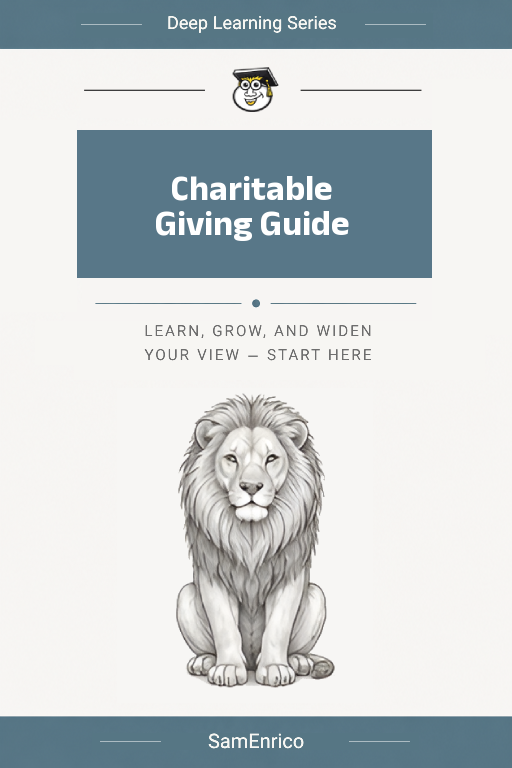 Charitable Giving GuideBright Edward$12.99
 Non Resident LLC Member Manager GuideBright Edward$12.99
 Understanding Lower Limb Deficiency HypospadiasBright Edward$17.99
 How to Become a Drawer UpfitterBright Edward$11.99
 Forex Trading Services BusinessBright Edward$11.99