
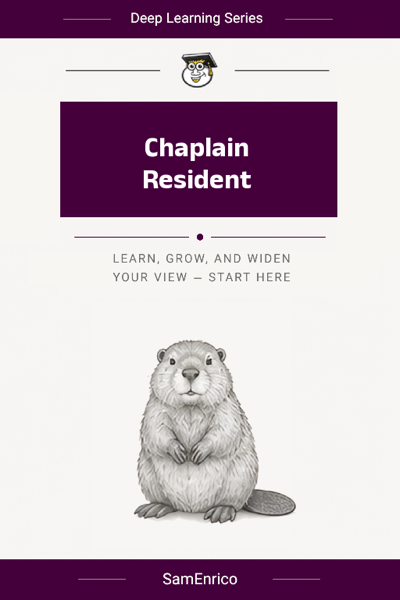
Chaplain Resident eBook
A Coursebook on Chaplain Resident
A Coursebook on Chaplain Resident
Formats
Free sample
Chapter 1: The Portal’s Threshold--The first time you walk onto a hospital unit as a chaplain resident, you will feel it. That queasy, electric mix of holy calling and utter incompetence. Your seminary training, your years of prayer, your carefully curated theology—none of it will tell you where to stand, when to speak, or how to breathe when a nurse pages a code blue and you realize you are the only spiritual care provider on call. This chapter exists because no one warned you about this moment. The best-selling books on chaplaincy assume you already know what a residency is.
The CPE orientation packets are full of policies, not wisdom. And your peers are smiling nervously, pretending they have it together.You are not alone, and you are not broken. The chaos you feel is not a sign that you chose the wrong path. It is the threshold. And this chapter is your map across it.The Myth of the Mini-Pastor Let us name the first lie you have been told, implicitly or explicitly, throughout your formation.
The lie is this: a chaplain is simply a pastor who works in a hospital instead of a church.This assumption destroys first-year residents. It leads you to carry a prayer book when you should carry silence. It makes you offer communion when a patient needs someone to hold their hand while they admit they are afraid of death. It convinces you that your job is to represent your tradition when your actual job is to enter the tradition of the person in the bed.A pastor preaches from authority. A chaplain sits in vulnerability.
A pastor represents a congregation. A chaplain represents the institution—and more importantly, represents nothing but presence. A pastor has answers. A chaplain has questions, and the humility to leave them unanswered.The residents who struggle most are the ones who cannot let go of the pastoral identity they trained so hard to earn. They arrive with sermon outlines in their heads, ready to comfort.
But the person who just lost a child does not need comfort. They need someone who can sit in the wreckage without trying to rebuild it in the same conversation.The hospital is not a parish with sicker people. It is a different country with different laws. And you are an immigrant.What This Book Is (And Is Not)Chaplain Resident is not a theology textbook. It assumes you have already done that work in seminary or your equivalent formation.
It will not teach you what to believe about suffering, evil, or death. It will teach you what to do when someone asks you those questions while their hands shake and their family cries in the corner.This book is not a CPE curriculum. It will not replicate the verbatim seminars or the group-process sessions you will experience in your residency. Instead, it gives you the conceptual framework that makes those seminars make sense. It is the map you consult after you get lost in the actual terrain.This book is also not a collection of scripts.
You will find no “Ten Things to Say to a Dying Patient” lists here. Those lists fail because every dying patient is different, and every chaplain is different, and the moment between them is unrepeatable. What you will find are frameworks, habits of mind, and reflective practices that generate your own authentic responses in real time.What this book is: a field guide to the first year of clinical chaplaincy. It is written by someone who has stood where you stand, who has frozen in doorways, who has said the wrong thing and stayed up all night replaying it. It is the book I wished someone had handed me on day one.The Hidden Curriculum of CPEEvery residency program has a formal curriculum.
You will attend seminars on ethics, documentation, grief theory, and interfaith practices. You will write verbatims and process notes. You will receive feedback from supervisors and peers.But the real learning—the formation that transforms you from a well-meaning volunteer into a professional chaplain—happens in the hidden curriculum. These are the lessons no one announces, the rules no one writes down, the truths that emerge only when you fail publicly in front of your peer group.Here are the most important elements of that hidden curriculum, named so you can see them coming.First: your emotional responses are data, not problems. In most professional settings, crying is unprofessional.
In CPE, your tears, your anger, your numbness, and your inappropriate laughter are all information about what is happening in the room. The question is not “How do I stop feeling this?” The question is “What is this feeling telling me about this patient, this family, this moment?”Second: you will be evaluated not on what you do but on what you learn from what you did wrong. A perfect verbatim—one where you said all the right things and the patient felt better—is actually a poor learning tool. The most valuable verbatim is the one where you froze, where you changed the subject, where you offered a prayer that landed like a stone. That is the visit that will teach you something.Third: your peers will see you more clearly than your supervisor can.
Your supervisor might observe you once a week for thirty minutes. Your peers will hear your verbatims, witness your reactions, and notice the patterns you cannot see in yourself. The feedback that stings the most is usually the feedback you need the most.Fourth: you will feel like a fraud. This is not a sign of imposter syndrome that will pass when you gain confidence. It is an accurate assessment of your actual competence at the beginning of the year.
You are not yet a skilled chaplain. That is why you are in residency. The fraud feeling is not a pathology to be cured. It is humility trying to break through your defenses.Fifth: the people who burn out are not the ones who care too much. They are the ones who do not know how to stop caring when they leave the building.
The hidden curriculum will teach you—through exhaustion, through tears, through the hard questions of your peers—that sustainable chaplaincy requires a disciplined exit from the unit. You will learn to leave the suffering where it belongs: with the patient, not in your chest at 2 AM.Resident vs. Intern: A Necessary Clarification Before we go further, we need to talk about words. Different programs use “intern” and “resident” in different ways. Some use “intern” for any first-year CPE student, regardless of hours.
Some use “resident” for anyone in a full-time, salaried position. Some reserve “resident” for people who have already completed at least one unit of CPE.Throughout this book, we will use the following definitions. Check them against your program’s usage, but understand the underlying distinctions.An intern is typically a first-time CPE student. They may be part-time or full-time. They are learning the most basic skills: how to enter a room, how to introduce themselves, how to end a visit.
Interns are rarely expected to carry an on-call pager overnight. Their job is to practice, to fail, and to learn…
This is the end of the free sample. Get the eBook to keep going. Buy now
About this book
Details
- Author
- Mccall Kindra
- Publisher
- SamEnrico
- Language
- English
- Genre
- Non-Fiction, Informative, Educational
- Released
- 2026-05-04
- Pages (approx.)
- 152
- Available as
- eBook, Audiobook

Read better in the ZLOADR app
Your eBooks on your phone or tablet. Sign in with your SamEnrico account and start reading.
More by Mccall Kindra
 Influencer Reality CheckMccall Kindra$11.99
 Stress Appetite ChangesMccall Kindra$11.99
 Fish Consumption Longevity GuideMccall Kindra$11.99
 The Performance Review EngagementMccall Kindra$11.99
 Kegel Exercise Technique GuideMccall Kindra$11.99
 Glitch Protocol: The Last Broadcast of Radio Free 1999Mccall Kindra$11.99
 The Breeder's Guide to Beltsville Small White TurkeysMccall Kindra$11.99
 Impact Pitch Practice GuideMccall Kindra$12.99
 Facebook Ad Frequency GuideMccall Kindra$12.99
 How to Start a Beakers Made of Paper Business (Beginners Guide)Mccall Kindra$11.99