
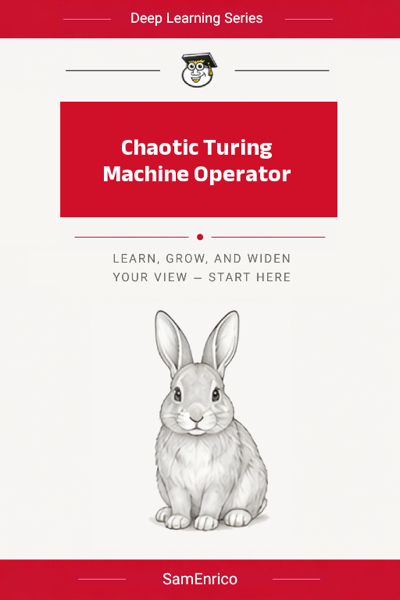
Non-FictionInformativeEducational
Chaotic Turing Machine Operator eBook
A Coursebook on Chaotic Turing Machine Operator
by Curley Kylee
A Coursebook on Chaotic Turing Machine Operator
Formats
Free sample
Chapter 1: The Ghost in the Circuit--The first time I watched a computer lie to itself, I was twenty-three years old, sitting in a dimly lit server room that smelled of burnt coffee and ozone. The machine in front of me—a perfectly ordinary rack server running a climate simulation—had been crunching the same equation for eleven hours. Every few minutes, it would spit out a result, check it against its internal error threshold, and then quietly discard the answer as “invalid.” The log files showed the same message scrolling past every thirty-seven seconds: Round-off error exceeded tolerance. Recalculating.The machine was trapped. It had convinced itself that its own calculations were untrustworthy, so it kept throwing away its work and starting over.
A perfect, deterministic loop of self-doubt executed at three gigahertz.I called my advisor, who laughed and said, “Welcome to the difference between math and physics.” Then he hung up.That night, I learned something that would take me five years to fully understand: Turing Machines don't exist. Not in the real world. They are beautiful, elegant mathematical fictions—like frictionless planes or ideal gases—that live inside textbooks and proofs. Every real computer is a different beast entirely. It is a physical object, subject to heat, noise, vibration, quantum tunneling, cosmic rays, and the slow, inexorable drift of aging capacitors.
And if you try to ignore that fact, the machine will eventually punish you by doing exactly what that climate server did: chasing its own tail forever, convinced that reality is wrong.This book is for people who want to stop pretending. It is for programmers who have felt the ground shift beneath their feet when a “deterministic” algorithm produces different results on two identical machines. It is for engineers who have watched a control system go haywire because a sensor reported 2.999 instead of 3.000. It is for physicists who know that the map is not the territory, and for computer scientists brave enough to admit that the territory actually matters.Welcome to the Chaotic Turing Machine. Welcome to the art of operating the un-operatable.1.1 The Premise of Purity: What Turing Actually Built In 1936, a twenty-four-year-old Alan Turing published a paper titled “On Computable Numbers, with an Application to the Entscheidungsproblem.” In it, he described a thought experiment so elegant that it would become the foundation of theoretical computer science.
Turing imagined a machine—not a physical device, but a mathematical abstraction—consisting of three parts:The Tape: An infinitely long strip divided into discrete squares, each containing a single symbol (typically 0 or 1).The Head: A read/write mechanism that can scan one square at a time, erase what it finds, write a new symbol, or move one square left or right.The State Table: A finite set of internal states and rules that determine what the head does next based on the current symbol and state.The brilliance of Turing’s model was its simplicity. He proved that any computation that could be performed by any mechanical device (including, eventually, the human brain) could be performed by this one machine. The Turing Machine became the gold standard for computability: if a problem can be solved by a Turing Machine, it is computable. If not, it belongs to the shadow realm of the unsolvable.But here is the detail that most textbooks gloss over: Turing’s machine was deterministic in the strongest possible sense. Given a starting tape configuration and an initial state, the entire future behavior of the machine—every symbol written, every move made—is fixed with mathematical certainty.
There is no noise. There is no drift. There is no aging components, no temperature fluctuations, no stray electromagnetic fields. The Turing Machine lives in a Platonic realm where every calculation is exact and every outcome follows inexorably from the last.That realm does not exist.1.2 The Halting Problem: A Glimpse of the Abyss Even within its perfect mathematical universe, Turing discovered a limit. He proved that no Turing Machine can decide, for all possible programs, whether another Turing Machine will eventually stop (halt) or run forever.
This is the famous Halting Problem, and it was Turing’s first crack in the wall of perfect computability.The proof is elegant. Imagine a machine H that takes as input a description of another machine M and determines whether M halts. Then construct a new machine D that, given an input M, asks H whether M halts on input M. If H says yes, D loops forever. If H says no, D halts.
Now feed D its own description. Contradiction. Therefore, H cannot exist.This result is often presented as a fascinating curiosity—a mathematical boundary beyond which computation cannot reach. And it is. But for our purposes, the Halting Problem points to something deeper.
It tells us that even in the idealized world of perfect mathematics, there are questions that cannot be answered by deterministic step-by-step reasoning. The universe of computation has inherent limits.Now imagine what happens when we leave the Platonic realm and enter the physical world. If the Halting Problem is undecidable in a perfect Turing Machine, what happens when the machine is made of hot silicon, vibrating atoms, and drifting voltages? What happens when the “state” of the machine is not a finite set of discrete symbols but a continuous analog reality that we can only approximate?We will return to this question in Chapter 11. For now, just hold onto this thought: if determinism has limits even in mathematics, those limits become vast chasms in physics.1.3 The Lie of Determinism: Why Your Computer Is Never in the State You Think It Is Every programmer has been taught that a computer is deterministic.
Given the same input and the same code, it will produce the same output. This is the bedrock assumption upon which debugging, testing, and formal verification are built.It is also, strictly speaking, false.Consider what happens inside a modern CPU. Billions of transistors switch on and off at billions of cycles per second. Each transistor is controlled by a voltage that must cross a threshold to register as a “1” rather than a “0.” But voltage is a continuous quantity, measured in fractions of a volt. Thermal noise—the random jitter of electrons caused by heat—adds fluctuations to every signal.
A transistor that should read “0” might briefly spike to “0.3” volts. If that spike happens at exactly the wrong nanosecond, a logic gate might register a “1” instead.This is not hypothetical. In 2015, researchers at the University of Toronto demonstrated that a single cosmic ray passing through a microprocessor could flip a bit in a running program. The machine continued executing, but now with a single 0 turned to 1. The result?
A financial trading algorithm that should have sold at 100.00insteadsoldat100.00 instead sold at 100.00insteadsoldat0.00. The deterministic machine became non-deterministic because the universe intervened.But we don’t need cosmic rays to break determinism. We can do it ourselves, inadvertently, every time we write a floating-point calculation.1.4 The Floating-Point Demon In mathematics, the number one-third is 13\frac{1}{3}31, a precise rational value. In a computer, one-third is represented as approximately 0.33333333333333330.33333333333333330.3333333333333333 (depending on precision). The difference between these two numbers is tiny—about 3.7×10−173.7 \times 10^{-17}3.7×10⁻¹⁷ in double…
This is the end of the free sample. Get the eBook to keep going. Buy now
About this book
Details
- Author
- Curley Kylee
- Publisher
- SamEnrico
- Language
- English
- Genre
- Non-Fiction, Informative, Educational
- Released
- 2026-05-04
- Pages (approx.)
- 146
- Available as
- eBook, Audiobook

Read better in the ZLOADR app
Your eBooks on your phone or tablet. Sign in with your SamEnrico account and start reading.
More by Curley Kylee
 Metabolic Syndrome Five SignsCurley Kylee$11.99
 Substance Induced Depressive DisorderCurley Kylee$11.99
 Detective Lou Smit JonBenétCurley Kylee$11.99
 Cooking for SobrietyCurley Kylee$11.99
 The Ball Court Strategists: How the Maya Built the First Great Sports DynastyCurley Kylee$11.99
 Learn to Play the GaidaCurley Kylee$11.99
 How to Become a Stave-log-cut-off Saw OperatorCurley Kylee$11.99
 IVR Marketing Offline GuideCurley Kylee$12.99
You may also like
 Hong Kong Handover 1997Dunn Johnnie$11.99
 Zumba For Postnatal Recovery CourseNeal Christian$11.99
 Zumba for BeginnersLadner Nikia$11.99
 YouTube Comment Mining GuideHumes Pandora$12.99
 Worry Box MeditationCarlin Rudy$11.99
 Workplace Stress MeditationNguyen Lynn$11.99
 Workplace Stress and Sleep RepairHawley Ivory$11.99
 Workplace Perfectionism CureDelaney Jeffry$11.99
 Workplace Injustice Anger GuideWallen Isabelle$11.99
 Work Addiction and Burnout LinkGreenwood Ester$11.99
 Women in Yoga and WellnessBeattie Galina$11.99
 Women in Stand Up ComedyChun Evangeline$11.99