
Non-FictionInformativeEducational
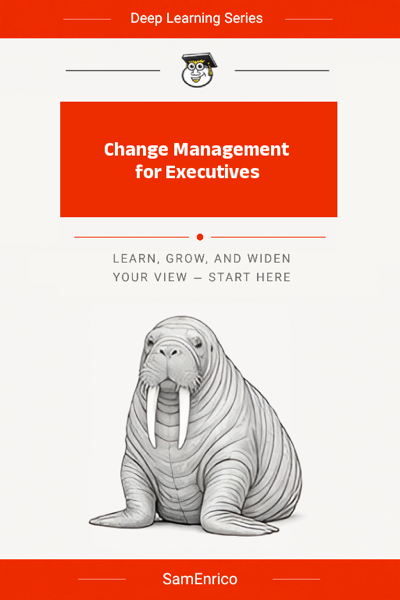
Change Management for Executives eBook
A Coursebook on Change Management for Executives
A Coursebook on Change Management for Executives
Formats
Free sample
Chapter 1: The 70% Lie--– Most executives believe that strategy is the hard part and execution is merely the follow-through. This belief is not just wrong—it is dangerous. You can have the most brilliant five-year plan ever written, backed by millions in consulting fees and hundreds of hours of leadership offsites. You can have the right people in the right seats, a healthy balance sheet, and a market tailwind at your back. None of it matters if your organization cannot change.
And here is the truth that no one tells you in business school: the average executive knows how to plan but has no idea how to lead change.The statistics are devastating and well-documented. Across industries, geographies, and company sizes, approximately seventy percent of major transformation efforts fail to achieve their stated objectives. That is not a rounding error. That is not bad luck. That is a systemic failure of leadership.
But here is what makes this statistic even more troubling: most executives who fail at change do not realize they are failing until it is too late. They confuse activity with progress. They mistake compliance for commitment. They launch initiatives with great fanfare, then wonder why, eighteen months later, nothing has fundamentally changed except that everyone is exhausted.This book exists because that failure is not inevitable. It is not even mysterious.
The causes of transformation failure have been studied, documented, and solved by researchers and practitioners over the past three decades. The problem is not a lack of knowledge. The problem is that the knowledge has not been translated into action for the one person who matters most: the executive in the corner office. This chapter will show you why strategy fails without execution, why execution fails without change leadership, and why change leadership fails without the one resource that is always in short supply at the top of organizations.The Leadership Paradox Defined Consider two hypothetical executives. Executive A spends three months developing a brilliant strategy.
She analyzes market trends, models financial scenarios, and crafts a detailed three-year plan. She presents it to the board, receives enthusiastic approval, and hands it off to her leadership team for execution. Then she moves on to the next strategic initiative. Executive B also develops a strategy, but she recognizes that the strategy is simply a hypothesis about the future. She knows that the real work begins after the plan is written.
She spends as much time designing the change process as she did designing the strategy. She anticipates resistance, builds coalitions, and personally leads the emotional journey of transformation. Which executive is more likely to succeed?The answer seems obvious, yet most executives behave like Executive A. They treat strategy as the "real" work and change management as a soft skill to be delegated to human resources or an internal communications team. This is the leadership paradox: executives are rewarded for strategic brilliance but evaluated on execution results, yet they invest almost nothing in learning how to execute through change.
You cannot delegate the human side of transformation. You cannot outsource the emotional labor of change. If you are not personally leading the change effort, you are signaling that it does not matter.Management versus Change Leadership To understand why change efforts fail, we must first distinguish between two fundamentally different activities that are almost always confused. Management is the science of optimizing existing operations. It answers questions like: How do we produce more efficiently?
How do we reduce variance? How do we improve quality within the current system? Management is about doing things right. It is essential, valuable, and completely insufficient for transformation.Change leadership is the art of guiding people through uncertainty. It answers questions like: How do we abandon what made us successful?
How do we navigate when the destination is unclear? How do we keep people engaged when the old rules no longer apply? Change leadership is about doing the right things when the right things are not obvious. It requires a different skill set, a different mindset, and a different relationship with risk.Here is the problem: executives are promoted because they are good at management. They optimized supply chains, improved sales processes, reduced costs.
Then they are asked to lead transformation, and they apply the same tools. They create project plans. They assign owners. They track milestones. These are management tools, and they are necessary but not sufficient.
What they do not do is address the fear, the resistance, the politics, and the exhaustion that accompany any significant change. You cannot project-plan your way through a crisis of meaning. You cannot milestone your way past human emotion.The executive’s unique role is to act as the Chief Change Architect. This does not mean you design every detail of the transformation. It means you create the conditions under which change can succeed.
You establish urgency. You model the new behaviors. You protect change agents from retaliation. You kill the projects that are draining energy without delivering results. And most importantly, you stay visible and engaged from the first conversation to the last, because the moment you turn away, everyone else will turn back to the old way.The Scarcity of Urgency Let us examine the most misunderstood concept in change leadership: urgency.
Most executives believe they have created urgency when they have simply announced a deadline. "We must launch this initiative by Q3" is not urgency. It is a calendar date. Urgency is an emotional state, not a logistical one. It is the genuine, visceral recognition that the status quo is more dangerous than the unknown.
Without urgency, every change effort will be met with polite nodding and quiet foot-dragging.John Kotter, one of the most cited researchers on change management, identified the creation of urgency as the first and most critical step in any transformation. In his study of successful change efforts, the leaders who succeeded did not simply announce a change. They made people feel the change in their bones. They brought customers into board meetings to describe their pain. They showed side-by-side comparisons of their declining performance against rising competitors.
They made the cost of inaction visible, personal, and immediate.But here is where most executives go wrong. They try to manufacture urgency through theatrical alarm. They declare a crisis that no one believes exists. They use fear as a blunt instrument. And it works, briefly, until people realize that the sky is not actually falling.
Then they check out completely. False urgency is worse than no urgency because it burns the very credibility you need to lead real change.True urgency is fact-based and emotionally resonant. It acknowledges both the rational case for change and the human fear of loss. It says: "Our numbers are declining. Our best people are leaving.
Our customers are telling us we are too slow. And I am scared too. But I am more scared of what happens if we do nothing." This is not weakness. This is honesty. And honesty is the foundation of trust, which is the only currency that matters in transformation.The Urgency Diagnostic Before you launch any change initiative, you must diagnose your organization’s urgency deficit.
The following four-quadrant diagnostic tool, adapted from Kotter’s framework and validated by decades of research, will help you assess whether…
This is the end of the free sample. Get the eBook to keep going. Buy now
About this book
Details
- Author
- Wilkins Nadine
- Publisher
- SamEnrico
- Language
- English
- Genre
- Non-Fiction, Informative, Educational
- Released
- 2026-05-04
- Pages (approx.)
- 149
- Available as
- eBook, Audiobook

Read better in the ZLOADR app
Your eBooks on your phone or tablet. Sign in with your SamEnrico account and start reading.
More by Wilkins Nadine
 Concierge MVP Validation MethodWilkins Nadine$11.99
 TM for AccountantsWilkins Nadine$11.99
 Bipolar Relationship Healing CourseWilkins Nadine$11.99
 Team Silent StormingWilkins Nadine$11.99
 Academic Faculty Stress GuideWilkins Nadine$11.99
 Intermittent Fasting for PregnancyWilkins Nadine$11.99
 Teen Rejection RecoveryWilkins Nadine$11.99
 Nancy Pelosi SpeakershipWilkins Nadine$11.99
 GH Research Future DirectionsWilkins Nadine$11.99
 The Last Broadcast: The Day the Internet VanishedWilkins Nadine$11.99
 Zero Day: The Untold Story of the Stuxnet CyberwarWilkins Nadine$11.99
 The Frozen Equations: Alhazen’s Arctic RevelationsWilkins Nadine$11.99
You may also like
 Hong Kong Handover 1997Dunn Johnnie$11.99
 Zumba For Postnatal Recovery CourseNeal Christian$11.99
 Zumba for BeginnersLadner Nikia$11.99
 YouTube Comment Mining GuideHumes Pandora$12.99
 Worry Box MeditationCarlin Rudy$11.99
 Workplace Stress MeditationNguyen Lynn$11.99
 Workplace Stress and Sleep RepairHawley Ivory$11.99
 Workplace Perfectionism CureDelaney Jeffry$11.99
 Workplace Injustice Anger GuideWallen Isabelle$11.99
 Work Addiction and Burnout LinkGreenwood Ester$11.99
 Women in Yoga and WellnessBeattie Galina$11.99
 Women in Stand Up ComedyChun Evangeline$11.99