
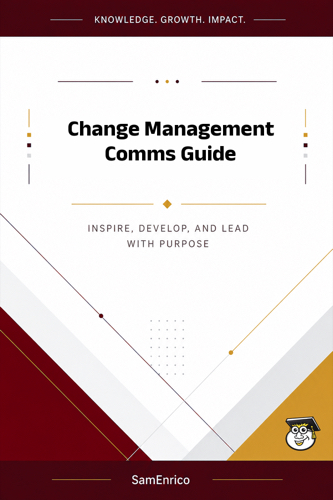
Non-FictionProfessional's Cheat SheetChange Comms
Change Management Comms Guide eBook
Communicate organizational changes effectively acr
by Lujan Sudie
Communicate organizational changes effectively across global offices.
Formats
Free sample
Chapter 1: The 10% Reality--–- The email was perfect. You spent three days on it. Legal approved it. Your VP signed off on the subject line. You hit send at 9:02 AM, and by 9:15 AM, you were already imagining the questions that would roll in—curious, engaged, maybe even excited.By 5:00 PM, nothing had happened.
No questions. No confusion. No pushback. Just silence.Three weeks later, a project manager from the Singapore office forwarded your email to a colleague with a one-line note: "Does this affect us?" You had mentioned Singapore by name. Twice.
The email was 847 words long. They had read the first sentence, skimmed the second paragraph, and closed it.This is not a failure of effort. It is not a failure of writing. It is a failure of physics.You are trying to send a signal through noise. And the noise is winning.Every day, the average global employee receives 127 emails.
They attend 3.5 hours of meetings. They toggle between Slack, Teams, Whats App, and a dozen other channels. Their attention is not a resource you can purchase with a well-crafted subject line. Their attention is a battlefield, and you are one of 47 people asking for it before lunch.This chapter is not a pep talk. It is an autopsy of why your best communication efforts fail—and the first step toward a method that actually works.The Anatomy of a Ghosted Announcement Let us name the problem precisely.
The 10% Reality is a brutal mathematical fact: in a distracted, global, multi-channel environment, only 10% of your audience will receive 10% of your message 10% of the time. The other 90% will miss it, ignore it, forget it, or misunderstand it.This is not hyperbole. This is based on internal communication data from over 200 global organizations analyzed across a decade of change management research. When employees are surveyed 72 hours after a major change announcement, fewer than one in ten can accurately recall the core "what, why, and how" of the change. Even when they have read the email.
Even when they attended the town hall.The problem is not your message. The problem is the architecture of attention.Consider what happens when an employee opens their inbox at 8:47 AM on a Tuesday. They have 23 unread messages from overnight. Their first meeting starts in 13 minutes. Their child is home sick.
Their largest customer just sent an angry note. And somewhere in the middle of the stack, buried between a calendar invite and a IT security reminder, is your beautifully crafted change announcement.They scan the subject line. They register that something is happening. They flag it for later. Later never comes.This is not malice.
This is survival. The human brain is wired to prioritize immediate threats over distant possibilities. A change that will take effect in six months is not a threat. An angry customer email is. Your announcement loses before it is even opened.And if it is opened?
The average time spent reading a corporate email is 11 seconds. In 11 seconds, a reader can absorb approximately 35 words—the length of a single paragraph. Your 847-word masterpiece required 4.5 minutes of undivided attention. You asked for something no one has to give.The Three-Way Split: Why Most Change Efforts Confuse the Problem Before we go further, we need to name three distinct disciplines that most organizations smash together into a single, dysfunctional lump.Project Management handles cost, resources, timelines, and technical deliverables. Did the software install correctly?
Was the budget met? These are binary questions. They have right and wrong answers.Change Management focuses on the people-side of transformation: readiness, adoption, proficiency, and resistance. It asks: Are people willing and able to do the new thing?Communications Management builds the narrative that makes change meaningful. It answers: What is changing?
Why now? Why should I care?Here is where almost everyone fails. They assume that good project management plus good change management equals good communication. It does not. Communications Management is not the exhaust of the other two.
It is the engine.A project can be perfectly on time and under budget. Change management can have flawless stakeholder analysis and resistance mitigation plans. But if the communication is unclear, inconsistent, or untrustworthy, the transformation will fail. Not slowly. Not quietly.
Catastrophically.I have watched a $47 million ERP implementation fail not because the software was bad, but because the Singapore office received the launch memo at 2 AM local time, misinterpreted a poorly translated phrase as a layoff notice, and spent the next three weeks in silent resistance while headquarters assumed everything was fine.The project was perfect. The change management plan was thorough. The communication was a disaster.This is why the book you are holding exists. Communications Management is not a sub-discipline of Change Management. It is the discipline.
Everything else is table stakes.The Email Trap: Why Your Best Tool Is Your Worst Enemy Let me name a villain. It is not ignorance. It is not laziness. It is convenience.The Email Trap is the belief that "I sent it, therefore they know it." It is the most seductive and dangerous fallacy in corporate communication. It feels like action.
It produces a sent folder full of evidence. It allows you to check a box and move on.Email is the channel of least resistance for the sender. It is also the channel of least attention for the receiver.Consider the physics of email in a global organization. An employee in Mumbai receives your message at 6:00 PM local time—the end of their day. They have 47 other unread messages.
They mark yours as unread for tomorrow morning. At 8:00 AM, they open it. But overnight, 14 new messages have arrived. Your message is now on page two. They skim.
They forget.An employee in San Francisco receives your message at 4:30 AM. Their phone buzzes. They do not read it. By the time they are at their desk, 5 hours later, your message has been buried by 23 others. They never see it again.Email is not a communication channel.
It is a black hole. It consumes messages and returns silence.The Email Trap has three specific symptoms. First, you find yourself forwarding the same message multiple times with "bumping this to the top of your inbox." Second, you start adding "URGENT" or "ACTION REQUIRED" to subject lines, diluting their power. Third, you assume silence means agreement, when silence almost always means "I did not read it."Breaking the Email Trap requires a radical shift in mindset. You must assume, as a starting premise, that every email you send will be seen by fewer than 20% of your audience and understood by fewer than 10%.
From that assumption, you build redundancy. From that assumption, you build multi-channel strategies. From that assumption, you build a communication plan that works despite the physics of attention, not in denial of it.The Town Hall Paradox: Live Events Are Not the Answer When email fails, most organizations do the intuitive thing: they gather everyone together. They schedule a town hall. They put a leader on a stage or a Zoom screen.
They talk for 45 minutes.This is the Town Hall Paradox. Town halls feel like communication. They look like communication. They are, in fact, one of the…
This is the end of the free sample. Get the eBook to keep going. Buy now
About this book
Details
- Author
- Lujan Sudie
- Publisher
- SamEnrico
- Language
- English
- Genre
- Non-Fiction, Professional's Cheat Sheet, Change Comms
- Released
- 2026-06-08
- Pages (approx.)
- 128
- Available as
- eBook, Audiobook

Read better in the ZLOADR app
Your eBooks on your phone or tablet. Sign in with your SamEnrico account and start reading.
More by Lujan Sudie
 Senior Self Esteem And SleepLujan Sudie$11.99
 The Behavioral Addiction Screening GuideLujan Sudie$11.99
 Gratitude as Legacy GuideLujan Sudie$11.99
 The Tumblr Fandom Comparison GuideLujan Sudie$11.99
 The Alchemists of Wall Street: How Black Economists Shaped Modern FinanceLujan Sudie$11.99
 How to Start a Civil Engineering Machinery and Equipment (wholesale) Business (Beginners Guide)Lujan Sudie$11.99
 Veterinary Client Care SpecialistLujan Sudie$11.99
 Private Annuity Rules UpdateLujan Sudie$12.99
 Employee Health ClimateLujan Sudie$12.99
 Understanding Spinal Bulbar Motor NeuropathyLujan Sudie$17.99
You may also like
 Hong Kong Handover 1997Dunn Johnnie$11.99
 Zumba For Postnatal Recovery CourseNeal Christian$11.99
 Zumba for BeginnersLadner Nikia$11.99
 YouTube Comment Mining GuideHumes Pandora$12.99
 Worry Box MeditationCarlin Rudy$11.99
 Workplace Stress MeditationNguyen Lynn$11.99
 Workplace Stress and Sleep RepairHawley Ivory$11.99
 Workplace Perfectionism CureDelaney Jeffry$11.99
 Workplace Injustice Anger GuideWallen Isabelle$11.99
 Work Addiction and Burnout LinkGreenwood Ester$11.99
 Women in Yoga and WellnessBeattie Galina$11.99
 Women in Stand Up ComedyChun Evangeline$11.99