
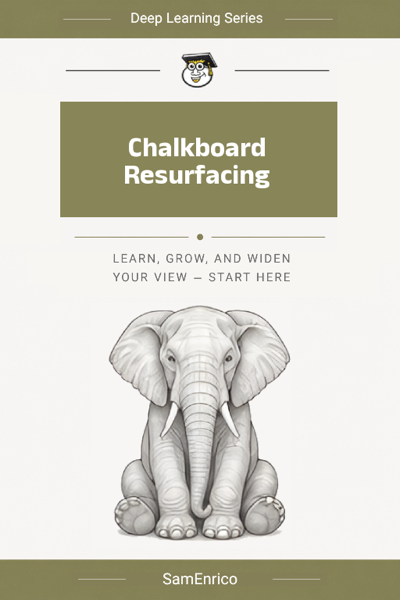
Non-FictionInformativeEducational
Chalkboard Resurfacing eBook
A Coursebook on Chalkboard Resurfacing
A Coursebook on Chalkboard Resurfacing
Formats
Free sample
Chapter 1: The Ghost in the Classroom...--The first time I saw a chalkboard truly die, I was standing in the back of a third-grade classroom in rural Ohio. The board was enormous — twelve feet wide, four feet tall, framed in varnished oak that had probably been installed when the school was built in 1953. The teacher, a woman in her sixties who had taught in that same room for thirty-four years, stood before it with a piece of yellow chalk in her hand. She wrote the date. Then she stopped.She tapped the board with her fingernail.
Nothing happened — no mark, no scratch, no indication that the surface acknowledged her presence. She wrote again, pressing harder. A faint, ghostly line appeared, like a whisper trying to become a scream. She erased it with the felt eraser, and the line did not disappear. It remained, pale but permanent, a scar on the green surface.
She looked at me and said, "It's tired. The board is just tired."She was wrong. The board was not tired. The board was dead.And the tragedy was that it didn't have to be. Someone, sometime in the previous decade, had cleaned it with a wet sponge.
Then someone else had done it again. Then a janitor had sprayed it with a generic glass cleaner. Then a substitute teacher had scrubbed it with a soapy rag to remove the ghosting that the previous wet cleanings had caused. Each act of misguided maintenance had driven chalk pigment deeper into the microscopic pores of the surface. What remained was not a chalkboard but a graveyard — a permanent record of every mistake ever made upon it.This book exists because that board — and millions like it — can be saved.
But saving it requires understanding what a chalkboard actually is, how it works, why it fails, and why almost everything you think you know about cleaning and maintaining chalkboards is wrong.The Engineering Definition of a Chalkboard: Understanding Surface Tooth Let us begin with a question that seems almost too simple to ask: What makes a chalkboard work?The answer is not the color, despite the common assumption that "green" or "black" surfaces are somehow inherently chalk-friendly. The answer is not the material, though slate, porcelain, and painted Masonite all have their own characteristics. The answer is a single physical property that engineers call tooth.Tooth is the measurable micro-texture of a surface. On a chalkboard, tooth exists in a very specific range: between 10 and 50 microns of vertical variation across the surface. To put that in perspective, a human hair is approximately 70 microns thick.
The tooth of a properly functioning chalkboard is finer than a hair but coarser than glass. It is a landscape of microscopic peaks and valleys, invisible to the naked eye but absolutely essential to the physics of writing with chalk.Here is how it works. Chalk is not a dye or an ink. It is a soft, compressed sedimentary rock — calcium carbonate — mixed with a binder that holds it together in stick form. When you drag a piece of chalk across a surface with proper tooth, two things happen simultaneously.
First, the friction between the chalk and the peaks of the surface abrades microscopic particles off the stick. Second, those particles fall into the valleys of the surface, where they are held by mechanical friction rather than by any adhesive or chemical bond. When you drag an eraser across the surface, the felt fibers sweep the particles out of the valleys and into the air or onto the eraser felt. The board returns to its original state, ready to receive new chalk.This is a beautiful piece of engineering. It is reversible, non-destructive, and entirely physical.
No chemical reaction occurs. No permanent bond is formed. The chalk and the board remain separate entities, interacting only through the geometry of the surface.Now consider what happens when the tooth is wrong. If the surface is too smooth — if the valleys are shallower than 10 microns — the chalk particles have nowhere to lodge. They skid across the surface, producing a faint, skipping line that requires excessive pressure.
This is why writing on glass or glossy paint is nearly impossible. There is no tooth.If the surface is too rough — if the valleys exceed 50 microns — the chalk particles fall in and cannot be removed by an eraser. They become permanently embedded, creating the phenomenon known as ghosting. The board appears to remember everything ever written on it, as if haunted by its own history.The ideal chalkboard exists in a narrow sweet spot between these two failures. And the entire art of chalkboard resurfacing — everything this book will teach you — is the art of restoring that sweet spot on surfaces that have lost it.The Three Horsemen of Surface Death: Ghosting, Scoring, and Chalking Every chalkboard dies three deaths.
Understanding them in order is essential to diagnosing what has gone wrong and choosing the correct resurfacing method.Ghosting is the first horseman and the most common cause of premature chalkboard death. Ghosting occurs when chalk particles migrate from the valleys of the surface into the material itself. This is not supposed to happen. In a healthy board, the valleys are dead ends — the particles lodge there temporarily but cannot penetrate deeper because the underlying material is non-porous (slate, porcelain, properly sealed paint). But when the surface becomes compromised — through age, abrasion, or chemical damage — microscopic cracks form.
These cracks act as channels, drawing chalk particles down into the substrate through capillary action. Once inside, the particles are trapped. No eraser can reach them. No cleaner can dissolve them without also dissolving the binder that holds the surface together.The early stages of ghosting are subtle. A faint shadow of yesterday's lesson remains after erasing.
The teacher shrugs and writes over it. Over months and years, the shadows accumulate until the board becomes a palimpsest — a layered manuscript of every equation, every vocabulary word, every announcement that was ever written there. By the time the ghosting becomes obvious to the naked eye, the damage is already severe.Scoring is the second horseman. Scoring is physical damage to the surface itself — scratches, gouges, and abrasions caused by improper tools or accidents. The most common culprits are metal chalk trays that have been bent and then forced back into place, scraping a line across the board; erasers that have picked up grit from the floor and become sandpaper; and vandalism (key scratches, permanent marker, or the misguided use of steel wool to "clean" ghosting).
Scoring is mechanically irreversible at the surface level. You cannot un-scratch a board any more than you can un-break a window. However — and this is crucial — scoring can often be covered through resurfacing. The 1960 patent that we will examine later in this chapter is built entirely on this principle: you do not need to repair the old surface. You only need to isolate it from the new one.Chalking is the third horseman and the most insidious.
Chalking describes the degradation of the surface binder itself — the material that holds the chalkboard's own structure together. On painted boards, this appears as a fine powder that rubs off on your…
This is the end of the free sample. Get the eBook to keep going. Buy now
About this book
Details
- Author
- Crutcher Lily
- Publisher
- SamEnrico
- Language
- English
- Genre
- Non-Fiction, Informative, Educational
- Released
- 2026-05-11
- Pages (approx.)
- 140
- Available as
- eBook, Audiobook

Read better in the ZLOADR app
Your eBooks on your phone or tablet. Sign in with your SamEnrico account and start reading.
More by Crutcher Lily
 Tinder Gold Subscription TrapCrutcher Lily$11.99
 Compulsive Shopping Triggers GuideCrutcher Lily$11.99
 Baby Sleep Pod SafetyCrutcher Lily$11.99
 Legal Risks of Work AngerCrutcher Lily$11.99
 Success Stories CollectionCrutcher Lily$11.99
 The Ghost of Station X: The Unsung Codebreakers of Bletchley ParkCrutcher Lily$11.99
 Water Tech Capital GuideCrutcher Lily$12.99
 Merger Agreement Review GuideCrutcher Lily$12.99
 Understanding Miller–dieker SyndromeCrutcher Lily$17.99
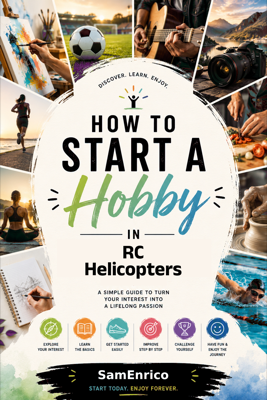 How to Start a Hobby in RC HelicoptersCrutcher Lily$11.99
You may also like
 Hong Kong Handover 1997Dunn Johnnie$11.99
 Zumba For Postnatal Recovery CourseNeal Christian$11.99
 Zumba for BeginnersLadner Nikia$11.99
 YouTube Comment Mining GuideHumes Pandora$12.99
 Worry Box MeditationCarlin Rudy$11.99
 Workplace Stress MeditationNguyen Lynn$11.99
 Workplace Stress and Sleep RepairHawley Ivory$11.99
 Workplace Perfectionism CureDelaney Jeffry$11.99
 Workplace Injustice Anger GuideWallen Isabelle$11.99
 Work Addiction and Burnout LinkGreenwood Ester$11.99
 Women in Yoga and WellnessBeattie Galina$11.99
 Women in Stand Up ComedyChun Evangeline$11.99