
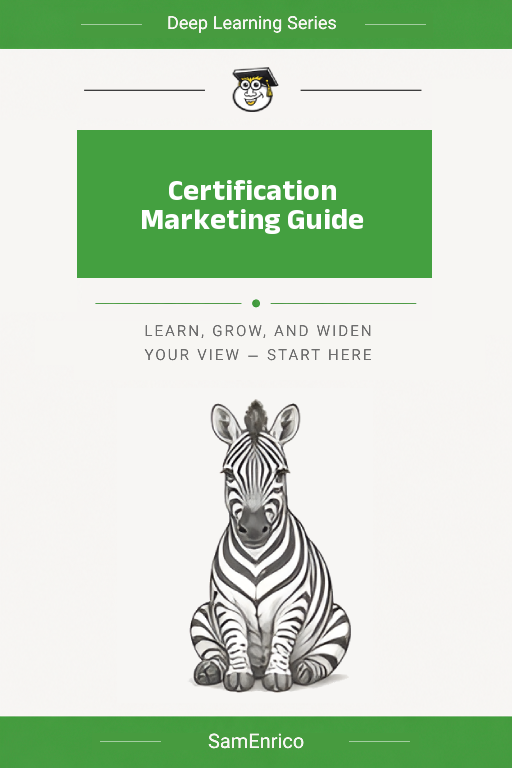
Non-FictionBusiness BriefMarketing
Certification Marketing Guide eBook
Promote sustainability certifications on packaging
Promote sustainability certifications on packaging, websites, and B2B marketing materials.
Formats
Free sample
Chapter 1: The Quiet Catastrophe--–- In a crowded boardroom overlooking a rain-streaked Manhattan skyline, the chief marketing officer of a multimillion-dollar organic food brand made a confession that would reshape how I thought about sustainability marketing forever. She slid a glossy package across the table – beautiful typography, wildflower illustrations, a premium matte finish. “We’ve held Fair Trade certification for three years,” she said, tapping the corner where the logo should have been. “We just never put it on the box. We didn't want to seem like we were trying too hard.”That moment captured the quiet catastrophe that this book exists to fix.Her product was demonstrably better for farmers, for the environment, and for the end consumer.
Her certification represented thousands of dollars in audit fees, countless hours of internal documentation, and a genuine commitment to ethical sourcing. Yet none of that value reached the shelf. None of it influenced the purchasing decision of the parent scanning the aisle. None of it differentiated her brand from the conventional product sitting two inches to the left.She was not alone. Across every sector – from apparel to electronics, home goods to industrial components – the same story plays out daily.
Companies invest significant resources to achieve legitimate, rigorous sustainability certifications. Then they hide those credentials as if they were embarrassing secrets rather than competitive weapons. They treat the certification as a compliance checkbox rather than a marketing asset. They spend money to earn trust and then spend nothing to cash that trust in.This chapter exists to diagnose that failure and to provide the foundational mindset shift required to fix it. We will explore three interconnected problems: the origins of “quiet sustainability,” the hidden costs of failing to market your certifications, and the core principle that will guide every tactical decision in the chapters that follow.
By the time you finish this chapter, you will understand not only why your certification marketing has likely underperformed, but also precisely how to begin reversing that trajectory.The Origins of Quiet Sustainability To understand why so many certified products fail to broadcast their credentials, we need to rewind to a period not long ago when sustainability claims were received with nearly universal skepticism. In the early 2000s, the term “green” entered marketing vocabulary with all the subtlety of a foghorn, but without the substance to back it up. Brands slapped leaves on packages, changed their packaging to earth tones, and issued press releases about “commitment” without providing a single verifiable metric. Consumers, increasingly sophisticated and cynical, learned to tune out environmental claims entirely.In response, a strange consensus emerged among well-intentioned sustainability professionals. They argued that the only way to avoid greenwashing was to say almost nothing at all.
Let the product speak for itself, they advised. Let the third-party certification sit quietly on the back panel. If you have to promote your green credentials, you probably don’t have real ones. This mindset, born of legitimate frustration with empty claims, metastasized into a pervasive culture of quietism that has done more harm to the sustainable products movement than any single greenwashing scandal.Consider the evidence. A 2022 global study of consumer packaged goods found that less than 15 percent of products carrying legitimate third-party ecolabels featured those labels on the primary display area of the package.
The remaining 85 percent relegated their certifications to the back panel, the side gusset, or – incredibly – the inner flap of a box that could only be seen after purchase. These companies had paid for the audit, paid for the annual fees, and paid for the right to use a trusted mark. Then they voluntarily chose to hide that mark where it could not possibly influence a purchasing decision.The same phenomenon appears in digital spaces. An audit of 500 B2B company websites revealed that 73 percent mentioned their sustainability certifications somewhere on the site, but only 12 percent had a dedicated, search-optimized verification page. The rest buried the information in PDF downloads, “About Us” subpages, or press releases from three years ago.
When a procurement officer searched for “ISO 14001 certified supplier” plus the company name, most of these certified companies did not even appear in the first page of search results. Their competitive advantage was invisible to the very buyers seeking it.The roots of this quietism run deeper than simple modesty. Three psychological forces are at work, each of which we will need to consciously counteract as we build your certification marketing strategy.First, there is the fear of greenwashing accusations. Many marketing teams have internalized the legitimate legal risks of environmental claims to such an extreme degree that they avoid any claim that cannot be accompanied by a three-page disclaimer. This risk aversion, while understandable, has created a paralysis where even truthful, verified, third-party certified claims go unmentioned.
The solution is not to avoid claims but to understand exactly what your certification permits you to say – a topic we will cover thoroughly in Chapter 2.Second, there is the assumption that consumers already know. Certification holders often believe that their certification is widely recognized and understood. The Fair Trade certified brand executive who hides the logo on the back panel assumes that anyone who cares about fair trade already knows to look for the mark. This assumption is demonstrably false. Consumer awareness of even the most prominent ecolabels rarely exceeds 30 percent in any given product category.
The consumers who care most about fair trade are also the consumers most likely to appreciate a clear, visible statement of certification.Third, there is the fear of alienating mainstream buyers. Research participants in focus groups frequently express concern that emphasizing sustainability too loudly will make their brand seem “crunchy,” “preachy,” or “expensive” to conventional consumers. This fear, while intuitively plausible, is not supported by purchase data. Meta-analyses of consumer response to certification labeling consistently show neutral or positive effects across all demographic segments. Mainstream buyers do not reject certified products because of the certification; they reject them when the certification is presented in a confusing, cluttered, or preachy manner.
The solution is better design and clearer messaging, not silence.The Hidden Costs of Silence When you hide a certification, you are not simply missing an opportunity. You are actively incurring costs that will never be recovered. Understanding these costs is essential to building the business case for the strategies we will implement throughout this book.Cost One: The Sunk Investment Without Return.You have already paid for the certification. The audit fees, the annual licensing fees, the internal labor hours spent documenting processes – these are sunk costs that will never generate a return unless the certification influences purchasing decisions. When a certification sits unseen on a back panel, its return on investment is zero.
You have spent money to earn trust and then thrown that trust away. No other marketing expense would be treated this way. Imagine spending fifty thousand dollars on a television advertisement and then airing it at three in the morning on a channel no one watches. That is precisely what quiet certification marketing accomplishes.Cost Two: The Competitive Disadvantage.Your competitors are likely already promoting their certifications, or they will soon. The market for sustainability claims is not static.
As regulatory pressure increases and consumer awareness grows, certifications will shift from differentiators to table stakes. In category after category…
This is the end of the free sample. Get the eBook to keep going. Buy now
About this book
Details
- Author
- Pantoja Elodia
- Publisher
- SamEnrico
- Language
- English
- Genre
- Non-Fiction, Business Brief, Marketing
- Released
- 2026-05-29
- Pages (approx.)
- 157
- Available as
- eBook, Audiobook

Read better in the ZLOADR app
Your eBooks on your phone or tablet. Sign in with your SamEnrico account and start reading.
More by Pantoja Elodia
 Angel Investment AccountingPantoja Elodia$11.99
 Forgiveness Emotion RegulationPantoja Elodia$11.99
 Pelvic Floor Strengthening BasicsPantoja Elodia$11.99
 Gambling Addiction For Construction WorkersPantoja Elodia$11.99
 $10 Hour Task IdentificationPantoja Elodia$11.99
 School of Diamond ThievesPantoja Elodia$11.99
 Anapanasati Beginner Breath GuidePantoja Elodia$11.99
 Eckhart Tolle PathPantoja Elodia$11.99
 The Spice King of the Gold Coast: John Holt’s Culinary EmpirePantoja Elodia$11.99
 The Ballad of the Last Wild Man: The Untold Story of the 'Wild Boy of Aveyron'Pantoja Elodia$11.99
 Mastering The Art of Istunka (Somalia)Pantoja Elodia$11.99
 How to Produce Hair CombsPantoja Elodia$11.99
You may also like
 Hong Kong Handover 1997Dunn Johnnie$11.99
 Zumba For Postnatal Recovery CourseNeal Christian$11.99
 Zumba for BeginnersLadner Nikia$11.99
 YouTube Comment Mining GuideHumes Pandora$12.99
 Worry Box MeditationCarlin Rudy$11.99
 Workplace Stress MeditationNguyen Lynn$11.99
 Workplace Stress and Sleep RepairHawley Ivory$11.99
 Workplace Perfectionism CureDelaney Jeffry$11.99
 Workplace Injustice Anger GuideWallen Isabelle$11.99
 Work Addiction and Burnout LinkGreenwood Ester$11.99
 Women in Yoga and WellnessBeattie Galina$11.99
 Women in Stand Up ComedyChun Evangeline$11.99