
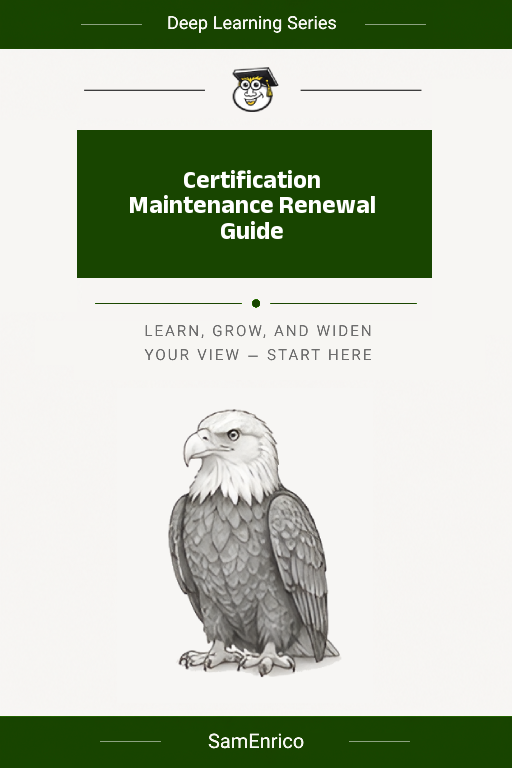
Non-FictionBusiness BriefMaintenance
Certification Maintenance Renewal Guide eBook
Manages ongoing compliance costs, annual audits, a
Manages ongoing compliance costs, annual audits, and renewal deadlines for sustainability certifications to avoid lapses in export status.
Formats
Free sample
Chapter 1: The Million-Dollar Gap--–- The Fed Ex envelope arrived at 4:47 PM on a Friday. Maria Vasquez, compliance director for a $47 million organic spice exporter, almost didn't open it. She was already packing her bag for a weekend trip to see her daughter's college soccer final. But something about the red "URGENT" stamp made her tear the perforated seal.Inside was a single sheet of paper from their largest European buyer, a German organic wholesaler that accounted for 62% of annual revenue. Three paragraphs.
One bullet point that stopped her heart:"Your ISO 14001 certification expired 11 days ago. As such, we are unable to accept shipments pending reinstatement of your active certification status. All pending containers will be held at port pending further notice."Maria stared at the date on her office wall calendar. November 17th. Her certification had expired on November 6th.
She had missed it by eleven days. Not eleven months. Not eleven weeks. Eleven days.The weekend trip never happened. Instead, Maria spent Saturday morning on a conference call with their German buyer's compliance officer, a man named Klaus who spoke in the flat, unapologetic tone of someone delivering a weather forecast rather than a death sentence.
He explained that the company's procurement software automatically flagged any supplier with a lapse in certification. The flag triggered an immediate hold on all open purchase orders. Reinstatement required not just proof of renewed certification, but a full supplier re-audit at Maria's company's expense—$18,000 plus travel costs from Frankfurt to their facility in North Carolina.The phone call ended at 9:47 AM. By 9:52 AM, Maria was on the line with their certifying body, begging for an emergency renewal. The answer was polite but firm: no exceptions.
The certification had lapsed. She would need to begin the recertification process from scratch. The earliest available audit slot was eight weeks out.Eight weeks of held shipments. Eight weeks of their German buyer sourcing from competitors. Eight weeks of interest accruing on containers of organic turmeric and cumin sitting in a Rotterdam warehouse.By the time Maria hung up, she had already done the math.
The direct costs of the lapse—rush recertification fees, expedited audit travel, port storage fees, contract renegotiation penalties—would exceed 90,000.Theindirectcosts—lostrevenuefromtheeight−weekpause,thepermanentlossoftwosmaller Europeanbuyerswhohadquietlymovedtoacertifiedcompetitorduringthelapse,andtheinternalhoursspentfirefightinginsteadofstrategicwork—wouldpushthetotalpast90,000. The indirect costs—lost revenue from the eight-week pause, the permanent loss of two smaller European buyers who had quietly moved to a certified competitor during the lapse, and the internal hours spent firefighting instead of strategic work—would push the total past 90,000.Theindirectcosts—lostrevenuefromtheeight−weekpause,thepermanentlossoftwosmaller Europeanbuyerswhohadquietlymovedtoacertifiedcompetitorduringthelapse,andtheinternalhoursspentfirefightinginsteadofstrategicwork—wouldpushthetotalpast230,000.All because of eleven days.The Invisible Catastrophe Maria's story is not an outlier. It is not a cautionary tale about an unusually careless compliance officer. It is, according to data from the International Accreditation Forum, a story that plays out in some form hundreds of times each year across the global supply chain. The specific details change—the certification type, the industry, the dollar amount—but the underlying pattern is maddeningly consistent: a perfectly good certification, maintained for years, allowed to expire because someone missed a deadline, overlooked a fee payment, or underestimated the lead time required for a recertification audit.The tragedy is that most of these lapses are entirely preventable.
They are not failures of technical competence or environmental performance. They are failures of maintenance—the unglamorous, uncelebrated, relentlessly administrative work of tracking deadlines, managing documentation, forecasting costs, and coordinating audits. This is not the work that earns anyone a promotion. It is not the work that gets highlighted in sustainability reports or celebrated at industry conferences. But when it fails, the consequences are swift, severe, and disproportionately large relative to the effort required to prevent them.This book exists to ensure that you never experience your own version of Maria's Fed Ex envelope.
Whether you manage a single certification or a portfolio of them across multiple facilities, whether you work for a multinational corporation or a twenty-person startup, the systems and strategies in these pages will transform certification maintenance from a source of anxiety into a predictable, manageable, even strategic advantage.The Four Risks of a Lapse Before we build the systems that prevent lapses, we must understand exactly what is at stake. The risks of allowing a certification to expire fall into four distinct categories, each capable of causing damage far beyond the immediate cost of recertification.Risk One: Loss of Export Status For thousands of companies, particularly those in food, forestry, electronics, and manufactured goods, sustainability certifications are not badges of virtue—they are passports to international markets. The European Union, for example, requires ISO 14001 certification for suppliers in multiple regulated categories. Japan's Green Procurement Law gives preference to certified suppliers. Major retailers including Walmart, Tesco, and Carrefour require active certifications as a condition of doing business.When a certification lapses, the effect is not gradual.
It is instantaneous. Customs databases, procurement platforms, and supplier registries are often integrated with certifying bodies' public records. The moment a certification expires, the automated systems that gatekeep international trade update accordingly. Shipments already in transit may be held at port. Purchase orders in the pipeline are frozen.
Future orders are rerouted to competitors.The cost of this disruption is not merely the value of the held shipments. It is the relationship damage with buyers who must scramble to find alternative suppliers. It is the signal sent to the market that your organization cannot manage basic compliance. It is the months, sometimes years, required to rebuild trust and claw back lost market share.Risk Two: Supply Chain Disqualification The era of "trust but verify" in supply chain management is over. Today's largest buyers operate under a "prove it or lose it" framework.
Walmart's Project Gigaton, Amazon's Climate Pledge Friendly, and similar initiatives at Home Depot, Lowe's, and Target all require active, current certifications from suppliers. These requirements are not suggestions. They are contractual obligations built into supplier agreements.When a certification lapses, the buyer's compliance team receives an alert. Depending on the strictness of the contract, consequences range from a formal warning to automatic disqualification from bidding on new contracts to immediate termination of existing agreements. For suppliers in competitive categories with thin margins, losing a major buyer over a lapsed certification is not a financial setback—it is an existential crisis.Consider the case of a Midwest-based automotive parts supplier that allowed its ISO 14001 certification to lapse by six weeks.
The company had supplied Ford Motor Company for nineteen years with zero quality issues. But Ford's supplier management system was automated. The lapse triggered an automatic hold on new purchase orders. By the time the supplier renewed its certification, two competitors had been invited to bid on the contracts that had been exclusively theirs for nearly two decades. The supplier never fully recovered the lost volume.Risk Three: Legal Liabilities The legal risks of a lapsed certification are less obvious but potentially more devastating than any commercial consequence.
Many sustainability certifications serve as presumptive evidence of regulatory compliance in environmental, health, and safety matters. An active ISO 14001 certification, for example, is often accepted by regulators as demonstration of a functioning environmental management system.When a certification lapses, that presumptive evidence disappears.…
This is the end of the free sample. Get the eBook to keep going. Buy now
About this book
Details
- Author
- Bustamante Theressa
- Publisher
- SamEnrico
- Language
- English
- Genre
- Non-Fiction, Business Brief, Maintenance
- Released
- 2026-06-01
- Pages (approx.)
- 158
- Available as
- eBook, Audiobook

Read better in the ZLOADR app
Your eBooks on your phone or tablet. Sign in with your SamEnrico account and start reading.
More by Bustamante Theressa
 ISO 27001 Refresh ReportBustamante Theressa$11.99
 Alcohol Withdrawal Protocol ExamplesBustamante Theressa$11.99
 Bipolar And Sleep ApneaBustamante Theressa$11.99Bipolar And Sleep ApneaBustamante Theressa$11.99
 Graduate Student Imposter SyndromeBustamante Theressa$11.99
 The Teen Self Esteem WorkbookBustamante Theressa$11.99
 The Boto Cor-de-Rosa: Amazon’s Shapeshifting River EnchanterBustamante Theressa$11.99
 Conveyor Belt Loading (Ski Lift)Bustamante Theressa$11.99
 Executive Summary for Grant ProposalsBustamante Theressa$12.99
 Understanding Primary Orthostatic TremorBustamante Theressa$17.99
You may also like
 Hong Kong Handover 1997Dunn Johnnie$11.99
 Zumba For Postnatal Recovery CourseNeal Christian$11.99
 Zumba for BeginnersLadner Nikia$11.99
 YouTube Comment Mining GuideHumes Pandora$12.99
 Worry Box MeditationCarlin Rudy$11.99
 Workplace Stress MeditationNguyen Lynn$11.99
 Workplace Stress and Sleep RepairHawley Ivory$11.99
 Workplace Perfectionism CureDelaney Jeffry$11.99
 Workplace Injustice Anger GuideWallen Isabelle$11.99
 Work Addiction and Burnout LinkGreenwood Ester$11.99
 Women in Yoga and WellnessBeattie Galina$11.99
 Women in Stand Up ComedyChun Evangeline$11.99