
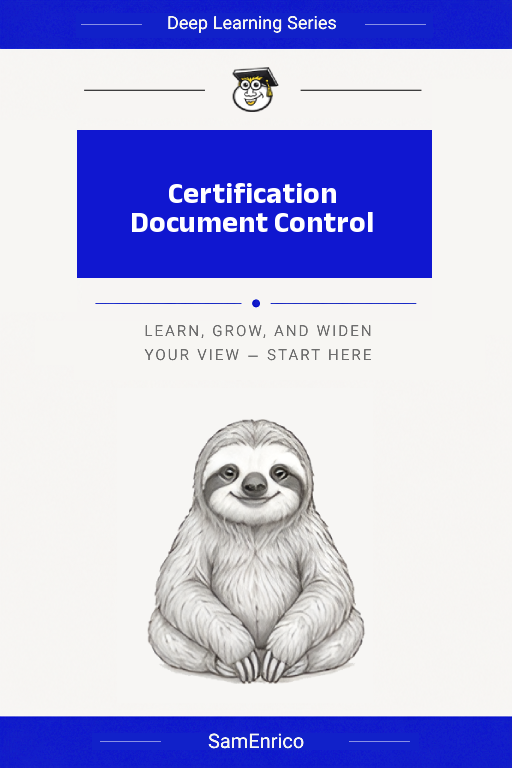
Certification Document Control eBook
Manage sustainability certification documentation
by Khan Barbera
Manage sustainability certification documentation for export with version control, retention policies, and e-library systems.
Formats
Free sample
Chapter 1: The Paperwork Paradox--–- In a refrigerated warehouse just outside Rotterdam, a forty-foot container sat unopened for twenty-three days. Inside was $420,000 worth of frozen organic beef from a certified sustainable farm in Paraguay. The beef was flawless. The cold chain was unbroken. The certificates of organic certification, sustainability compliance, and veterinary inspection were all present, signed, and stamped.The container never cleared customs.The problem was not a missing document.
It was a document that existed in two versions. The exporter had issued a Proof of Sustainability on March 15th. The freight forwarder, unable to find that email, had requested a replacement on March 28th. The exporter, unaware that the original had already been sent, issued a second Proof of Sustainability with a new document number. The buyer received both.
Customs received the first. The sustainability certification body, when queried, confirmed that only the second document number was valid because the first had been "superseded" internally.Three versions of reality. One container. Zero solutions.The beef was eventually donated to a food bank after the exporter paid $47,000 in storage fees and lost the customer permanently. The exporter's quality manager told me six months later: "We had all the documents.
We just couldn't prove which one was real."That sentence captures the central paradox of modern export documentation. Having the right certificates is no longer enough. You must also prove, beyond any reasonable doubt, that those certificates are authentic, current, and properly linked to the specific shipment they accompany. You need documents about your documents. You need metadata, audit trails, version histories, and controlled repositories.
You need, in short, certification document control.The Silent Transformation of Global Trade For most of maritime history, paperwork played a supporting role. The bill of lading proved ownership. The commercial invoice proved value. The certificate of origin proved nationality. Everything else was secondary.
Customs officials focused on tariffs and contraband, not on whether a sustainability declaration had been issued within thirty days of shipment.That world ended sometime between 2018 and 2025, though few noticed the transition happening in real time.The European Union's Renewable Energy Directive (RED II), fully implemented in 2021, required biofuels to demonstrate 70% greenhouse gas savings compared to fossil fuels. That demonstration required documentation. Lots of documentation. The ISCC certification scheme, which dominates the biofuel market, responded by creating a Proof of Sustainability document that must follow every shipment from feedstock to fuel pump. Miss a signature, a date, or a linkage between documents, and the sustainability claim evaporates.Then came the EU Deforestation Regulation (EUDR), effective June 2025 for large operators and June 2026 for small ones.
For the first time, importers into the EU must prove that specific products—soy, palm oil, coffee, cocoa, rubber, wood, and cattle—did not come from land deforested after December 31, 2020. The proof requires geolocation polygons for every plot of land involved in production. Not GPS points. Polygons. The difference is like providing a full architectural blueprint versus a single dot on a map.The Carbon Border Adjustment Mechanism (CBAM), phased in from 2026 to 2034, requires importers of carbon-intensive goods to report and eventually pay for embedded emissions.
The documentation must trace emissions from raw material extraction through final production. Each step requires verified data. Each data point requires a document. Each document requires control.These three regulations alone have transformed sustainability documentation from a niche concern into a core business process. And they are not outliers.
Japan's Green Transformation (GX) policy, the UK's post-Brexit environmental standards, and California's Low Carbon Fuel Standard all operate on similar principles: prove it with documents, or it did not happen.Why "We Have the Certificates" Is No Longer Enough I have heard some variation of this sentence from hundreds of exporters: "But we have the certificate. It's right here." Then they pull up a PDF on their laptop. The auditor looks at the PDF, then looks at the exporter, then asks a series of questions that the exporter cannot answer.Who issued this certificate to you? The name is on the document, but can you prove that the person who signed it was authorized to do so on that date?When was this certificate issued to you? The date is on the document, but can you prove that this version is the most current and that no subsequent revisions have been made?What shipments does this certificate apply to?
The certificate may list batch numbers, but can you prove that those batches actually shipped and that no other shipments used the same certificate fraudulently?Who has seen this certificate? The document may have been emailed to a dozen people, but can you prove that none of them altered it before forwarding it?Is this certificate still valid? The expiration date may be in the future, but can you prove that no suspension or withdrawal has occurred since the document was issued?These questions are not hypothetical. I have watched auditors ask every single one. I have watched exporters stammer, shuffle papers, and eventually admit that they could not answer.
The certificates were genuine. The products were compliant. But the documentation control was absent, and the audit failed.This is the paperwork paradox: more documents create more uncertainty unless those documents themselves are managed as rigorously as the products they describe.The Anatomy of a Documentation Failure Let us dissect a real failure to understand how seemingly minor gaps compound into catastrophic results.A Southeast Asian palm oil exporter, which I will call Agri Global, held valid ISCC certification. It shipped 5,000 metric tons of palm oil to a Dutch biofuel refiner. The shipment was divided into three containers, each with its own Proof of Sustainability document.
All three documents were issued correctly, within the thirty-day window, with all required signatures.The shipment arrived in Rotterdam. The Dutch refiner accepted it. Payment was made. Success.Six months later, an auditor arrived at Agri Global's headquarters for the annual ISCC recertification audit. The auditor requested documentation for three random shipments, including the Rotterdam shipment.
Agri Global's documentation team pulled the files.This is what they found:File One: The Proof of Sustainability for the Rotterdam shipment's first container was present, but the metadata showed it had been last modified two weeks after the shipment date. No log indicated who made the modification or why.File Two: The second container's Proof of Sustainability was present, but the batch number on the document did not exactly match the batch number on the bill of lading. One document said "Batch 4012-A." The other said "Batch 4012A." The difference was a single hyphen.File Three: The third container's Proof of Sustainability could not be found at all. A search of the shared drive revealed a file named "ISCC_Po S_FINAL.pdf" and another named "ISCC_Po S_FINAL_FINAL.pdf." Neither matched the shipment date.The auditor issued three non-conformances. Agri Global had thirty days to respond.Here is where the story becomes instructive.
Agri Global had the correct certificates. The palm oil was genuinely sustainable. The shipment had been accepted and paid for. But because the documentation system could not prove these facts to an auditor's satisfaction, Agri Global faced certification suspension.The company spent 180 staff hours…
This is the end of the free sample. Get the eBook to keep going. Buy now
About this book
Details
- Author
- Khan Barbera
- Publisher
- SamEnrico
- Language
- English
- Genre
- Non-Fiction, Business Brief
- Released
- 2026-05-28
- Pages (approx.)
- 151
- Available as
- eBook, Audiobook

Read better in the ZLOADR app
Your eBooks on your phone or tablet. Sign in with your SamEnrico account and start reading.
More by Khan Barbera
 Self Talk for Grief WorkbookKhan Barbera$11.99
 Anxiety Relief Body ScanKhan Barbera$11.99
 Self Esteem AffirmationsKhan Barbera$11.99
 Unsubscribe From TemptationKhan Barbera$11.99
 The Influencer Affiliate Link GuideKhan Barbera$11.99The Influencer Affiliate Link GuideKhan Barbera$11.99
 The Opium King of Cairo: The Fraud That Poisoned an EmpireKhan Barbera$11.99
 Understanding Urinary Tract NeoplasmKhan Barbera$17.99
 Low Income Customer PersonaKhan Barbera$12.99
 Grocery StockerKhan Barbera$11.99
 How to Start a Domestic Non-electric Heating Equipment Business (Beginners Guide)Khan Barbera$11.99
You may also like
 Hong Kong Handover 1997Dunn Johnnie$11.99
 Zumba For Postnatal Recovery CourseNeal Christian$11.99
 Zumba for BeginnersLadner Nikia$11.99
 YouTube Comment Mining GuideHumes Pandora$12.99
 Worry Box MeditationCarlin Rudy$11.99
 Workplace Stress MeditationNguyen Lynn$11.99
 Workplace Stress and Sleep RepairHawley Ivory$11.99
 Workplace Perfectionism CureDelaney Jeffry$11.99
 Workplace Injustice Anger GuideWallen Isabelle$11.99
 Work Addiction and Burnout LinkGreenwood Ester$11.99
 Women in Yoga and WellnessBeattie Galina$11.99
 Women in Stand Up ComedyChun Evangeline$11.99