
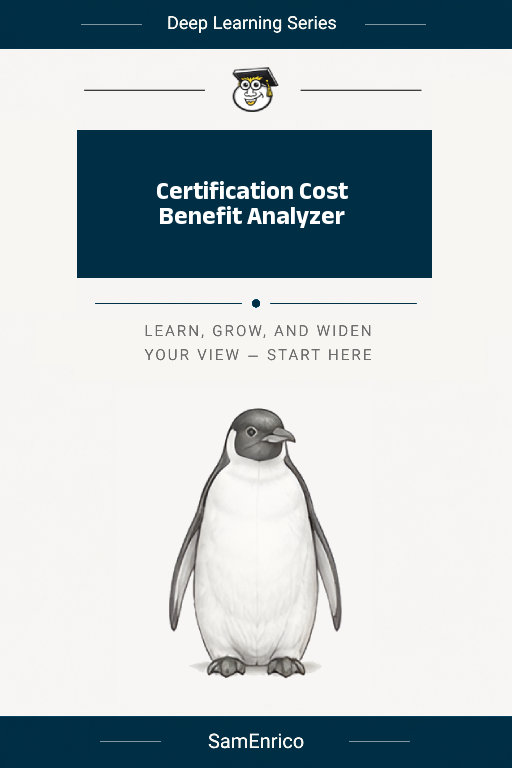
Certification Cost Benefit Analyzer eBook
Calculate ROI for 30 sustainability certifications
by Gandy Ulrike
Calculate ROI for 30 sustainability certifications with payback periods, premium pricing, and market access value.
Formats
Free sample
Chapter 1: The Million Dollar Badge--–- In 2019, a mid-sized specialty coffee roaster in Portland, Oregon, paid 47,000tobecome Fair Trade Certified.Theyprintednewpackaging,trainedtheirsalesteam,andlaunchedamarketingcampaigncelebratingtheirethicalsourcing.Oneyearlater,theyhadgeneratedexactly47,000 to become Fair Trade Certified. They printed new packaging, trained their sales team, and launched a marketing campaign celebrating their ethical sourcing. One year later, they had generated exactly 47,000tobecome Fair Trade Certified.Theyprintednewpackaging,trainedtheirsalesteam,andlaunchedamarketingcampaigncelebratingtheirethicalsourcing.Oneyearlater,theyhadgeneratedexactly12,000 in additional revenue directly attributable to the certification. Their CFO, who had opposed the investment from the start, calculated the ROI at negative 74 percent. The sustainability manager who championed the initiative was quietly reassigned.
The certification was not renewed.Three thousand miles away, a family-owned textile mill in South Carolina spent 28,000toachieve GOTScertificationfortheirorganiccottonline.Theydidnotrunamarketingcampaign.Theydidnotchangetheirpackaging.Theysimplyrespondedtoan RFPfroma Europeanapparelbrandthatrequired GOTSasaconditionofbidding.Thatsinglecontractwasworth28,000 to achieve GOTS certification for their organic cotton line. They did not run a marketing campaign. They did not change their packaging. They simply responded to an RFP from a European apparel brand that required GOTS as a condition of bidding. That single contract was worth 28,000toachieve GOTScertificationfortheirorganiccottonline.Theydidnotrunamarketingcampaign.Theydidnotchangetheirpackaging.Theysimplyrespondedtoan RFPfroma Europeanapparelbrandthatrequired GOTSasaconditionofbidding.Thatsinglecontractwasworth2.4 million annually.
The certification paid for itself in the first six weeks.Two companies. Two sustainability certifications. One lost money. One printed money. The difference was not the certification itself.
Both Fair Trade and GOTS are legitimate, well-regarded standards. The difference was something far more fundamental: one company treated certification as a marketing expense, the other treated it as a capital investment with a calculable return.This book exists because that distinction is the difference between wasting hundreds of thousands of dollars and building a durable competitive advantage.The Great Certification Gold Rush We are living through an unprecedented expansion of sustainability certification schemes. As of 2025, there are more than 450 active ecolabels and certification programs worldwide, according to the Ecolabel Index. The global market for certified products exceeded 1.2trillionin2024.Companiesarespendinganestimated1.2 trillion in 2024. Companies are spending an estimated 1.2trillionin2024.Companiesarespendinganestimated15 billion annually on certification fees, audit costs, consultant services, and internal compliance labor.And most of that money is being wasted.Not because certifications are useless.
They are not. The best certifications deliver measurable financial returns through premium pricing, operational savings, market access, and reduced cost of capital. But the worst certifications are expensive badges that no customer has ever asked for, no retailer has ever required, and no lender has ever discounted. The challenge facing every sustainability manager, supply chain director, and CFO is not whether to pursue certification. It is which certification to pursue, in what order, at what cost, and with what expected return.This book provides the answer to that question.The Silo Problem The primary failure mode of most certification initiatives is structural, not technical.
Decision-making is isolated in departments that do not speak the language of return on investment. Sustainability teams chase certifications that look good in annual reports. Marketing teams want badges that differentiate products on crowded shelves. Supply chain teams need compliance documentation to satisfy buyer scorecards.But no one calculates the payback period.No one runs a net present value analysis.No one asks the question that a CFO would ask before approving a million-dollar capital expense: what is the internal rate of return on this investment?This chapter diagnoses that failure and introduces the framework that will transform how you evaluate every certification you consider from this point forward.Consider the data. A 2023 study by the Sustainability Accounting Standards Board found that only 12 percent of companies that hold sustainability certifications can calculate the return on investment for those certifications.
The other 88 percent simply renew year after year because they always have. They treat certification like a utility bill rather than an investment thesis.This book is for the 12 percent. And for the 88 percent who want to join them.The Capital Asset Shift The most important sentence you will read in this book is this: treat every certification as a capital asset with a calculable payback period, net present value, and risk profile.A capital asset is something you buy that produces value over time. A factory machine. A fleet of trucks.
A software platform. You would never purchase a million-dollar piece of equipment without running the numbers. You would never approve a new warehouse lease without projecting the return.Yet companies routinely spend hundreds of thousands of dollars on certifications without ever calculating whether those certifications will pay for themselves.This book changes that.The methodology we will build together treats certification as an asset with four distinct value streams:First, premium pricing. Some certifications allow you to charge more for your products or services. Organic coffee commands 12 to 22 percent premiums.
LEED-certified office space commands 2 to 5 percent higher rent. But premium pricing is not automatic. It depends on market conditions, customer awareness, and competitive density.Second, operational alpha. Many certifications force process improvements that reduce energy consumption, waste disposal fees, and material costs. ISO 50001 delivers 5 to 15 percent energy reduction in year one.
TRUE Zero Waste cuts disposal costs by 15 to 30 percent. These savings are predictable, measurable, and often larger than premium pricing.Third, market access value. Some certifications are not about charging more. They are about being allowed to bid at all. Government contracts, major retailer scorecards, and EU export requirements increasingly mandate specific certifications.
The value of market access is the annual contract value multiplied by the probability of losing that contract without certification. For many B2B companies, this is the largest and most overlooked ROI component.Fourth, cost of capital impact. Certified companies increasingly qualify for green loans and sustainability-linked loans with interest rate discounts of 5 to 25 basis points. On a 10millionloan,thattranslatesto10 million loan, that translates to 10millionloan,thattranslatesto50,000 to $250,000 in annual interest savings. This is free money for doing what you were already doing.Four value streams.
One unified framework. The Certification Cost Benefit Analyzer Score, or CBA Score, collapses these four streams into a single number from zero to one hundred that tells you exactly which certifications will make you money and which will burn it.The CBA Score Explained The CBA Score is the central analytical tool of this book. It combines five financial metrics into a weighted score that you can calculate for any certification before you spend a dollar.The five metrics are:Net Present Value, weighted at 30 percent. This is the sum of all future cash flows from certification—premium pricing, operational savings, market access value, and interest savings—discounted to today's dollars. A positive NPV means the certification creates value.
A negative NPV means it destroys value.Payback Period, weighted at 25 percent. This is the number of months or years until cumulative benefits exceed cumulative costs. Payback under two years is exceptional. Two to five years is standard. Over five years requires strategic justification.Internal Rate of Return, weighted at 20 percent.
This is the annual percentage return on your certification investment. An IRR above 15 percent is excellent. Eight to 15 percent is acceptable. Below 8 percent requires a compelling non-financial reason.Cost of Capital Impact, weighted at 15 percent. This is the reduction in borrowing costs from green loan eligibility.
For companies with debt, this can be a significant driver. For companies without debt, this weight shifts to market access value.Risk Adjustment Factor, weighted at…
This is the end of the free sample. Get the eBook to keep going. Buy now
About this book
Details
- Author
- Gandy Ulrike
- Publisher
- SamEnrico
- Language
- English
- Genre
- Non-Fiction, Business Brief
- Released
- 2026-06-01
- Pages (approx.)
- 154
- Available as
- eBook, Audiobook

Read better in the ZLOADR app
Your eBooks on your phone or tablet. Sign in with your SamEnrico account and start reading.
More by Gandy Ulrike
 Self Talk for Body Image WorkbookGandy Ulrike$11.99
 Vendor Anger Management GuideGandy Ulrike$11.99
 Korean Business NegotiationGandy Ulrike$11.99
 BPD and Substance UseGandy Ulrike$11.99
 The Survivor Guilt GuideGandy Ulrike$11.99
 The Ghost of La Casona: Colombia’s Forgotten WitnessGandy Ulrike$11.99
 Understanding Urachal CancerGandy Ulrike$17.99
 Pre Seed Incubator GuideGandy Ulrike$12.99
 Food Production LaborerGandy Ulrike$11.99
 How to Start a Domestic Ironmongery (wholesale) Business (Beginners Guide)Gandy Ulrike$11.99
You may also like
 Hong Kong Handover 1997Dunn Johnnie$11.99
 Zumba For Postnatal Recovery CourseNeal Christian$11.99
 Zumba for BeginnersLadner Nikia$11.99
 YouTube Comment Mining GuideHumes Pandora$12.99
 Worry Box MeditationCarlin Rudy$11.99
 Workplace Stress MeditationNguyen Lynn$11.99
 Workplace Stress and Sleep RepairHawley Ivory$11.99
 Workplace Perfectionism CureDelaney Jeffry$11.99
 Workplace Injustice Anger GuideWallen Isabelle$11.99
 Work Addiction and Burnout LinkGreenwood Ester$11.99
 Women in Yoga and WellnessBeattie Galina$11.99
 Women in Stand Up ComedyChun Evangeline$11.99