
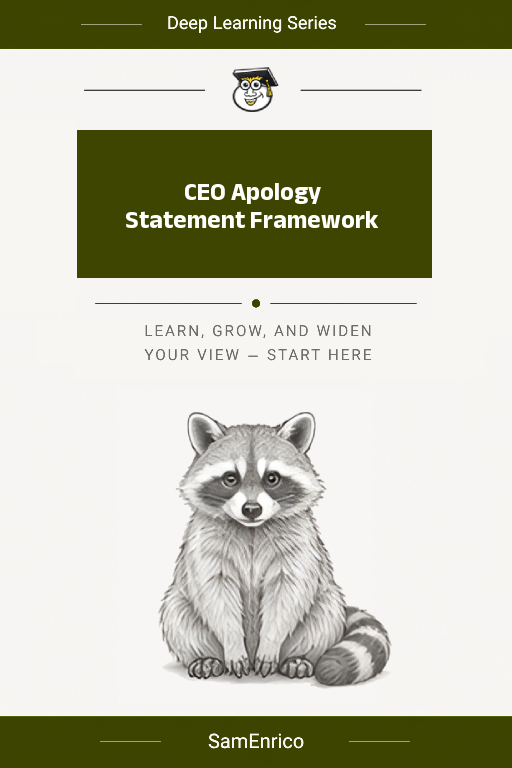
CEO Apology Statement Framework
Write sincere apology with specific regret, no exc
Write sincere apology with specific regret, no excuses, and concrete corrective actions to restore trust.
Formats
About this book
Free sample
Chapter 1: The Specificity Paradox--–- Most CEOs believe that saying “I’m sorry” is enough. They stand before cameras, issue a carefully lawyered statement, and wait for the news cycle to move on. Then they are genuinely confused when trust continues to erode, when employees update their résumés, when customers flee to competitors, and when the stock price never fully recovers. The problem is not that they are insincere. Many of them truly feel regret.
The problem is that they have been trained to apologize the wrong way—vaguely, defensively, and without the one ingredient that transforms a corporate statement into genuine restoration: specificity.This chapter introduces the foundational concept of the entire book: specific regret. Before you can eliminate excuses, before you can design corrective actions, before you can choose the right medium or navigate legal pitfalls, you must first learn to name exactly what happened, to whom, which value was violated, and what emotions your victims are feeling. Without these four components, your apology is not an apology at all. It is what communication scholars call “apologetic discourse”—a genre of corporate speech designed to sound like an apology while carefully avoiding any actual accountability.The difference between a generic apology and a specific apology is the difference between being forgiven and being forgotten. A generic apology is forgotten immediately.
A specific apology becomes the foundation for trust restoration. This chapter teaches you how to build that foundation.The Three Fatal Flaws Revisited Before diving into the anatomy of specific regret, it is worth revisiting the three fatal flaws introduced in this book’s opening chapters, because specificity is the antidote to all three.Vagueness is the first flaw. When a CEO says “we regret any inconvenience this may have caused,” they have said nothing at all. What inconvenience? To whom?
Caused by what action? The vagueness signals either ignorance or concealment. Specificity kills vagueness dead. When you name the harm, the victim, the violated value, and the emotional impact, there is nowhere to hide.Defensiveness is the second flaw. When a CEO says “mistakes were made”…
This is the end of the free sample. Get the eBook to keep going. Buy now
Contents
- Chapter 1
- Chapter 2
- Chapter 3
- Chapter 4
- Chapter 5
- Chapter 6
- Chapter 7
- Chapter 8
- Chapter 9
- Chapter 10
- Chapter 11
- Chapter 12
Details
- Author
- Santana Rosalee
- Publisher
- SamEnrico
- Language
- English
- Genre
- Non-Fiction, Crisis Management
- Released
- 2026-06-01
- Pages (approx.)
- 147
- Available as
- eBook, Audiobook

Read better in the ZLOADR app
Your eBooks on your phone or tablet. Sign in with your SamEnrico account and start reading.
More by Santana Rosalee
 The Trance Depth Scale WorkbookSantana Rosalee$11.99
 The Anti Imposter ManifestoSantana Rosalee$11.99
 The Balloon Release TechniqueSantana Rosalee$11.99
 Anti Dilution Provisions DatabaseSantana Rosalee$11.99
 Anger In LGBTQ CouplesSantana Rosalee$11.99
 The Restaurant Chef Stress ManualSantana Rosalee$11.99
 Pet Loss For BuddhistsSantana Rosalee$11.99
 OCD and AutismSantana Rosalee$11.99
 Gov Mayor Master GuideSantana Rosalee$11.99
 The Bone Orchard's Guardian: The Tale of the AdzeSantana Rosalee$11.99
 The Silk Road of Code: Al-Kashi’s Mathematical Legacy in Central AsiaSantana Rosalee$11.99
 Screams in the Sky: The I-35W Bridge Collapse and the Amusement Park That Wasn'tSantana Rosalee$11.99
You may also like
 White Squire Defense StrategyChapin Broderick$12.99
 Voting Rights Plan DefenseThames Sterling$12.99
 Unocal Proportionality Test GuideDaniels Leroy$12.99
 Third Party Endorsement During ScandalMccurdy Suzy$12.99
 Successor Training Without Founder PresenceMetzger Kasi$12.99
 Sprinkler System Accidental TriggeringCummings Heather$12.99
 Solo Founder Health Emergency PlanSaunders Lester$12.99
 Smoke Odor Removal From OfficeJackson Maureen$12.99
 Smoke Damaged Painting RestorationLake Charmaine$12.99
 Small Business Ransomware Survival GuideAndrus Gerda$12.99
 Shareholder Rights Plan ExpirationMarcum Talisha$12.99
 Shareholder Identification DefenseWilliamson Doug$12.99