
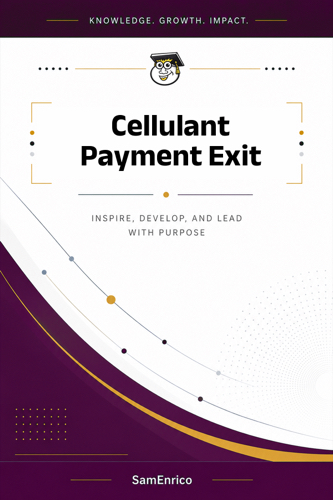
Non-FictionBusiness BriefPE Exit
Cellulant Payment Exit eBook
Study the Kenyan payment processor's private equit
Study the Kenyan payment processor's private equity secondary round.
Formats
Free sample
Chapter 1: The Boy Who Hated Queues...--The queue began at the bank’s iron gate, snaked across a cracked concrete courtyard, and disappeared into the shade of a tin-roofed awning where fifty or sixty people—mostly women, mostly carrying children on their backs—waited to pay for things they had already used. Electricity. Water. School fees. Each transaction required a paper form, a carbon copy, a rubber stamp, and twenty minutes of standing in the sun.Ken Njoroge was twelve years old when his mother sent him to pay the family’s electricity bill.
He remembers the heat rising from the pavement, the smell of sweat and diesel exhaust from passing matatus, and the way the man behind the window moved slowly, deliberately, as if speed were an insult to his authority. Ken waited for two hours. By the time he reached the window, his feet ached and his school uniform was soaked through. He handed over the cash. The man stamped the form.
Ken walked home.When he gave his mother the receipt, she did not thank him. She looked at his red face, his tired eyes, and said only: “Next time, go earlier.”That day—that moment—was the beginning of Cellulant.The Problem That Would Not Go Away Ken Njoroge did not know he was going to build a company. He was a boy who hated inefficiency. The queue at the electricity office was inefficient. The paper forms were inefficient.
The fact that his mother had to send him—a child—because she could not leave work was inefficient. Inefficiency, he would later learn, is the mother of fortune.By the time Ken reached university in Nairobi, he had not forgotten the queue. He had simply filed it away, like a photograph in a drawer, waiting for the right frame. He studied computer science. He learned to code.
He built systems that worked fast, that did not require carbon copies or rubber stamps. And when he met Bolaji Akinboro—a Nigerian student with a salesman’s charm and a founder’s restlessness—the photograph came out of the drawer.Bolaji had stood in queues too. Everyone in Lagos had stood in queues. Everyone in Accra, in Kampala, in Dar es Salaam. Across Africa, millions of people spent hours each week waiting to pay for essential services because no one had built a better way.
The banks were not going to build it—they profited from the inefficiency. The utilities were not going to build it—they were owned by governments that moved slowly. The phone companies might build it, but they were focused on voice calls and text messages, not payments.The opportunity was obvious. The execution was not.The Year Nothing Worked Cellulant was founded in 2004, which is another way of saying: two young men incorporated a company with no product, no customers, and no revenue. They had a vision—digitize payments across Africa—and they had a first office, which was a storage closet in a shared workspace in Nairobi.
The rent was affordable. The ambition was not.For the first three years, Cellulant built software that almost no one wanted. The company’s first product was a bill payment system for utilities—exactly the problem Ken had experienced as a child. But convincing a government-owned electricity company to change its payment process was like convincing a river to flow backward. The utility executives listened politely, admired the demo, and said: “We will call you.”They never called.Ken and Bolaji learned a hard lesson: in Africa, the problem is not technology.
Technology is easy. The problem is trust. The utilities did not trust a pair of twenty-something founders with a laptop and a dream. The banks did not trust them either. The mobile operators—Safaricom included—were focused on voice minutes, not payment infrastructure.By 2006, Cellulant was running out of money.
Ken remembers looking at the bank balance and calculating how many weeks they had left. Four, maybe five. He did not tell Bolaji at first. He stayed up late, rewriting code, trying to make the product so good that someone—anyone—would pay for it.Then came the call that changed everything.The Kenya Power Breakthrough Kenya Power was not looking for innovation. Kenya Power was looking for a solution to a specific, maddening problem: every month, millions of customers paid their electricity bills in cash at bank branches.
The banks charged Kenya Power a fee for processing those payments. The fee was small per transaction—a few shillings—but multiplied by millions of customers, it became a fortune. Kenya Power wanted to reduce that fee. They did not care about digitization or financial inclusion or any of the grand visions that animated Ken and Bolaji. They just wanted to pay less money to banks.Cellulant’s pitch was simple: build a system that allows customers to pay their bills at any bank, not just the designated branches.
Spread the volume. Reduce the fees. Kenya Power agreed to a pilot.The pilot worked. Then it scaled. Within eighteen months, Cellulant was processing millions of payments per month for Kenya Power.
The company was profitable—barely—but profitable. More importantly, Cellulant had something it had never had before: a reference customer. Other utilities called. Then airlines called. Then the government called.The queue problem was being solved, one transaction at a time.The M-Pesa Explosion In 2007, Safaricom launched a product that almost no one understood.
It was called M-Pesa—the “M” stood for mobile, the “Pesa” was Swahili for money. The idea was simple: use your phone to send money to anyone, anywhere, instantly. The execution was revolutionary.M-Pesa was not supposed to become the backbone of Kenya’s economy. It was a pilot project, funded by the UK’s Department for International Development, designed to test whether mobile phones could deliver micro-loans. But when Safaricom added person-to-person transfers, something unexpected happened.
People started using M-Pesa for everything. They paid for groceries. They paid school fees. They sent money to relatives in rural villages. They saved money under the mattress—except the mattress was now their phone.By 2010, M-Pesa had seventeen million users.
That was more than the entire adult population of Kenya. The banks had spent decades trying to reach the unbanked. M-Pesa had done it in three years, not by building branches but by turning every phone with a SIM card into a bank account.Ken Njoroge watched this happen and recognized the opportunity immediately. M-Pesa was a payment rail—a way to move money cheaply and instantly. But M-Pesa was not connected to the formal economy.
You could send money to your cousin, but you could not pay your electricity bill directly from M-Pesa. You could buy airtime, but you could not pay for groceries at a supermarket that used a bank’s payment terminal.Cellulant’s insight was simple: build the bridge. Connect M-Pesa to everything else.The Bridge Builder The technical challenge was significant. M-Pesa spoke a different language than the banks. The banks spoke a different language than the utilities.
Cellulant’s software had to translate between them, in real time, without losing a single shilling. A failed transaction meant a…
This is the end of the free sample. Get the eBook to keep going. Buy now
About this book
Details
- Author
- Menendez Emerita
- Publisher
- SamEnrico
- Language
- English
- Genre
- Non-Fiction, Business Brief, PE Exit
- Released
- 2026-06-07
- Pages (approx.)
- 142
- Available as
- eBook, Audiobook

Read better in the ZLOADR app
Your eBooks on your phone or tablet. Sign in with your SamEnrico account and start reading.
More by Menendez Emerita
 Inner Child MeditationMenendez Emerita$11.99
 The Self Imposed LimitMenendez Emerita$11.99
 The Jesuits Formation GuideMenendez Emerita$11.99
 Healthcare Worker Anger GuideMenendez Emerita$11.99
 The Maestro of the Savannah: Chevalier de Saint-Georges and the Birth of Classical AfricaMenendez Emerita$11.99
 How to Start a Chemical Woodpulp Business (Beginners Guide)Menendez Emerita$11.99
 VA Productivity Tracking GuideMenendez Emerita$12.99
 JEE Physics Formula HandbookMenendez Emerita$12.99
 Understanding Phytanic ACID Oxidase DeficiencyMenendez Emerita$17.99
You may also like
 Hong Kong Handover 1997Dunn Johnnie$11.99
 Zumba For Postnatal Recovery CourseNeal Christian$11.99
 Zumba for BeginnersLadner Nikia$11.99
 YouTube Comment Mining GuideHumes Pandora$12.99
 Worry Box MeditationCarlin Rudy$11.99
 Workplace Stress MeditationNguyen Lynn$11.99
 Workplace Stress and Sleep RepairHawley Ivory$11.99
 Workplace Perfectionism CureDelaney Jeffry$11.99
 Workplace Injustice Anger GuideWallen Isabelle$11.99
 Work Addiction and Burnout LinkGreenwood Ester$11.99
 Women in Yoga and WellnessBeattie Galina$11.99
 Women in Stand Up ComedyChun Evangeline$11.99